
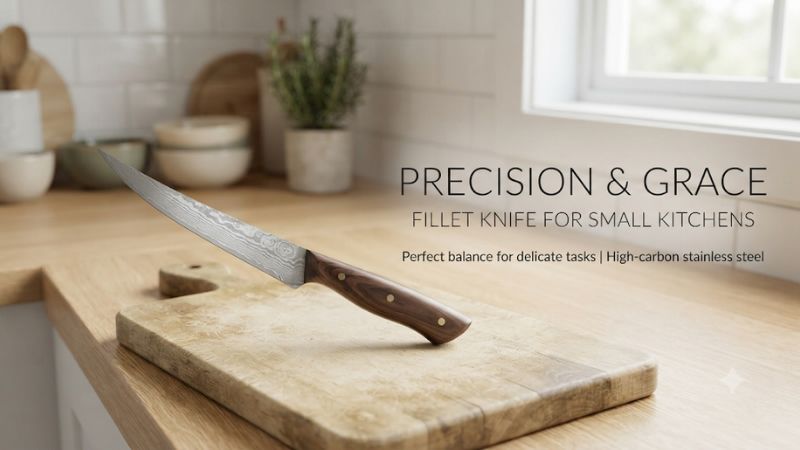
A fillet knife for small kitchens should provide enough flexibility and control for preparing fish without demanding a large cutting area or bulky storage. Shorter manual blades often make more sense than powered systems when counter and drawer space are limited. This guide explains blade selection, handle comfort, compact storage, food safety, and the features that matter most in an apartment or small home kitchen.
- Quick Answer: Choose a Manageable Manual Fillet Knife
- Why Small Kitchens Need a Different Fillet Knife Setup
- Choosing the Best Fillet Knife Blade Length
- Choose the Right Blade Flexibility
- Handle Design and Everyday Control
- Manual Versus Electric Fillet Knives in Small Kitchens
- Choosing a Cutting Board for a Compact Kitchen
- Smart Fillet Knife Storage for Small Kitchens
- Cleaning and Food Safety After Fish Preparation
- Buying on a Budget: What Is Worth Paying For?
- Common Small-Kitchen Buying Mistakes
- Frequently Asked Questions
- Conclusion
Quick Answer: Choose a Manageable Manual Fillet Knife
For many small kitchens, a six- to seven-inch manual fillet knife is a practical starting point. It can handle smaller fish and detailed trimming without the long blade or additional accessories associated with larger models. However, households that frequently prepare sizeable salmon or other large fish may still benefit from an eight-inch knife if the workspace provides adequate clearance.
Recommended configurations:
- Best overall for compact kitchens: Six- to seven-inch flexible manual fillet knife.
- Best for smaller fish: Narrow six-inch blade.
- Best for larger fish: Seven- or eight-inch blade where space permits.
- Best for everyday cleaning: Synthetic handle with manufacturer-approved care.
- Best for limited storage: Properly fitted blade guard and dedicated drawer position.
- Best for occasional fish dinners: Straightforward manual design without electrical components.
- Best for frequent large batches: Consider a powered model only if the kitchen can safely accommodate it.
The best small-kitchen knife is not necessarily the shortest. A blade that is too short for the fish can require awkward repositioning and extra cuts. Choose sufficient length while retaining comfortable control on the available cutting board.
Why Small Kitchens Need a Different Fillet Knife Setup
Small kitchens often combine food preparation, dishwashing, and appliance storage within a limited countertop area. A large fish, long cutting board, and sharp fillet knife can quickly create a crowded workspace. The correct equipment should make preparation more controlled rather than forcing the cook to work around obstructions or place the knife near the sink edge.
Understand Your Available Cutting Space
Before choosing a blade, identify where fish will be prepared. The working surface should have enough room for the cutting board, ingredient, knife movement, and safe hand placement. A crowded counter can encourage cutting at uncomfortable angles or moving the knife around appliances.
Important considerations:
- Available counter width.
- Clear space in front of the board.
- Nearby appliance cords.
- Sink position.
- Board stability.
- Room for prepared fillets.
- Space for removing waste.
- Safe knife placement between cuts.
A small kitchen can support fish preparation when the work area is organized thoughtfully.
However, it should not be necessary to balance a cutting board over a sink or appliance.
If the preparation area is too small for a whole fish, purchasing professionally filleted fish may be the better option.
Choose Equipment Around Actual Cooking Habits
Some households prepare fresh fish weekly, while others buy frozen fillets that arrive ready to cook. The amount of work performed determines whether a specialized knife is needed.
A fillet knife is useful when:
- You regularly purchase whole fish.
- You remove skin from suitable fillets.
- You trim fish portions.
- You want better control around fish contours.
- You have an appropriate preparation surface.
A separate fillet knife may be unnecessary when:
- You mainly purchase prepared fillets.
- You rarely handle whole fish.
- Your existing knives meet the task safely.
- Storage is extremely limited.
- You do not have a suitable cutting board.
A small kitchen benefits from fewer well-chosen tools rather than several specialty knives that are rarely used.
Avoid Overcrowding the Workstation
Fish preparation involves raw ingredients, sharp equipment, packaging, and waste. These items should not compete for the same small area.
Arrange the space before starting.
Useful preparation zones:
- Stable cutting board.
- Clean container for prepared fish.
- Separate container for waste.
- Safe location for the knife.
- Cleaning supplies within reach.
- Clear path to refrigeration.
Keep ready-to-eat foods away from raw seafood and its juices.
A practical layout makes both cooking and cleanup easier.
Choosing the Best Fillet Knife Blade Length
Blade length affects how much cutting reach is available and how comfortably the knife moves around a fish. For compact kitchens, the goal is to match the blade to normal ingredients and board dimensions. Shorter knives can offer maneuverability, while longer knives may be more useful for broad fillets.
Four- to Five-Inch Fillet Knives
Short fillet knives can be useful for small fish and detailed work. Their compact size may suit limited cutting boards, but they can become inefficient when working with larger fish.
Best For: Small fish and precise trimming.
Advantages:
- Compact blade.
- Manageable storage.
- Useful for detailed work.
- Easier movement around small ingredients.
Limitations:
- Short cutting strokes.
- Less reach for large fish.
- May require more repositioning.
- Not ideal for every skin-removal task.
Buy If: You regularly prepare small species and prefer short, controlled movements.
Skip If: You frequently handle large fish portions.
Do not choose the shortest blade solely because your kitchen is small. The fish’s size and the intended cut remain important.
Six-Inch Fillet Knives
A six-inch flexible fillet knife can provide a useful balance between maneuverability and cutting length. Products such as the Dexter-Russell SOFGRIP six-inch flexible model demonstrate this format. For households preparing smaller fish or occasional fillets, the length can be practical without requiring a particularly large storage arrangement.
Best For: Everyday small-to-medium fish preparation.
Advantages:
- Compact working length.
- Useful for detailed trimming.
- Several reputable manufacturer options.
- Fits many ordinary kitchen cutting boards.
- Easier storage than longer knives.
Limitations:
- Less efficient for some large fillets.
- Still requires protected storage.
- Flexibility varies by model.
- Not suitable for heavy bone cutting.
Buy If: You want one compact manual knife for regular fish preparation.
Skip If: Your primary work involves exceptionally large fish.
For many apartment kitchens, six inches provides a sensible starting point.
Seven- and Eight-Inch Fillet Knives
Seven- and eight-inch blades provide additional reach and are common among established kitchen knife manufacturers. A longer edge can make it easier to work along larger fish while allowing controlled slicing movements.
Best For: Medium-to-large fish and households with suitable counter space.
Advantages:
- Longer cutting edge.
- Useful for broader fillets.
- Versatile fish-preparation range.
- Multiple handle designs.
Limitations:
- Needs more board space.
- Requires longer protected storage.
- May feel cumbersome for tiny fish.
- More blade to control.
Buy If: You have a stable full-size board and regularly prepare larger fish.
Skip If: Your cutting area is very restricted or fish preparation is minimal.
An eight-inch knife is not inherently incompatible with a small kitchen, but the full working arrangement must remain comfortable and safe.
Choose the Right Blade Flexibility
A fish fillet knife is commonly designed with a thin blade capable of bending along the fish’s contours. However, the degree of flexibility varies. The correct stiffness should match the ingredients and the user’s experience rather than a general assumption that greater flexibility is always better.
Flexible Blades for Delicate Fish
Flexible blades can follow curved fish structures and support controlled separation of flesh from bones or skin.
Advantages:
- Adapts to gentle contours.
- Useful for delicate flesh.
- Can support thin slicing.
- May reduce unnecessary cutting into edible portions.
Limitations:
- Requires controlled pressure.
- May bend more than beginners expect.
- Not intended for forceful cuts.
- Can feel less predictable with hard resistance.
Buy If: You regularly prepare fish that benefits from delicate contour-following cuts.
Skip If: You need a firmer blade for different meat-preparation tasks.
Flexibility is not permission to twist or pry the knife.
Use it according to the intended cutting technique.
Semi-Flexible Blades for Mixed Tasks
A semi-flexible fillet knife bends less than an especially flexible model, potentially offering a more predictable feel for some users. It may be appropriate when a household prepares different fish species and wants a balance between contour following and controlled support.
Advantages:
- Moderate bending.
- Useful for mixed preparation.
- Can feel more stable to certain users.
- May serve a wider range of fish sizes.
Limitations:
- Not as adaptable to delicate contours.
- Actual stiffness differs by manufacturer.
- Still unsuitable for chopping bones.
- Cannot replace every specialist knife.
Buy If: You want one knife for varied fish preparation and prefer some blade resistance.
Skip If: You require maximum flexibility for a specific task.
The term semi-flexible is not standardized across every manufacturer.
Read the exact product description before choosing.
Avoid Confusing Fillet Knives With Boning Knives
Boning knives may have similar narrow blades but are often designed for meat trimming around bones and joints.
Fillet knife priorities:
- Suitable flexibility.
- Narrow fish-oriented profile.
- Skin separation.
- Fish contour cutting.
Boning knife priorities:
- Meat trimming.
- Connective tissue.
- Work around joints.
- Stiff or flexible blade choices.
A small kitchen does not automatically need both.
Choose the specialist knife that matches the ingredient prepared most often.
Handle Design and Everyday Control
Fish preparation can involve wet surfaces and slippery ingredients. A handle should provide a comfortable, controlled grip that does not encourage excessive force. The best material depends on cleaning habits, hand comfort, and the intended use rather than appearance alone.
Synthetic Handles for Practical Maintenance
Synthetic handles are common on food-service fillet knives because they can be molded into ergonomic shapes and cleaned according to manufacturer instructions. Some use textured surfaces intended to support grip.
Useful features:
- Comfortable handle shape.
- Secure construction.
- Appropriate texture.
- Smooth cleanable transitions.
- Manageable overall weight.
- No loose components.
Potential limitations:
- Deep textures can collect residue.
- Some polymers may discolor over time.
- Grip comfort is personal.
- Not every synthetic handle is dishwasher-safe.
A well-designed synthetic handle can be a practical choice for compact home kitchens.
Wooden Handles for Traditional Preference
Traditional fillet knives often use wooden handles, including birchwood designs associated with certain fishing knives.
Advantages:
- Familiar traditional appearance.
- Distinct hand feel.
- Available with protective sheaths.
- Suitable for careful manual use.
Limitations:
- Moisture care is important.
- Wood can deteriorate when neglected.
- Cleaning requirements may be more restrictive.
- Included leather sheaths should remain appropriately dry.
Buy If: You appreciate natural materials and can maintain them.
Skip If: You want the simplest possible cleaning routine.
Do not store a wet knife inside a leather sheath.
Assess Balance and Grip Comfort
Blade length alone does not determine how a fillet knife feels.
A handle that is too narrow or a blade that feels awkwardly balanced may reduce comfort during delicate work.
If possible, assess the knife in person before buying.
Comfort considerations:
- Hand size.
- Handle thickness.
- Weight distribution.
- Wrist position.
- Ease of controlled movement.
- Finger clearance.
A knife that feels manageable is generally a better purchase than one chosen solely for decorative appearance.
Manual Versus Electric Fillet Knives in Small Kitchens
Electric fillet knives can be useful for frequent processing, but they introduce a motor, blades, power requirements, and additional cleaning. In a compact home kitchen, those needs may outweigh the benefits. Manual knives are usually simpler to store and operate, although the best choice depends on fish-preparation volume.
Why Manual Fillet Knives Often Make More Sense
A manual fillet knife requires no electrical outlet and occupies relatively little space when stored with appropriate protection.
Benefits:
- Compact footprint.
- No motor.
- Fewer components.
- Straightforward cleaning.
- Multiple blade-length options.
- Easy placement in a suitable drawer.
Limitations:
- Requires manual technique.
- Edge maintenance remains necessary.
- Repetitive work can be tiring.
- No single blade is ideal for every fish.
For occasional fish dinners, a good manual knife usually provides enough functionality.
When an Electric Fillet Knife May Be Worthwhile
Electric systems use powered moving blades and may be relevant when fish preparation is frequent or involves substantial quantities.
Consider one when:
- You regularly process multiple fish.
- A suitable powered workspace is available.
- Storage is sufficient.
- You can follow electrical safety requirements.
- You accept additional cleaning steps.
Avoid one when:
- Fish preparation is infrequent.
- Counter space is extremely limited.
- The work area is crowded with water and cords.
- You want minimal equipment maintenance.
A powered system should be chosen for a clear repeated-use benefit rather than because it appears more advanced.
Choosing a Cutting Board for a Compact Kitchen
A fillet knife needs a stable working surface, and the fish must fit comfortably on it. The cutting board should not shift during use, and the work area must leave room for safe hand movement. A small but appropriately sized board is more valuable than a larger board balanced insecurely over a sink or appliance.
Measure the Fish and Board Together
Consider the typical length and width of the fish you prepare.
A board that accommodates a small trout may not be suitable for a large salmon.
Check:
- Board length.
- Board width.
- Stable contact with the counter.
- Room for the knife’s cutting motion.
- Space for hands.
- Ability to clean and sanitize.
- Storage location when not in use.
Do not let raw fish extend over the edge into an unsafe workspace.
If the fish is too large for the available board, choose professionally prepared portions.
Choose Appropriate Board Materials
Suitable wood and food-preparation polymer boards are common options.
Wooden boards:
- Require appropriate cleaning and drying.
- Can be durable when maintained.
- May need more moisture attention.
Polymer boards:
- Often straightforward to clean.
- Available in compact dimensions.
- Some are dishwasher-safe.
- Require replacement when severely damaged.
Avoid cutting directly on glass, ceramic, or stone.
Hard surfaces can damage the knife edge and may increase instability.
Keep the Board Stable
A cutting board should rest securely on the countertop.
If it slides, address the problem using a suitable non-slip solution.
Do not continue cutting while attempting to hold the board in place with the other hand.
A stable surface is particularly important when working with slippery fish.
Smart Fillet Knife Storage for Small Kitchens
Compact kitchens rarely have spare counter space for multiple knife blocks. A fillet knife should therefore have a protected drawer or cabinet location. The storage method must cover the cutting edge and prevent contact with other utensils while remaining easy to clean.
Use a Fitted Blade Guard
A fitted guard can make a manual fillet knife more practical in a small drawer.
Features to consider:
- Correct blade length.
- Complete edge coverage.
- Tip protection.
- Secure fit.
- Suitable material.
- Easy controlled removal.
Do not assume every knife guard fits every flexible blade.
Check the product’s dimensions.
Consider a Compact Knife Drawer Organizer
Some drawer organizers include narrow knife channels, but a fillet knife’s length and flexibility may make certain slots unsuitable.
Measure:
- Blade length.
- Blade width.
- Handle dimensions.
- Organizer depth.
- Drawer height.
- Clearance for retrieval.
Never leave a sharp fillet knife loose among silverware.
If the existing organizer cannot accommodate it, choose an appropriate separate protected location.
Avoid Countertop Clutter
A knife left beside a sink can be accidentally covered by dishes, towels, or packaging.
Store it promptly after cleaning and drying.
Safe habits:
- Do not leave the edge exposed.
- Keep away from the counter edge.
- Avoid placing under towels.
- Store separately from ordinary utensils.
- Restrict children’s access.
- Use the intended protective cover.
A small kitchen benefits from clear, predictable storage positions.
Cleaning and Food Safety After Fish Preparation
Fish preparation involves raw seafood, moisture, and potentially contaminated surfaces. A specialized blade does not reduce the need for proper washing, refrigerated storage, or safe cooking. Cleaning the knife and board promptly is particularly important when the same small counter is used for preparing vegetables and ready-to-eat foods.
Clean the Knife Thoroughly
Follow the manufacturer’s care instructions after every use.
Routine cleaning:
- Remove fish residue.
- Wash carefully with appropriate detergent.
- Clean the handle and blade junction.
- Rinse safely.
- Dry thoroughly.
- Inspect the edge.
- Return to protected storage.
Do not leave the knife submerged among dishes.
The exposed edge can injure anyone reaching into the sink.
Prevent Cross-Contamination
Raw fish should be separated from ready-to-eat ingredients.
Essential practices:
- Wash hands after handling raw seafood.
- Clean boards and utensils.
- Keep raw fish contained.
- Refrigerate promptly.
- Prevent juices from reaching other food.
- Cook fish appropriately.
- Clean work surfaces after preparation.
Fish intended for raw consumption requires additional specialized safety considerations.
Do not assume that home filleting makes ordinary grocery fish safe to serve raw.
Maintain the Edge and Handle
A dull knife can require excessive cutting pressure.
Follow the manufacturer sharpening guidance.
Avoid bending flexible blades excessively during maintenance.
Check the handle for damage and the blade for corrosion or chips.
A simple, well-maintained knife is often more practical than an elaborate model neglected between uses.
Buying on a Budget: What Is Worth Paying For?
Small kitchens benefit from equipment that performs a clear function and can be stored efficiently. A fillet knife does not need to be expensive, but it should come from an identifiable manufacturer with suitable construction and care information. Buyers should consider the total cost of the knife, protective storage, and sharpening rather than only the initial price.
Prioritize the Blade and Handle
Spend according to actual function.
Most important:
- Appropriate length.
- Suitable flexibility.
- Comfortable handle.
- Clear manufacturer instructions.
- Proper edge maintenance.
- Safe storage.
Less important for occasional use:
- Decorative finishes.
- Elaborate packaging.
- Large matching knife sets.
- Unnecessary powered accessories.
A good fit with your ingredients and workspace is more useful than premium presentation alone.
Avoid Buying Multiple Specialist Knives Immediately
A compact kitchen rarely needs three different fillet knives for occasional meals.
Start with one suitable manual blade.
Use it for the fish you normally prepare.
Add another specialized option only when repeated use reveals a real limitation.
This approach also keeps cleaning and storage simple.
Consider Professionally Filleted Fish
If your apartment lacks an appropriate cutting area, purchasing pre-filleted fish can reduce equipment needs.
Many fish counters can prepare suitable fish portions.
This option may be especially convenient when space is limited or fish preparation is infrequent.
The value of a fillet knife should be measured against how often you will actually use it.
Common Small-Kitchen Buying Mistakes
Small-space buyers often choose knives based on compact appearance without considering the fish, cutting board, and storage method. Other mistakes include buying powered equipment for rare use or selecting an extremely flexible blade that feels difficult to control. A balanced choice begins with the full preparation workflow.
Choosing a Blade Too Short for the Fish
A short knife may fit the drawer perfectly but be inefficient for large fillets.
Match blade length to the ingredient.
Do not choose the smallest available knife simply because the kitchen is small.
Ignoring Board Stability
A knife cannot compensate for a sliding board.
Use a suitable stable cutting surface.
Avoid balancing the board over the sink or appliances.
If the workspace is inadequate, choose another food-preparation method.
Leaving the Knife Loose in Storage
A narrow sharp blade can injure someone reaching into a drawer.
Use a fitted guard or compatible organizer.
Keep it separate from everyday cutlery and out of children’s reach.
Buying an Electric Model Without Planning Storage
Powered fillet knives require more than space for the blade.
Consider the handle, motor, power cord or charging components, interchangeable blades, and cleaning accessories.
A compact manual knife may be the better choice.
Frequently Asked Questions
Buyers with compact kitchens often want to know whether a short fillet knife is sufficient, whether electric models are practical, and how to store flexible blades safely. The most useful answers depend on fish size and actual workspace dimensions. A manageable knife and stable board are more important than maximizing the number of specialized tools.
What Size Fillet Knife Is Best for a Small Kitchen?
A six- to seven-inch manual fillet knife is a practical starting point for many compact kitchens, particularly when preparing smaller fish. An eight-inch blade may be more useful for larger fillets when the cutting board and storage area can accommodate it. Choose based on the fish and comfortable cutting movements, not just available drawer length.
Can I Use a Fillet Knife in a Studio Apartment?
Yes, if you have a suitable food-preparation area, stable cutting board, safe storage, and appropriate cleaning facilities. A compact manual knife can fit many apartment kitchens. However, crowded counters and inadequate work surfaces can make whole-fish preparation impractical. Purchasing prepared fillets may be easier when the space is too restricted.
Is a Flexible Fillet Knife Better for Beginners?
Flexibility can help the blade follow fish contours, but an extremely flexible knife may feel less predictable to someone learning the technique. The best choice depends on the fish and the user’s comfort. A moderately flexible manual blade is worth considering for mixed home use. Avoid using excessive force or twisting against bones.
Do I Need an Electric Fillet Knife?
Most occasional home cooks do not need one. Electric models may help with repeated fish-processing tasks, but they require power, additional storage, and more involved cleaning. In a small kitchen, a manual knife is generally simpler. Consider electric equipment only when preparation frequency and workspace justify it.
How Should I Store a Fillet Knife in a Small Drawer?
Use a compatible blade guard or dedicated knife organizer that protects the entire cutting edge and tip. Ensure the knife fits without bending or contacting other utensils. Do not place a bare fillet knife loosely among silverware. Keep sharp tools inaccessible to children and follow the manufacturer’s storage instructions.
Can I Use a Fillet Knife for Other Kitchen Tasks?
A fillet knife may handle certain delicate trimming and slicing tasks, but it is not a substitute for a chef’s knife, cleaver, or serrated bread knife. Its narrow flexible blade is designed for particular cutting movements. Avoid forceful chopping, prying, frozen foods, or cutting through hard bones. Use the correct tool for each task.
Conclusion
A fillet knife for small kitchens should provide enough blade length for your usual fish while remaining comfortable to use, clean, and store. A six- to seven-inch manual knife is a practical starting point for many apartments, while a longer blade may suit larger fish when adequate board space exists. Prioritize suitable flexibility, a secure handle, and protected drawer storage over elaborate accessories. If whole-fish preparation is rare or the workspace is inadequate, purchasing ready-to-cook fillets may be the more convenient choice.




Write Your Review
No reviews yet. Be the first to share your experience!