
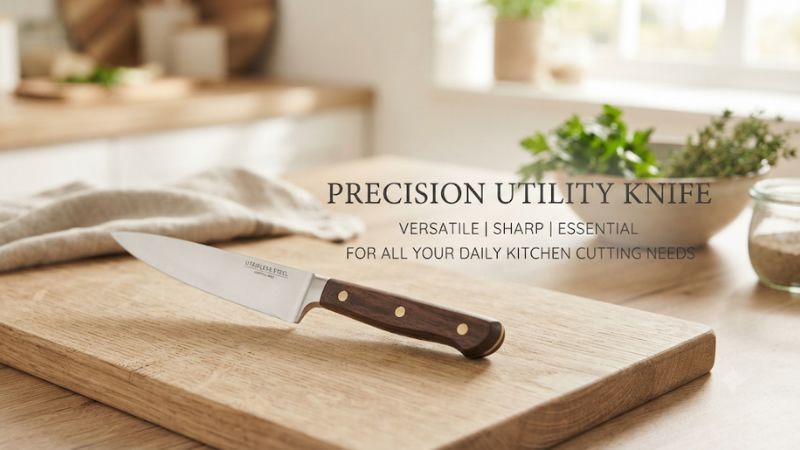
A versatile utility kitchen knife fills the gap between a small paring knife and a full-size chef’s knife. It can be especially useful for slicing tomatoes, preparing sandwiches, trimming vegetables, and cutting medium-size ingredients when a larger blade feels unnecessary. This guide compares six established options and explains how blade length, edge style, handle design, and storage affect everyday performance.
- Quick Verdict: The Best Utility Kitchen Knives
- Quick Comparison Table
- How We Selected These Utility Knives
- Detailed Reviews of Six Utility Kitchen Knives
- Buying Guide: How to Choose the Right Utility Knife
- What Can a Utility Kitchen Knife Do?
- Common Utility Knife Buying Mistakes
- Frequently Asked Questions
- Conclusion
Quick Verdict: The Best Utility Kitchen Knives
Utility knives are often overlooked because their tasks overlap with chef’s knives and paring knives. However, a well-chosen four- to six-inch utility blade can be a practical tool for kitchens where small and medium ingredients are prepared frequently. The important decision is whether you need a straight edge for controlled cuts, a serrated edge for soft-skinned foods, or a slightly larger multipurpose profile.
Our six recommended options:
- Best overall straight-edge option: WÜSTHOF Classic 5-Inch Utility Knife.
- Best for tomatoes and sandwiches: ZWILLING Pro 5-Inch Serrated Utility Knife.
- Best premium Japanese choice: Shun Classic 6-Inch Utility Knife.
- Best all-metal design: GLOBAL GS-3 5-Inch Chef’s Utility Knife.
- Best compact everyday alternative: WÜSTHOF Classic 4.5-Inch Utility Knife.
- Best practical serrated alternative: Victorinox Swiss Classic 4.5-Inch Serrated Utility Knife.
The WÜSTHOF Classic five-inch straight-edge model is a useful general-purpose choice when you want more reach than a paring knife without moving to a full-size chef’s knife.
ZWILLING Pro offers a serrated alternative that can be especially relevant for tomatoes, small rolls, and sandwiches.
Shun Classic provides a six-inch blade for more extended slicing, while GLOBAL offers a distinctive stainless steel handle and a compact chef’s utility format.
The shorter WÜSTHOF Classic may suit smaller ingredients, and Victorinox provides a straightforward serrated option with a practical synthetic handle.
The best purchase depends on the foods you cut most frequently rather than a universal ranking of blade quality.
Quick Comparison Table
A utility knife can be a short chef’s knife, a narrow all-purpose blade, or a serrated slicer, depending on the manufacturer. These formats are not interchangeable for every task. A straight blade can be easier to maintain with conventional sharpening tools, while a serrated blade may engage certain tomato skins and bread crusts with less initial pressure.
| Knife | Blade Length | Edge Type | Best For | Main Trade-Off |
|---|---|---|---|---|
| WÜSTHOF Classic Utility | 5 in | Straight | General small and medium food prep | Less reach than a chef’s knife |
| ZWILLING Pro Serrated Utility | 5 in | Serrated | Tomatoes, rolls, sandwiches | Less ideal for fine precise trimming |
| Shun Classic Utility | 6 in | Straight | Controlled longer cuts | Premium maintenance requirements |
| GLOBAL GS-3 Chef’s Utility | 5 in | Straight | Compact multipurpose preparation | All-metal handle preference |
| WÜSTHOF Classic Utility | 4.5 in | Straight | Smaller ingredients | Limited cutting reach |
| Victorinox Swiss Classic Serrated Utility | 4.5 in | Serrated | Soft-skinned foods and small bread | Serrated sharpening differs |
The table highlights design differences rather than tested results.
A sharp straight-edge utility knife may slice tomatoes very well, while a serrated model can be useful when the cook wants an edge that engages the skin readily.
How We Selected These Utility Knives
The shortlist focuses on identifiable manufacturer products that represent distinct utility-knife formats. We considered edge type, blade length, handle design, intended applications, cleaning, sharpening, and how well each model fits the space between a paring knife and a chef’s knife. These are editorial recommendations based on published characteristics, not invented hands-on test results.
Selection criteria
- Versatility: Ability to handle everyday small and medium ingredients.
- Blade length: Practicality for compact cutting boards.
- Edge type: Straight or serrated according to intended use.
- Handle comfort: Secure control during short slicing motions.
- Construction: Documented blade and handle materials.
- Maintenance: Ease of sharpening and cleaning.
- Storage: Appropriate protection in a kitchen drawer or block.
- Safety: Suitable use and grip.
- Value: Whether the knife fills a real gap in the existing collection.
We intentionally included both straight and serrated knives because the search term covers more than one blade style.
A buyer should decide which format best supports the kitchen’s needs before focusing on premium steel or decorative finishes.
Detailed Reviews of Six Utility Kitchen Knives
The knives below cover ordinary straight-edge preparation, serrated slicing, Japanese-style construction, and compact handling. Each review identifies the model’s principal strengths, intended uses, and practical limitations. Because a utility knife is a general category, the most important comparison is how each blade fits the household’s existing cooking equipment.
WÜSTHOF Classic 5-Inch Utility Knife — Best Overall
The WÜSTHOF Classic 5-Inch Utility Knife is a forged German kitchen knife designed for food-preparation tasks that fall between the roles of a chef’s knife and a paring knife. Its narrow straight blade provides useful cutting reach for small vegetables, fruit, and ordinary kitchen ingredients, while the traditional riveted handle offers the familiar construction associated with the Classic range.
Key Specifications
- Brand: WÜSTHOF.
- Series: Classic.
- Product: 5-Inch Utility Knife.
- Blade length: 5 inches.
- Construction: Forged German steel.
- Edge: Straight.
- Handle: Triple-riveted synthetic construction.
- Intended use: Multipurpose preparation.
Why We Picked It
A five-inch straight-edge blade is a versatile middle ground.
It can handle many ingredients that feel awkward under a tiny paring knife while requiring less space than a full-size chef’s knife.
Features and Practical Performance
This knife is useful for slicing small cucumbers, cutting apples on a board, trimming peppers, and preparing sandwich ingredients.
The narrow blade can also approach detailed tasks that do not require the broad profile of a chef’s knife.
However, a five-inch utility knife is not a replacement for a large chef’s knife when chopping substantial quantities of vegetables.
Its shorter blade requires more strokes for larger foods.
The knife should be used with a stable board and maintained according to WÜSTHOF’s sharpening guidance.
Pros
- Versatile five-inch length.
- Forged German construction.
- Straight-edge blade.
- Traditional handle.
- Suitable for everyday small and medium ingredients.
Cons
- Less reach than larger knives.
- Premium cost category.
- Not optimized for crusty bread.
Buy If
You want a straight-edge utility knife to complement a chef’s knife and paring knife.
Skip If
You mainly cut tomatoes and bread and prefer serrations.
ZWILLING Pro 5-Inch Serrated Utility Knife
The ZWILLING Pro 5-Inch Serrated Utility Knife is a German-made forged blade that combines a compact length with a serrated edge. It is designed for foods that can be difficult to start cutting with a dull plain edge, including tomatoes and certain bread products. Its Pro-series handle and curved bolster provide a distinctive alternative to simple synthetic-handled utility knives.
Key Specifications
- Brand: ZWILLING.
- Series: Pro.
- Model: 38400-133.
- Blade length: 5 inches.
- Construction: Forged.
- Manufacturing: Germany.
- Edge: Serrated.
- Bolster: Curved.
- Handle: Traditional riveted construction.
Why We Picked It
Serrated utility knives serve a useful purpose in kitchens where soft-skinned foods and sandwiches are prepared frequently.
The five-inch length provides more cutting reach than many tomato knives without requiring the storage space of a full bread knife.
Features and Practical Performance
Use the knife for cutting tomatoes on a board, portioning small rolls, and preparing suitable sandwich ingredients.
The serrations can help engage certain skins or crusts during a gentle slicing motion.
However, a serrated edge is not ideal for every precision task.
Fine trimming, small decorative cuts, and certain vegetables may be easier with a sharp straight-edge knife.
Serrated sharpening also requires an appropriate method.
Do not assume that a standard pull-through sharpener is suitable for this blade.
Pros
- Five-inch serrated blade.
- Forged construction.
- Curved bolster.
- Practical for tomatoes and sandwiches.
- Compact compared with a bread knife.
Cons
- Serrated edge requires different maintenance.
- Less suited to fine peeling.
- Premium construction may be unnecessary for occasional use.
Buy If
You frequently slice tomatoes, rolls, and sandwich ingredients and prefer a serrated utility format.
Skip If
You need a straight-edge precision knife for detailed trimming.
Shun Classic 6-Inch Utility Knife
The Shun Classic 6-Inch Utility Knife is a Japanese-made straight-edge blade with a VG-MAX cutting core and Pakkawood handle. Its six-inch length provides a larger cutting range than compact four- and five-inch utility models while remaining shorter than a conventional eight-inch chef’s knife. It is relevant to cooks who value careful slicing and refined knife construction.
Key Specifications
- Brand: Shun.
- Series: Classic.
- Model: DM0701.
- Blade length: 6 inches.
- Core steel: VG-MAX.
- Blade construction: Layered stainless steel.
- Handle: Ebony-finished Pakkawood.
- Country of manufacture: Japan.
- Intended use: Multipurpose food preparation.
Why We Picked It
The six-inch blade creates a useful middle category for cooks who find a small utility knife restrictive but do not need a full-size chef’s knife.
Its straight edge is also suitable for controlled slicing and trimming.
Features and Practical Performance
Use the knife for preparing vegetables, cutting fruit, slicing boneless proteins, and other compatible tasks.
The fine edge can be useful when properly maintained, but it should not be subjected to twisting, prying, or hard bone cutting.
The Pakkawood handle requires appropriate cleaning and moisture care.
Unlike a purely utilitarian knife, this model may appeal to cooks who value the complete construction and presentation.
However, layered steel decoration does not establish that the knife is objectively sharper than every simpler alternative.
Pros
- Six-inch useful cutting reach.
- VG-MAX core.
- Japanese manufacture.
- Straight-edge design.
- Refined handle.
Cons
- More demanding ownership expectations.
- Premium purchase category.
- Less compact than four-inch models.
Buy If
You want a refined Japanese utility knife for controlled everyday preparation.
Skip If
You need an inexpensive serrated tomato knife.
GLOBAL GS-3 5-Inch Chef’s Utility Knife
The GLOBAL GS-3 5-Inch Chef’s Utility Knife is a Japanese-made compact knife with the brand’s recognizable all-stainless design. It offers a blade length between small paring knives and traditional chef’s knives, making it useful for modest food-preparation tasks. Its metal handle and streamlined profile distinguish it from models with separate wooden or synthetic grips.
Key Specifications
- Brand: GLOBAL.
- Model: GS-3.
- Product designation: Chef’s Utility Knife.
- Blade length: 5 inches.
- Blade: Stainless steel.
- Handle: Stainless steel with textured pattern.
- Country of manufacture: Japan.
- Intended use: Compact all-purpose preparation.
Why We Picked It
The GS-3 is a distinctive choice for users who already prefer GLOBAL’s handle construction.
A five-inch knife can be a comfortable tool for everyday slicing when a larger blade would occupy unnecessary space.
Features and Practical Performance
The GS-3 can serve tasks such as slicing fruit, cutting small vegetables, and preparing boneless ingredients on a board.
Its blade offers more reach than a three-inch paring knife but less than a traditional chef’s knife.
The handle is the main preference-sensitive feature.
Some cooks appreciate an all-metal grip, while others prefer the texture and warmth of synthetic or wood materials.
Users should avoid cutting with wet or greasy hands and maintain a secure grip.
The knife also needs suitable sharpening and protective storage.
Pros
- Compact five-inch format.
- Japanese manufacture.
- Streamlined all-stainless design.
- Useful for everyday preparation.
- Distinctive handle.
Cons
- Metal handle may not suit everyone.
- Limited reach for large ingredients.
- Requires careful cleaning and sharpening.
Buy If
You like GLOBAL’s handle design and want a compact multipurpose blade.
Skip If
You prefer textured synthetic handles or need a serrated utility knife.
WÜSTHOF Classic 4.5-Inch Utility Knife
The WÜSTHOF Classic 4.5-Inch Utility Knife provides a shorter version of the general-purpose straight-edge utility format. Its forged German steel construction and familiar triple-riveted handle make it relevant to kitchens where blade control and compact storage matter. The shorter length can be especially useful for preparing small vegetables and fruit on limited cutting-board space.
Key Specifications
- Brand: WÜSTHOF.
- Series: Classic.
- Model: 1040100412.
- Blade length: 4.5 inches.
- Construction: Forged German steel.
- Edge: Straight.
- Handle: Triple-riveted synthetic material.
- Intended use: Small and medium preparation.
Why We Picked It
A half-inch reduction can be relevant when the user prefers a compact cutting motion.
The shorter utility knife also provides a different alternative to purchasing another full-size chef’s knife.
Features and Practical Performance
Use it for slicing small fruit, preparing snack vegetables, and trimming ingredients that require more reach than a paring blade.
The straight edge supports controlled cuts when properly sharpened.
However, shorter blades are not automatically safer.
A small knife can still cause serious cuts when the user holds food incorrectly or cuts toward the hand.
The product should be handled on a suitable board and stored with edge protection.
For large vegetables or extensive chopping, a chef’s knife remains more practical.
Pros
- Compact blade.
- Forged German construction.
- Traditional grip.
- Useful for smaller ingredients.
- Familiar straight-edge maintenance.
Cons
- Limited reach.
- May overlap with existing paring knives.
- Not intended for heavy chopping.
Buy If
You want a compact straight-edge utility knife for smaller household tasks.
Skip If
You already own a similar paring knife and need more cutting length.
Victorinox Swiss Classic 4.5-Inch Serrated Utility Knife
The Victorinox Swiss Classic 4.5-Inch Serrated Utility Knife is a practical small kitchen slicer intended for foods that benefit from a toothed cutting edge. It appears within the Swiss Classic kitchen cutlery range and offers a lightweight alternative to forged serrated utility knives. Its compact size is particularly relevant to households preparing sandwiches, tomatoes, and small bread products.
Key Specifications
- Brand: Victorinox.
- Series: Swiss Classic.
- Product type: Serrated Utility Knife.
- Blade length: Approximately 4.5 inches.
- Blade material: Stainless steel.
- Edge: Serrated.
- Handle: Synthetic.
- Intended application: Small kitchen slicing.
Why We Picked It
The Swiss Classic design emphasizes everyday usability rather than elaborate finish.
A compact serrated knife is often useful when cutting a tomato or roll but a full bread knife would be unnecessarily long.
Features and Practical Performance
The blade can be used for small rolls, tomatoes, and other compatible foods.
The serrated edge should be guided through the ingredient with controlled slicing movements.
Do not press aggressively or use the point to pry.
The synthetic handle is intended for ordinary kitchen work, but grip comfort should still be assessed.
A serrated edge requires different sharpening care from a plain blade.
For fine trimming or peeling, a dedicated straight-edge paring knife may be more convenient.
Pros
- Compact serrated design.
- Practical synthetic handle.
- Established Swiss cutlery line.
- Useful for tomatoes and small bread.
- Straightforward everyday format.
Cons
- Not ideal for detailed peeling.
- Serrated sharpening requires care.
- Limited reach for larger foods.
Buy If
You want a simple compact serrated slicer for tomatoes, rolls, and sandwiches.
Skip If
You need a straight-edge knife for precise trimming.
Buying Guide: How to Choose the Right Utility Knife
A utility knife should fill a clear gap in the kitchen’s existing cutlery. If you already own a comfortable chef’s knife and paring knife, consider whether a medium blade would actually make routine tasks more convenient. The right knife should offer useful length and edge geometry without becoming a redundant purchase.
Choose the Right Blade Length
Utility kitchen knives commonly have blades around four to six inches, although manufacturers use the category differently. A shorter blade offers compact handling, while a six-inch model provides greater reach for vegetables and boneless proteins.
Length guide
- 4 inches: Compact fruit and vegetable work.
- 4.5 inches: Small everyday slicing tasks.
- 5 inches: General-purpose utility preparation.
- 6 inches: Longer cuts and larger ingredients.
A five-inch straight-edge knife is a practical starting point.
However, the best length also depends on cutting-board size and hand comfort.
Understand Straight Versus Serrated Edges
The edge type is one of the most important decisions when buying a utility knife. Straight edges are useful for controlled chopping and slicing, while serrated edges can engage certain skins and crusts. The best choice depends on the food rather than the knife’s price.
Straight-edge applications
- Small vegetable preparation.
- Fruit slicing.
- Fine trimming.
- Boneless protein portioning.
- Controlled garnish cuts.
Serrated-edge applications
- Tomatoes.
- Small sandwich rolls.
- Some citrus fruits.
- Soft bread.
- Selected delicate foods with firm skins.
A sharp straight blade can also slice tomatoes effectively.
Serrations are an alternative, not a universal upgrade.
Compare Utility Knives With Paring Knives
A paring knife is generally shorter and intended for detailed work, while a utility knife provides additional reach for board-based slicing. The distinction can be useful when deciding whether another knife is genuinely necessary.
Paring knife strengths
- Hulling strawberries.
- Removing small blemishes.
- Fine trimming.
- Peeling.
- Small detail work.
Utility knife strengths
- Slicing tomatoes.
- Preparing sandwiches.
- Cutting medium-size fruit.
- Portioning small boneless foods.
- General compact preparation.
A utility knife should complement a paring knife rather than duplicate its exact role.
Consider Handle Comfort and Materials
Utility knives are often used for repetitive short cuts, making a secure grip important. Handle shape, texture, and balance influence control, while materials affect cleaning requirements.
Handle features
- Secure surface.
- Comfortable circumference.
- Stable blade attachment.
- Appropriate finger clearance.
- Easy cleaning.
- Suitable hand position.
- Compatible storage.
A forged knife with a premium handle does not guarantee greater comfort than a practical synthetic alternative.
Choose according to your own grip and cutting habits.
Plan Sharpening and Maintenance
Straight-edge utility knives can be sharpened using appropriate conventional methods, while serrated knives require special attention to tooth geometry. The correct method depends on the model and manufacturer instructions.
Maintenance checklist
- Clean after food preparation.
- Dry promptly.
- Use suitable boards.
- Avoid hard surfaces.
- Sharpen when needed.
- Protect the edge during storage.
- Inspect handle integrity.
- Follow model-specific care instructions.
No utility knife remains sharp permanently.
Consider Storage and Kitchen Space
A compact knife is easier to store than a full-size chef’s knife, but its exposed edge still requires protection. A short sheath or dedicated slot can make the knife accessible while reducing accidental contact.
Storage options
- Compatible blade guard.
- Knife block.
- Secure in-drawer organizer.
- Properly installed magnetic strip.
- Closed cabinet storage.
Do not leave sharp utility knives loose in a drawer.
What Can a Utility Kitchen Knife Do?
A utility knife is most valuable when it handles several small tasks without requiring a large blade. The following applications show how straight-edge and serrated designs can support daily cooking. Choose the appropriate edge for the ingredient and avoid forcing the knife into tasks better handled by larger or specialized equipment.
Preparing Sandwiches and Lunches
A compact utility knife can slice tomatoes, cucumbers, and small bread rolls while keeping the preparation area manageable. A serrated blade may be useful for tomatoes and soft rolls, while a straight edge can handle vegetables and boneless proteins.
Suggested routine
- Use a stable cutting board.
- Prepare vegetables first when appropriate.
- Choose the correct edge.
- Keep ingredients separated.
- Clean between raw and ready-to-eat foods.
- Store the knife safely after use.
For large crusty bread loaves, use a proper bread knife.
Cutting Fruit for Breakfast
A utility knife can be convenient for apples, pears, oranges, and other medium-size fruit. It provides more reach than a short paring knife while remaining easier to maneuver than a large chef’s knife on a small board.
Useful tasks
- Apple wedges.
- Pear slices.
- Orange sections.
- Small melon portions.
- Fruit garnishes.
- Snack preparation.
Use a peeler or paring knife for particularly delicate work.
Small Vegetable Preparation
For a meal requiring only one tomato, half an onion, and a few mushrooms, a utility knife may feel more convenient than a large chef’s knife. However, substantial vegetable chopping is usually better handled with a larger blade and suitable board.
Practical tasks
- Mushroom slices.
- Shallot trimming.
- Cucumber rounds.
- Small pepper pieces.
- Tomato wedges.
- Garlic preparation.
Choose the tool that provides controlled, comfortable movement.
Common Utility Knife Buying Mistakes
Utility knives can become redundant when shoppers purchase them without considering the tasks already covered by existing cutlery. Other mistakes involve choosing the wrong edge style or neglecting sharpening and storage requirements. Avoiding these issues helps ensure the knife contributes genuine everyday value.
Mistakes to avoid
- Buying a utility knife identical in function to an existing blade.
- Choosing serrations for every cutting task.
- Purchasing a blade too short for normal ingredients.
- Ignoring handle comfort.
- Treating a utility knife as a cleaver.
- Cutting hard bones.
- Cutting frozen foods.
- Applying force to a delicate edge.
- Assuming all stainless steel knives are dishwasher-safe.
- Neglecting serrated-edge sharpening.
- Storing the exposed blade loosely.
- Using an unsuitable cutting board.
The best utility knife is one you reach for because it solves a specific preparation problem.
Frequently Asked Questions
Utility kitchen knives occupy an intermediate category that can overlap with chef’s knives, paring knives, and tomato knives. Buyers often wonder whether they need one, which blade length works best, and whether serrations are more versatile. The following answers clarify these practical questions.
What Is a Utility Kitchen Knife Used For?
A utility kitchen knife is typically used for small and medium-size food preparation, including fruit, vegetables, sandwiches, and selected boneless ingredients. Its blade is usually longer than a paring knife and shorter than a conventional chef’s knife.
The exact applications depend on whether the edge is straight or serrated.
Is a Utility Knife Worth Buying?
It can be worthwhile when you regularly prepare ingredients that feel too large for a paring knife but do not require a full chef’s knife. A five-inch blade is a useful general-purpose size for many households.
If your current knives already handle these tasks comfortably, another blade may be unnecessary.
Should a Utility Kitchen Knife Be Serrated?
Choose serrations when you frequently cut tomatoes, small rolls, and foods with soft interiors and firmer skins. Choose a straight edge for more controlled trimming, small vegetable preparation, and everyday precision cuts.
Neither edge is universally better.
Can a Utility Knife Replace a Chef’s Knife?
Not completely. A utility knife can handle many smaller tasks, but its shorter blade offers less cutting reach and less convenience when chopping substantial quantities of vegetables.
A chef’s knife remains the more versatile main preparation blade for many kitchens.
What Size Utility Knife Is Best?
A blade around five inches is a practical middle ground for many home cooks. Four- or 4.5-inch options are more compact, while six inches provides additional reach.
Choose according to your hand, board, and typical ingredients.
How Should I Sharpen a Serrated Utility Knife?
Serrated knives require sharpening methods suited to their tooth pattern. Ordinary straight-edge sharpening systems may damage the serrations if used incorrectly.
Follow the manufacturer’s instructions or consult a qualified sharpening service.
Conclusion
The best utility kitchen knife should fill the space between a paring knife and a chef’s knife while matching the ingredients you prepare most often. WÜSTHOF Classic provides straight-edge options in practical lengths, ZWILLING Pro suits serrated tomato and sandwich work, Shun Classic offers refined six-inch cutting, GLOBAL GS-3 provides a compact all-metal design, and Victorinox Swiss Classic offers another straightforward serrated alternative. Choose edge type before decorative features, maintain the blade properly, and store it with appropriate protection.



Write Your Review
No reviews yet. Be the first to share your experience!