
A vacuum sealer for busy mornings can make breakfast preparation more organized by packaging ingredients and cooked foods ahead of time. However, vacuum sealing does not cook, sterilize, or make perishable food safe at room temperature. This guide explains which features matter for meal prep, how sealing systems differ, and when simpler food containers may be more convenient.
- Quick Verdict: Is a Vacuum Sealer Worth Buying for Breakfast Prep?
- Understanding Vacuum Sealer Types
- Best Breakfast Meal-Prep Uses
- Choosing the Right Vacuum Sealer
- Size and Countertop Convenience
- Food Safety: The Most Important Consideration
- How to Organize Breakfast Meal Prep
- Cleaning and Maintenance
- When a Vacuum Sealer Is Not Worth Buying
- Common Buying Mistakes
- Frequently Asked Questions
- Conclusion
Quick Verdict: Is a Vacuum Sealer Worth Buying for Breakfast Prep?
For households preparing breakfast ingredients several days in advance, an external suction vacuum sealer with straightforward controls and reliable bag compatibility is a practical starting category.
However, a vacuum sealer is not essential for every breakfast routine.
If you only refrigerate overnight oats, prepared fruit, or sandwiches for short periods, reusable food containers may be simpler.
A vacuum sealer becomes more useful when you regularly portion and freeze foods for later use.
| Feature | Why It Matters | Priority |
|---|---|---|
| Consistent sealing | Helps maintain package closure | Essential |
| Bag compatibility | Determines packaging options | High |
| Moist-food control | Useful for some prepared ingredients | High when needed |
| Pulse vacuum | Offers greater suction control | Useful |
| Seal-only function | Allows closing bags without vacuuming | High |
| Removable drip tray | Simplifies cleaning | Useful |
| Compact storage | Important for small kitchens | High |
| Replacement consumables | Affects ongoing cost | High |
Choose a sealing system based on the foods you prepare and how often you package them.
Understanding Vacuum Sealer Types
External Suction Vacuum Sealers
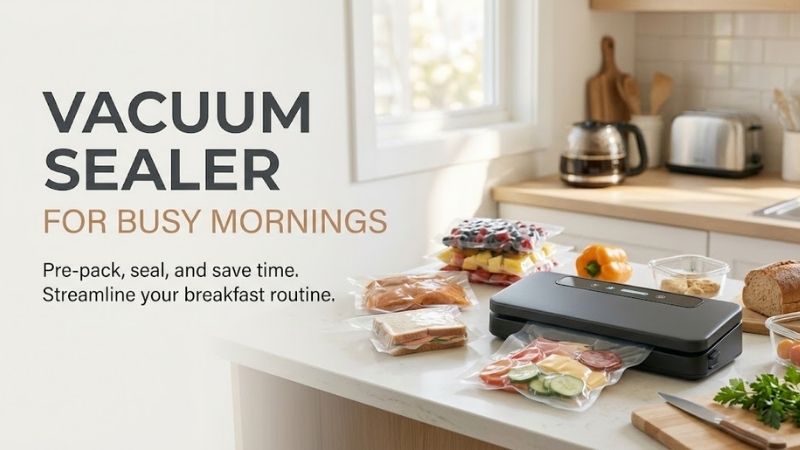
External suction sealers remove air from compatible bags and heat-seal their open ends.
They are common in home kitchens.
Many require embossed or textured bags designed to allow air removal.
Their main advantages can include relatively compact dimensions and straightforward operation.
However, liquids may be drawn toward the sealing area.
Wet foods require particular attention to manufacturer instructions.
Chamber Vacuum Sealers
Chamber sealers remove air from an enclosed chamber containing the package.
They can be useful for certain liquids and moist foods when used correctly.
However, chamber machines are generally larger and may cost more.
For ordinary breakfast preparation, their added complexity may not be justified.
They are more suitable when frequent sealing of suitable wet foods is a major requirement.
Handheld Vacuum Sealers
Handheld systems often remove air from compatible reusable bags or containers through a dedicated valve.
They may require less storage space.
However, their sealing mechanisms differ from heat-sealed bags.
Choose only accessories designed for the specific system.
Vacuum Sealer vs. Ordinary Food Containers
Airtight containers can be sufficient for many short-term refrigerated foods.
Vacuum sealing may help reduce air exposure and freezer-related quality loss when suitable packaging is used.
However, it does not automatically extend every food’s safe storage life.
Food safety depends on the ingredients, temperature, handling, and storage duration.
Best Breakfast Meal-Prep Uses
Freezing Prepared Breakfast Portions
A vacuum sealer can be useful for packaging suitable fully cooked breakfast portions before freezing.
Examples may include certain breakfast sandwiches, waffles, pancakes, or cooked breakfast meats.
However, packaging should occur only after food has been safely cooked and cooled.
Follow appropriate refrigeration or freezing procedures.
Do not leave prepared food on the counter while sealing multiple portions.
Portioning Breakfast Meats
Raw or cooked breakfast meats can be portioned for appropriate cold storage.
This may help organize freezer inventory.
However, raw meat requires careful handling to prevent cross-contamination.
Clean and sanitize contact surfaces and sealing equipment according to manufacturer instructions.
Keep raw and ready-to-eat foods separate.
Freezing Smoothie Ingredients
Certain fruits and suitable smoothie ingredients can be portioned in freezer bags.
However, vacuum suction may crush soft fruit.
Some sealers provide gentler settings or pulse controls.
Alternatively, freezing ingredients separately before packaging may be appropriate when consistent with safe handling instructions.
Do not treat vacuum sealing as a substitute for freezing.
Storing Bread and Bagels
Air removal may help reduce exposure to freezer air.
However, soft bread can be compressed by strong vacuum suction.
Use a suitable gentle setting or packaging method.
For everyday fresh bread, a simple food-storage bag may be adequate.
Preparing Oatmeal Ingredients
Dry oats and other shelf-stable dry ingredients may be portioned for convenience.
However, vacuum sealing does not automatically make every dry mixture shelf stable.
Ingredients containing moisture or perishable additions require different storage conditions.
For ordinary breakfast oats, reusable containers may be more economical.
Choosing the Right Vacuum Sealer
Sealing Reliability
The appliance must create an appropriate seal across the intended bag width.
A failed seal can allow air or moisture to enter.
Check whether the machine provides clear instructions for positioning bags and confirming a complete seal.
Do not assume that a package is properly sealed simply because the machine completed its cycle.
Bag Width
Sealers have model-specific maximum bag widths.
Choose a machine that accommodates your normal portion sizes.
Oversized bags may waste material.
Undersized bags may leave insufficient room for sealing.
Follow minimum bag-length and fill-clearance instructions.
Dry and Moist Settings
Some sealers offer separate settings for different food moisture levels.
These may change sealing behavior or heat-seal duration.
However, a moist setting does not make an external suction sealer suitable for every liquid.
Check the manual for soups, sauces, and other wet ingredients.
Pulse Vacuum Control
Pulse control may help when packaging delicate foods.
It allows greater control over air removal.
However, its effectiveness depends on bag material, food structure, and appliance design.
This feature is useful when you regularly seal soft bread, berries, or fragile ingredients.
Seal-Only Function
A seal-only function closes compatible bags without running a full vacuum cycle.
It can be useful for creating bags from rolls or sealing packages when vacuum removal is unnecessary.
However, the correct sealing procedure varies by machine.
Size and Countertop Convenience
External Dimensions
Measure where the sealer will operate and where it will be stored.
Some models have long housings because they accommodate wide bags.
A narrow profile may still require substantial countertop width.
Lid Opening
The sealer may need extra clearance to open its lid and insert packaging.
Check complete operating dimensions.
Bag Roll Storage
Some machines include built-in roll storage and cutters.
These features can simplify preparation but may increase appliance size.
Separate rolls and cutters require their own storage space.
Weight and Portability
A lightweight machine may be easier to retrieve for weekly meal preparation.
However, weight alone does not indicate build quality.
Choose an appliance that can be placed securely during sealing.
Food Safety: The Most Important Consideration
Vacuum Sealing Does Not Sterilize Food
Removing air does not eliminate bacteria, viruses, spores, or other hazards.
Certain microorganisms can grow under reduced-oxygen conditions.
For that reason, vacuum sealing should be treated as a packaging method rather than a food-safety treatment.
Foods requiring refrigeration or freezing still require appropriate cold storage.
Refrigeration Requirements
Vacuum-sealed perishable foods must be refrigerated or frozen.
For ordinary US household food safety, keep refrigerated food at 40°F or below and frozen food at 0°F or below.
Do not leave sealed meat, eggs, cooked breakfast sandwiches, or other perishables at room temperature merely because their packaging looks airtight.
Follow conservative storage guidance appropriate to the food.
Freezer Storage
Vacuum packaging can help protect suitable foods from air exposure during freezing.
However, freezer storage duration and quality vary.
Label packages with their contents and preparation dates.
Use appropriate freezer-safe bags.
Vacuum sealing does not guarantee indefinite food quality.
Cooling Cooked Foods
Cooked breakfast foods must be cooled promptly and safely.
Use shallow containers or other appropriate cooling methods before packaging.
Do not leave cooked food at room temperature beyond the general two-hour limit, reduced to one hour when ambient temperatures exceed 90°F.
Avoid sealing hot food if doing so conflicts with safe cooling or manufacturer requirements.
Reheating
Previously cooked refrigerated breakfast foods should be reheated appropriately.
For leftovers, the general recommended internal temperature is 165°F.
Do not assume that vacuum packaging changes this requirement.
Only heat food inside vacuum-sealer bags when the bag manufacturer explicitly approves the specific cooking or reheating method.
Special Risks With Reduced-Oxygen Packaging
Vacuum packaging changes the atmosphere surrounding food.
This can affect which microorganisms may grow during storage.
Certain hazards associated with reduced-oxygen environments are especially important for improperly handled foods.
Do not use home vacuum sealing to make ordinary cooked meals shelf stable.
Do not substitute vacuum sealing for pressure canning or other validated preservation processes.
How to Organize Breakfast Meal Prep
Step 1: Decide What to Prepare
Choose foods that are suitable for advance preparation and cold storage.
Determine how many portions you actually need.
Avoid preparing more than you can safely refrigerate or freeze.
Step 2: Cook Ingredients Properly
Prepare eggs, meat, and other ingredients according to appropriate food-safety instructions.
For example, egg dishes generally require 160°F, ground beef and pork 160°F, and poultry 165°F.
Use a food thermometer when needed.
Step 3: Cool Food Safely
Use appropriate containers and prompt refrigeration to cool cooked foods.
Do not leave large quantities at room temperature.
Wait until packaging is appropriate under both food-safety guidance and the sealer’s instructions.
Step 4: Select Compatible Bags
Use bags designed for the exact sealing system.
Check whether they are suitable for freezing or other intended uses.
Do not assume that ordinary household plastic bags can be heat sealed safely.
Step 5: Package Appropriate Portions
Place food inside the bag while leaving the manufacturer-required space above the contents.
Keep the sealing area clean and dry when required.
Avoid introducing food residue into the sealing mechanism.
Step 6: Select the Correct Setting
Use the approved dry, moist, pulse, or other function as appropriate.
Do not attempt to seal unsupported liquids.
Follow the machine’s operating procedure.
Step 7: Inspect the Seal
Check that the sealed seam is continuous and free of obvious defects.
If the seal is incomplete, follow manufacturer instructions for resealing.
Do not rely on a visibly damaged package for long-term storage.
Step 8: Label and Refrigerate or Freeze
Record the contents and date.
Store perishable foods at safe temperatures immediately.
Organize the refrigerator or freezer so that older portions can be used first.
Cleaning and Maintenance
Clean the Sealing Area
Food residue and moisture can interfere with sealing.
Follow the manufacturer-approved cleaning method.
Disconnect the machine when required.
Do not immerse electrical components.
Maintain Gaskets
Sealing gaskets may become worn or dirty.
Inspect them according to the manual.
Use only compatible replacement parts.
Empty Drip Trays
Some sealers include removable trays that collect moisture.
Clean and dry them after use.
Do not allow food residue to remain inside the appliance.
Protect the Heating Strip
The sealing element may become hot.
Allow it to cool before cleaning.
Do not scrape it with sharp tools.
Store the Lid Correctly
Some vacuum sealers require a particular storage position to avoid compressing their gaskets.
Follow the manufacturer’s instructions.
Do not assume that every machine should be stored with its lid tightly locked.
When a Vacuum Sealer Is Not Worth Buying
Short-Term Refrigerator Storage
If you only store breakfast ingredients overnight or for a short period, ordinary covered containers may be sufficient.
Vacuum sealing may create unnecessary bag waste and preparation work.
Daily Single-Serving Meals
For someone making one fresh sandwich each morning, vacuum sealing offers limited practical benefit.
A reusable lunch container may be more convenient.
Limited Freezer Space
A sealer can organize packages, but it cannot create additional freezer capacity.
If your freezer is consistently full, evaluate storage space before buying.
Very Small Meal-Prep Volumes
The cost of bags and the time required to package food may outweigh the benefits when only a few portions are prepared.
Common Buying Mistakes
Assuming Vacuum Sealed Means Shelf Stable
Perishable foods still require refrigeration or freezing.
Buying Incompatible Bags
Bag types vary between external suction, chamber, and handheld systems.
Ignoring Ongoing Bag Costs
Consumable packaging affects long-term value.
Trying to Seal Unsupported Liquids
External suction machines may draw liquid into the sealing mechanism.
Packaging Food Before Safe Cooling
Improper cooling can create food-safety problems.
Using Nonapproved Bags for Heating
Not all vacuum bags are suitable for microwaves, boiling water, or sous-vide cooking.
Frequently Asked Questions
Is a Vacuum Sealer Worth It for Breakfast Meal Prep?
It can be useful when you regularly freeze prepared breakfast portions or bulk ingredients. For short-term refrigeration, reusable containers may be simpler.
Can I Vacuum Seal Breakfast Sandwiches?
Suitable fully cooked sandwiches may be packaged and frozen when properly cooled and handled. Follow food-safety guidance and use appropriate freezer bags.
Does Vacuum Sealing Keep Food Safe Without Refrigeration?
No. Vacuum sealing does not sterilize food or remove the need for refrigeration or freezing.
Can I Vacuum Seal Raw Eggs?
Do not assume ordinary shell eggs or raw egg mixtures are suitable for home vacuum sealing. Follow validated food-safety guidance rather than improvising storage methods.
Is a Chamber Sealer Better Than an External Suction Sealer?
A chamber sealer may be more practical for frequent packaging of certain moist foods, but it is generally larger and may cost more. External suction models are often sufficient for suitable dry or solid foods.
Can I Reheat Food in Vacuum-Sealed Bags?
Only when the bags are explicitly approved for the intended heating method. Follow food-safety temperature requirements and packaging instructions.
Conclusion
The best vacuum sealer for busy mornings should support your actual meal-prep routine without creating unnecessary packaging work. An external suction model is a sensible choice for households that regularly freeze breakfast portions and ingredients, while simple reusable containers may be better for short-term storage. Prioritize reliable seals, compatible bags, easy cleaning, and proper refrigeration or freezing, because vacuum packaging alone does not make food safe.



Write Your Review
No reviews yet. Be the first to share your experience!