
The right rice storage container keeps dry rice organized, protects it from kitchen humidity, and makes measuring easier. This guide compares six real storage formats, from compact pantry canisters to bulk dispensers, and explains which features matter for your shopping habits, rice variety, cabinet space, and daily cooking routine.
Quick Verdict
Rice storage seems simple until a half-used bag spills in a cabinet, absorbs nearby odors, or attracts pantry pests. A good storage setup begins with a clean, dry, food-suitable container that closes reliably and fits the amount of rice you actually use. The best choice is therefore not always the largest or most expensive model. Six choices below are presented by best-fit use case rather than by an invented test score. Each recommendation is based on documented product format and the practical fit of that format to common household needs.
- Best for compact cabinets: OXO Good Grips POP Big Square Short
- Best for medium pantry storage: Rubbermaid Brilliance Pantry, 16 Cup
- Best for daily bulk dispensing: Lifewit 25.4-Pound Rice Dispenser
- Best dedicated large rice case: LocknLock HPL510
- Best commercial-style bin: Cambro CamSquares Camwear, 8 Quart
- Best protected secondary storage: IRIS WeatherPro 19-Quart Box
All six designs solve legitimate but different storage problems. The small POP is a daily workhorse for modest quantities; the 16-cup Rubbermaid suits larger but not industrial-size pantry use; dedicated rice cases and dispensers suit high-volume households. Cambro favors straightforward commercial-style handling, while the IRIS box is best approached as a bulk-storage solution whose exact food-contact instructions deserve extra scrutiny.
Dry white rice and brown rice have different storage characteristics. The oils naturally present in brown rice make cool storage and faster turnover more important than for polished white rice. A container helps exclude moisture and odors, but no ordinary countertop canister cancels the effects of heat, time, or using a damp scoop.
Quick Comparison Table
A comparison table is most useful when it makes differences visible without pretending that one unit solves every pantry problem. The capacities and features below describe identified product variants; capacities stated in volume are not automatic promises about the weight of a particular ingredient or the number of unusually sized spice bottles that fit.
| Product | Best For | Key Specifications | Main Advantage | Main Trade-Off |
|---|---|---|---|---|
| OXO Good Grips POP Big Square Short, 2.8 Quart | Smaller households that buy a few pounds of rice at a time | 2.8-quart / 2.6-liter capacity | Compact footprint with a visible fill level | Requires refilling if rice consumption is high |
| Rubbermaid Brilliance Pantry Container, 16 Cup | Families wanting a larger clear canister with locking latches | 16-cup capacity | Documented 16-cup size for substantial pantry storage | Potentially tall for shorter shelves |
| Lifewit Rice Dispenser Container, 25.4 Pound | High-volume white-rice households that want a dispensing mechanism | Manufacturer-stated rice capacity up to 25.4 pounds | Button dispensing can keep the bulk supply less frequently exposed | Dispenser parts require careful periodic cleaning |
| LocknLock Classic HPL510 Rice Storage Case | Bulk buyers who prefer a conventional lidded rice case | LocknLock Classic HPL510 model | Dedicated rice-case format with identified model number | Bulky for cabinets designed around small canisters |
| Cambro CamSquares Camwear Container, 8 Quart | Home cooks who want restaurant-style modular dry storage | 8-quart capacity from the CamSquares Classic Camwear range | Clearly identified commercial food-storage format | May require a separately selected lid |
| IRIS USA WeatherPro 19-Quart Gasket Storage Box | Bulk dry-goods organization where a larger protected secondary bin is needed | 19-quart WeatherPro gasket box | High-capacity latched design for bulk overstock | Awkward for small daily servings |
All six designs solve legitimate but different storage problems. The small POP is a daily workhorse for modest quantities; the 16-cup Rubbermaid suits larger but not industrial-size pantry use; dedicated rice cases and dispensers suit high-volume households. Cambro favors straightforward commercial-style handling, while the IRIS box is best approached as a bulk-storage solution whose exact food-contact instructions deserve extra scrutiny.
How We Selected These Products
These recommendations use verifiable model identities, published product descriptions, and ordinary considerations involved in daily kitchen storage. They are editorial matches to buyer needs, not the result of our own laboratory, durability, leakproof, or cooking tests. When a size or accessory varies by market, the article identifies that uncertainty rather than inventing a universal specification.
- Food suitability: confirm the actual model is intended for direct dry-food contact, especially when considering general storage boxes.
- Sealing method: look at the lid-and-gasket design, not only advertising phrases such as airtight or fresh-lock.
- Capacity: compare the bag you regularly buy against usable volume, not just the largest number printed on a listing.
- Daily access: scooping, opening a lid, and dispensing through a chute create different workflows.
- Cleaning: consider removable seals, grain chutes, inner corners, and whether the whole unit can dry completely.
Rice storage seems simple until a half-used bag spills in a cabinet, absorbs nearby odors, or attracts pantry pests. A good storage setup begins with a clean, dry, food-suitable container that closes reliably and fits the amount of rice you actually use. The best choice is therefore not always the largest or most expensive model.
The shortlist deliberately includes different storage formats. A range of formats is more helpful than filling the page with nearly identical sizes of one model, because the main decision is often how the storage works in your home, not which logo appears on the lid. Manufacturer descriptions are treated as descriptions of design, not as independently measured performance.
Detailed Product Recommendations
Below, each recommendation covers the exact product family or model, its intended buyer, the meaningful advantages of its storage design, and the important limitations that a product listing might not emphasize. Read the trade-off as carefully as the headline feature; a container or rack that does not fit your space is not a good purchase regardless of its stated capacity.
The recommendations are ordered to move from straightforward everyday organization to more specialized storage arrangements. They do not imply that the first product has been independently proved superior to the last. Use the comparison table together with the practical examples below.
OXO Good Grips POP Big Square Short, 2.8 Quart
OXO Good Grips POP Big Square Short, 2.8 Quart is most relevant for smaller households that buy a few pounds of rice at a time. The broad square opening is easier to use with a dedicated dry scoop than a narrow pour spout. Its shorter profile also fits shelves that cannot accommodate tall cereal canisters. The clear walls allow quick inventory checks before grocery shopping. Its suitability rests on the documented product format and how that format changes routine storage, not on an invented claim that it outperformed other products in detailed research.
Why we picked it. OXO explicitly identifies rice as a suitable dry good for this model, and the compact geometry makes everyday refills manageable. It suits shoppers who dislike balancing oversized bins on high pantry shelves. The button lid is convenient when you open the container frequently.
Features and practical use. For a household preparing rice a few evenings each week, keeping a modest working supply next to the cooking zone saves trips to a bulk bag elsewhere. Keep the scoop clean and completely dry; moisture on a measuring cup defeats the purpose of a protective seal. The stated volume is not an automatic weight guarantee for every rice variety.
Important limitation. The short model is a poor substitute for a large 10- or 25-pound rice bag. A push-button seal is not a vacuum system, and a full container can still spill if someone handles it carelessly with the lid disengaged.
Key specifications
- 2.8-quart / 2.6-liter capacity
- Push-button POP lid
- Clear, stackable square body
- Manufacturer lists a 6.25-by-6.3-inch footprint and 6.75-inch height
Pros
- Compact footprint with a visible fill level
- Simple one-handed button operation when set on a stable shelf
Cons
- Requires refilling if rice consumption is high
- Not a dedicated bulk-bag solution
Best for and decision summary
- Best for: Smaller households that buy a few pounds of rice at a time
- Buy if: You prioritize easy daily scooping and small pantry compartments
- Skip if: You usually buy ten pounds or more in one trip
What to verify before ordering. Compare the full usable footprint with the exact placement you have in mind. Check the product variant, care instructions, and any accessories or mounting hardware, because a similar product photo is not reliable proof that the item will meet your specific needs.
Rubbermaid Brilliance Pantry Container, 16 Cup
Rubbermaid Brilliance Pantry Container, 16 Cup is most relevant for families wanting a larger clear canister with locking latches. The locking sides provide a visual and tactile closure cue, helpful in a busy household where several people use the pantry. A rectangular shape can line up neatly with flour, sugar, and pasta containers, reducing dead space between mismatched round jars. Its suitability rests on the documented product format and how that format changes routine storage, not on an invented claim that it outperformed other products in detailed research.
Why we picked it. Rubbermaid documents the container as suited to rice and other dry grains. The 16-cup capacity gives it a different role from compact countertop jars, while clear construction supports straightforward stock rotation. Its lid design is worth considering where accidental lid placement is a common nuisance.
Features and practical use. Use this size as a practical bridge between small weekly purchases and the largest bulk sacks. First test that a rice scoop fits the opening and that you can lift the full container safely from its shelf. For precise serving portions, use the rice cooker cup or a kitchen scale rather than treating the 16-cup container capacity as a portion measurement.
Important limitation. A tall container may not fit below a shallow cabinet shelf, and latch-style lids take a little more effort than a simple flip opening. The capacity is expressed in volume, not a manufacturer guarantee that a certain bag weight will fit.
Key specifications
- 16-cup capacity
- Model 1994228
- Clear Tritan-style plastic body
- Locking side latches and seal
- Manufacturer lists 7.9 × 5.4 × 9.4 inches
Pros
- Documented 16-cup size for substantial pantry storage
- Clear body and positive locking lid
Cons
- Potentially tall for shorter shelves
- Not an automatic rice dispenser
Best for and decision summary
- Best for: Families wanting a larger clear canister with locking latches
- Buy if: You want a mid-to-large pantry canister with secure latch closure
- Skip if: You need measured push-button dispensing or a portable bottle
What to verify before ordering. Compare the full usable footprint with the exact placement you have in mind. Check the product variant, care instructions, and any accessories or mounting hardware, because a similar product photo is not reliable proof that the item will meet your specific needs.
Lifewit Rice Dispenser Container, 25.4 Pound
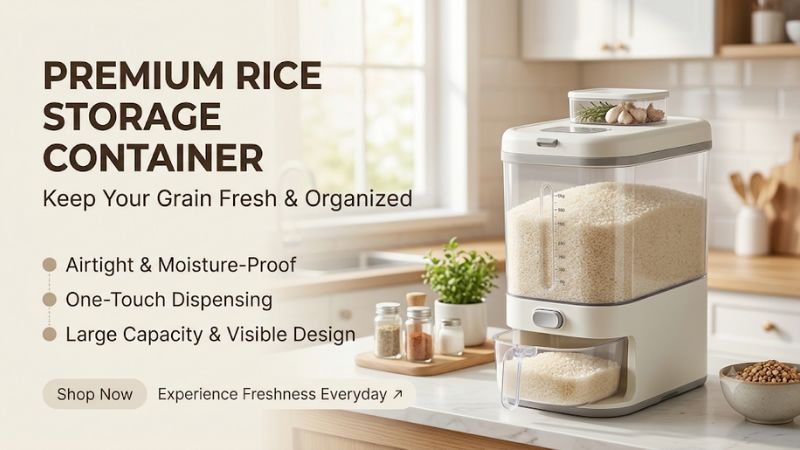
Lifewit Rice Dispenser Container, 25.4 Pound is most relevant for high-volume white-rice households that want a dispensing mechanism. Instead of reaching into the rice with a scoop, users dispense grain into a removable cup. That changes where the container can sit: access to the lower outlet matters more than access from the top for every meal. The measuring cup is also designed to help rinse rice after dispensing. Its suitability rests on the documented product format and how that format changes routine storage, not on an invented claim that it outperformed other products in detailed research.
Why we picked it. The brand describes a 25.4-pound dispenser with a button-operated outlet, clearly separating it from ordinary pantry canisters. For families that cook rice nearly every day, an outlet can reduce repeated contact with the main supply and limit loose grains on a crowded shelf.
Features and practical use. Position the dispenser on a level, sturdy surface before loading it. Check that a full bag will fit without forcing the lid, and practice dispensing a small portion to understand the flow. Its measuring marks are useful for routine cooking, but a scale remains preferable when a recipe requires exact weights. Clean and dry the outlet thoroughly before reassembly.
Important limitation. Moving parts and a grain chute create additional surfaces that need cleaning. A sealing ring at the lid does not mean the dispensing outlet can be left dirty or damp. It is not sensible for travelers or homes that buy only a pound of specialty rice occasionally.
Key specifications
- Manufacturer-stated rice capacity up to 25.4 pounds
- Polypropylene body
- Sealing ring
- Push-button dispense control
- Marked measuring cup with rinse holes
Pros
- Button dispensing can keep the bulk supply less frequently exposed
- Large published rice capacity with included measuring cup
Cons
- Dispenser parts require careful periodic cleaning
- Too large for a small shelf or infrequent rice use
Best for and decision summary
- Best for: High-volume white-rice households that want a dispensing mechanism
- Buy if: You cook rice daily and normally purchase bulk bags
- Skip if: You need a portable container or store only small quantities
What to verify before ordering. Compare the full usable footprint with the exact placement you have in mind. Check the product variant, care instructions, and any accessories or mounting hardware, because a similar product photo is not reliable proof that the item will meet your specific needs.
LocknLock Classic HPL510 Rice Storage Case
LocknLock Classic HPL510 Rice Storage Case is most relevant for bulk buyers who prefer a conventional lidded rice case. This model approaches rice storage as a dedicated grain case rather than a stack of small multipurpose canisters. A wide access opening supports refilling from a heavier sack and using a separate measuring scoop. The locking lid also gives a consistent way to close the container after each use. Its suitability rests on the documented product format and how that format changes routine storage, not on an invented claim that it outperformed other products in detailed research.
Why we picked it. LocknLock lists the HPL510 in its Classic range as a dedicated rice-storage model, which is more compelling than assuming an arbitrary utility bin is approved for direct grain contact. It is useful where a 10-kilogram purchase is the household norm and storage space is reserved for rice.
Features and practical use. Measure cabinet depth and the height needed to lift or fully open the lid before buying. A nominal 10-kilogram rice case is intended for bulk storage, so assign a dedicated spot instead of repeatedly lifting it onto a top shelf. If a bag is damp or damaged, do not pour it into an otherwise clean container and assume the seal will solve the problem.
Important limitation. Its large physical size and capacity are unnecessary for apartment households that switch between several rice varieties. LocknLock sells regional models and configurations, so shoppers should confirm that the HPL510—not a similar-looking container—is the actual item on the listing.
Key specifications
- LocknLock Classic HPL510 model
- Manufacturer identifies it as rice storage for 10 kilograms
- Classic-series four-side-locking lid and silicone packing
Pros
- Dedicated rice-case format with identified model number
- Lid closure designed for storing a larger staple supply
Cons
- Bulky for cabinets designed around small canisters
- Exact accessories may depend on the regional listing
Best for and decision summary
- Best for: Bulk buyers who prefer a conventional lidded rice case
- Buy if: You store a large household quantity in one fixed location
- Skip if: You prefer small containers for multiple rice types
What to verify before ordering. Compare the full usable footprint with the exact placement you have in mind. Check the product variant, care instructions, and any accessories or mounting hardware, because a similar product photo is not reliable proof that the item will meet your specific needs.
Cambro CamSquares Camwear Container, 8 Quart
Cambro CamSquares Camwear Container, 8 Quart is most relevant for home cooks who want restaurant-style modular dry storage. Cambro’s commercial-food-storage approach emphasizes capacity identification, repeatable stacking, and access with a scoop. The square walls can pack efficiently on deep shelves, and larger openings simplify cleaning after the container is empty. This works particularly well when keeping rice, dry beans, and grains in a consistent container family. Its suitability rests on the documented product format and how that format changes routine storage, not on an invented claim that it outperformed other products in detailed research.
Why we picked it. Cambro publishes a distinct CamSquares Camwear food-storage lineup with identifiable 8-quart models, making it a well-defined alternative for a serious pantry. It is a practical option for cooks who refill larger amounts but do not need a dispenser mechanism or decorative countertop presentation.
Features and practical use. Confirm the matching lid material and closure before ordering; not all lids are included with commercial containers. A fitted lid is essential, because a food-grade bin without a properly closed top does not address pantry pests or humidity. Mark the fill date and rice variety on a removable label for inventory rotation.
Important limitation. Commercial containers tend to look utilitarian, and an ordinary fitted lid should not be confused with a mechanically locking lid. The capacity is in quarts; verify the chosen bag’s approximate volume and leave room for a scoop rather than assuming an exact pound equivalence.
Key specifications
- 8-quart capacity from the CamSquares Classic Camwear range
- Square food-storage body
- Compatible matching lid is a separate buying consideration
Pros
- Clearly identified commercial food-storage format
- Wide opening and square shelf-efficient shape
Cons
- May require a separately selected lid
- Less refined looking on a visible countertop
Best for and decision summary
- Best for: Home cooks who want restaurant-style modular dry storage
- Buy if: You already use restaurant-style labeled bins for pantry staples
- Skip if: You want a compact button-operated countertop dispenser
What to verify before ordering. Compare the full usable footprint with the exact placement you have in mind. Check the product variant, care instructions, and any accessories or mounting hardware, because a similar product photo is not reliable proof that the item will meet your specific needs.
IRIS USA WeatherPro 19-Quart Gasket Storage Box
IRIS USA WeatherPro 19-Quart Gasket Storage Box is most relevant for bulk dry-goods organization where a larger protected secondary bin is needed. The sizable weatherproof-style box is more appropriate for organized bulk storage than for dispensing a single cup every evening. Its latch-and-gasket design is useful around grocery overstock kept away from the main cooking counter, where shoppers value a closed outer barrier and clear visual access. Its suitability rests on the documented product format and how that format changes routine storage, not on an invented claim that it outperformed other products in detailed research.
Why we picked it. IRIS USA explicitly mentions rice and flour as possible pantry contents for this 19-quart product, rather than requiring an assumption from the product name alone. Its capacity and storage-box geometry serve a different need from a small rice cooker-side container or appliance-like dispenser.
Features and practical use. Treat this model as a dry-food storage option only when the exact product labeling and cleaning instructions match your intended direct-food use. The general WeatherPro family includes nonfood storage configurations, so verify the specific unit. Keep contents in their original sealed food packaging if uncertain about direct-food contact or if using the box for secondary bag protection.
Important limitation. It is physically bulky, not purpose-built for convenient portion scooping, and a gasketed storage box is not automatically equivalent to a pantry canister with a food-contact certification for every configuration. Users should not store food directly in any bin whose exact instructions prohibit it.
Key specifications
- 19-quart WeatherPro gasket box
- Latch closure
- Manufacturer describes the BPA-free storage-box material as usable for rice and flour
Pros
- High-capacity latched design for bulk overstock
- Maker identifies rice as a potential pantry use
Cons
- Awkward for small daily servings
- Requires exact-model food-contact confirmation before direct fill
Best for and decision summary
- Best for: Bulk dry-goods organization where a larger protected secondary bin is needed
- Buy if: You need a large protected storage location for a bag of rice
- Skip if: You need a countertop canister with an integrated scoop or dispenser
What to verify before ordering. Compare the full usable footprint with the exact placement you have in mind. Check the product variant, care instructions, and any accessories or mounting hardware, because a similar product photo is not reliable proof that the item will meet your specific needs.
Buying Guide: What Matters Before You Order
Most disappointing rice-storage purchases come from guessing at size or overlooking how the container will be used. Picture the full daily action: lifting the lid, positioning a scoop, pouring into a cooker, cleaning around the rim, and closing the container again. Each step affects whether the purchase is a genuine improvement over the original bag. The considerations below provide a repeatable checklist that applies to the six models, and they also help assess products that are not on this shortlist. Treat the guidance as a way to make a fit-for-purpose decision, not a reason to overbuy features.
Start by measuring the location, counting your typical supply, and deciding how often you open the container or rack. The following factors explain why different homes benefit from different designs.
Capacity and rice type
A printed volume in quarts or cups is not interchangeable with pounds of dry rice, because different grains settle differently and manufacturers do not always specify the same filling method. Buy around your usual bag size and allow extra room for a scoop, pouring, or the lid mechanism. This factor also changes ongoing maintenance and the amount of extra time needed in the kitchen, so it deserves attention even if a product looks attractive or has a prominent marketing claim.
A household that buys a small bag every two weeks needs a different footprint from a family that purchases a bulk sack every month. Measure the longest regular shopping interval, not an imagined maximum future stockpile. Brown rice is especially worth buying in quantities you can finish while it remains at its best quality.
Practical checks
- Measure the real storage space and available access path before buying.
- Verify the exact product model, size, lid, or mounting configuration.
- Choose a setup you can inspect and clean without special effort.
Consider your future routine as well as the first day after installation or decanting. A product that solves one nuisance but creates daily handling problems is unlikely to remain useful over time.
The lid, seal, and pest prevention
The most important closure feature is repeatability: the lid must close fully every time, without crumbs lodged in the gasket or an awkward latch that people leave open. A good seal helps guard against humidity and pantry insects, but it is not a substitute for checking the food before storage. This factor also changes ongoing maintenance and the amount of extra time needed in the kitchen, so it deserves attention even if a product looks attractive or has a prominent marketing claim.
Inspect locking arms, sealing rings, buttons, and dispensing chutes for spaces where grains can collect. A dispenser may reduce how often the main chamber is opened, yet its outlet must also be maintained. Keep the storage location clean and avoid placing rice next to strongly scented foods.
Practical checks
- Measure the real storage space and available access path before buying.
- Verify the exact product model, size, lid, or mounting configuration.
- Choose a setup you can inspect and clean without special effort.
Consider your future routine as well as the first day after installation or decanting. A product that solves one nuisance but creates daily handling problems is unlikely to remain useful over time.
Shelf layout and safe lifting
A container is useful only when it can be reached without a spill or strain. Record the clear internal dimensions of the shelf and the extra height needed to open the lid. Consider the filled weight before choosing a high cabinet; a floor-level or waist-height shelf is often safer for large rice cases. This factor also changes ongoing maintenance and the amount of extra time needed in the kitchen, so it deserves attention even if a product looks attractive or has a prominent marketing claim.
Tall, narrow designs preserve floor area but can be awkward to refill; low, wide designs make scooping easy but consume more shelf width. For families with children, choose a location where the container will not be pulled from an edge and where the lid cannot be unintentionally left open.
Practical checks
- Measure the real storage space and available access path before buying.
- Verify the exact product model, size, lid, or mounting configuration.
- Choose a setup you can inspect and clean without special effort.
Consider your future routine as well as the first day after installation or decanting. A product that solves one nuisance but creates daily handling problems is unlikely to remain useful over time.
Cleaning and everyday handling
Dry storage containers need to be truly dry before refilling, including under lid gaskets and around dispenser mechanisms. The easiest models allow you to inspect every surface and reach the corners with a soft brush or cloth. Follow the specific maker’s cleaning guidance rather than assuming every plastic lid is dishwasher-safe. This factor also changes ongoing maintenance and the amount of extra time needed in the kitchen, so it deserves attention even if a product looks attractive or has a prominent marketing claim.
Always use a clean, dry measuring utensil. If you find webbing, insects, unusual odors, or damp clumps, investigate the rice and surrounding pantry instead of relying on a fresh container to fix contaminated contents. Date labels make rotation easier across more than one rice variety.
Practical checks
- Measure the real storage space and available access path before buying.
- Verify the exact product model, size, lid, or mounting configuration.
- Choose a setup you can inspect and clean without special effort.
Consider your future routine as well as the first day after installation or decanting. A product that solves one nuisance but creates daily handling problems is unlikely to remain useful over time.
Which Setup Fits Your Household?
A useful purchase should fit a household scenario rather than an abstract product ranking. The same nominal capacity or bottle count can be convenient in one kitchen and entirely wrong in another. The examples below connect shopping frequency, available space, and daily habits to practical storage arrangements without assuming that all homes share one ideal layout.
- A person cooking rice twice weekly may prefer a small see-through canister that is pleasant to open and refill.
- A family preparing rice daily may gain more from a secure mid-size bin or a large dispenser with a cup at hand.
- A home purchasing twenty-pound bags should reserve floor-level shelf space and avoid lifting the full container overhead.
- A household using jasmine, basmati, and brown rice may do better with separate labeled containers instead of one enormous bin.
Dry white rice and brown rice have different storage characteristics. The oils naturally present in brown rice make cool storage and faster turnover more important than for polished white rice. A container helps exclude moisture and odors, but no ordinary countertop canister cancels the effects of heat, time, or using a damp scoop.
Before you buy, perform a five-minute setup test: imagine filling the container or mounting the rack, opening it when cooking, getting the ingredient you need, closing it with one hand occupied, and cleaning it after a spill. If any step seems awkward, compare another storage format.
Frequently Asked Questions
These practical questions come up when readers try to translate a product’s specifications into everyday storage decisions. They also clarify the limits of claims such as airtight, high capacity, and space-saving. Consider the answers in the context of your own ingredient type, jar collection, cooking frequency, and the manufacturer’s exact instructions.
The answers focus on reasonable handling, compatibility, and quality rather than promises that any organizer or container works perfectly in every kitchen.
Is an airtight rice container enough to prevent insects?
A reliable seal can lower the risk of new contamination by limiting access, but it cannot eliminate insects already present in a bag. Inspect rice when transferring it, clean the shelf, and keep the lid closed. If signs of infestation appear, handle the affected food according to safe household food-storage practices rather than assuming a new lid will solve the issue. The useful decision is to match the storage practice to the product you actually own and the conditions in your kitchen. A product description may explain a feature but does not replace attention to cleanliness, compatibility, and realistic use.
Practical takeaway: Before purchasing, verify the exact model, its documented cleaning or installation instructions, and the dimensions available in your kitchen. General advice cannot replace these fit checks.
Should brown rice be stored differently from white rice?
Yes. Brown rice contains oils in its bran layer that make it more vulnerable to quality loss during long warm storage. Keep it cool, use it sooner, and consider refrigeration or freezing for longer storage. White rice tolerates pantry storage better when kept dry and protected, but it still benefits from appropriate rotation and pest control. The useful decision is to match the storage practice to the product you actually own and the conditions in your kitchen. A product description may explain a feature but does not replace attention to cleanliness, compatibility, and realistic use.
Practical takeaway: Before purchasing, verify the exact model, its documented cleaning or installation instructions, and the dimensions available in your kitchen. General advice cannot replace these fit checks.
Will a five-pound bag fit any five-quart container?
Not necessarily. The relationship between volume and weight depends on rice variety, packaging, settling, and the usable shape beneath the lid. If the maker provides an explicit bag-fit statement, prioritize that evidence. Otherwise, compare the capacity conservatively, leave headroom, and be prepared for a small remainder. The useful decision is to match the storage practice to the product you actually own and the conditions in your kitchen. A product description may explain a feature but does not replace attention to cleanliness, compatibility, and realistic use.
Practical takeaway: Before purchasing, verify the exact model, its documented cleaning or installation instructions, and the dimensions available in your kitchen. General advice cannot replace these fit checks.
Can I pour new rice on top of the old supply?
Avoid doing this repeatedly. It hides older rice at the bottom and makes it difficult to inspect and clean the container. Ideally, use most of the remaining stock, empty the container, clean and thoroughly dry it as needed, then refill and label with the new purchase date. This is especially useful when several rice varieties are in rotation. The useful decision is to match the storage practice to the product you actually own and the conditions in your kitchen. A product description may explain a feature but does not replace attention to cleanliness, compatibility, and realistic use.
Practical takeaway: Before purchasing, verify the exact model, its documented cleaning or installation instructions, and the dimensions available in your kitchen. General advice cannot replace these fit checks.
Can a rice dispenser replace a measuring cup?
A dispenser can reduce scooping, and some include a marked cup, but cooking recipes and rice cooker cups may use different volume conventions. Learn the capacity of your specific cooker cup and follow your recipe or cooker instructions. A kitchen scale is more reliable when the recipe specifies a weight of dry rice. The useful decision is to match the storage practice to the product you actually own and the conditions in your kitchen. A product description may explain a feature but does not replace attention to cleanliness, compatibility, and realistic use.
Practical takeaway: Before purchasing, verify the exact model, its documented cleaning or installation instructions, and the dimensions available in your kitchen. General advice cannot replace these fit checks.
Conclusion
The most useful rice storage container is the one matched to your usual bag size and your actual cabinet setup. For small supplies, the OXO POP short model offers compact everyday access; for moderate pantry quantities, the Rubbermaid Brilliance container is a straightforward latch-top option. Heavy rice users should compare the Lifewit dispenser and LocknLock rice case, while commercial-style and secondary bulk storage require closer attention to lids and exact food suitability. Whatever you choose, dry handling, reliable closure, and regular stock rotation matter more than claims that a container can make rice last forever.





Write Your Review
No reviews yet. Be the first to share your experience!