
An under sink trash can hides kitchen waste while keeping a useful disposal point close to food preparation. However, plumbing, cabinet doors, and cleaning supplies can make this space difficult to organize. Compare six identifiable waste systems, from compact door-mounted buckets to specialized pull-outs, and learn how to choose a safe, accessible setup that fits your cabinet.
- Quick Verdict: Which Under Sink Trash Can Is Best?
- Quick Comparison Table
- How We Selected These Under-Sink Trash Cans
- Six Under-Sink Trash Cans Compared in Detail
- Buying Guide: What Matters Most Under the Sink?
- Installation and Safety Considerations
- Common Buying Mistakes
- Frequently Asked Questions
- Conclusion
Quick Verdict: Which Under Sink Trash Can Is Best?
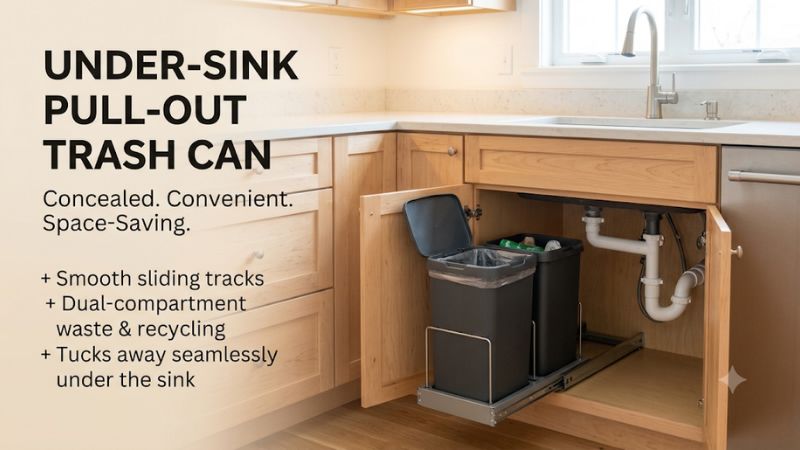
The best under-sink waste container is determined by the cabinet’s actual usable space rather than its outside dimensions. A small hanging bin may be suitable where plumbing dominates the interior, while a purpose-built pull-out can improve access in a deeper cabinet. Dual-bin systems help households separate different waste streams, provided there is enough space to remove each container and handle bags.
Our six recommendations:
- Best for compact door-mounted storage: simplehuman 10L Door-Mounted In-Cabinet Can.
- Best for flexible waste sorting: IKEA HÅLLBAR 5-Gallon Recycling Solution With Pull-Out.
- Best for a simple sliding waste bin: simplehuman 30L Under Counter Pull-Out Can.
- Best for sink-base cabinets: Rev-A-Shelf RV-814PB Under-Sink Waste Container.
- Best for compact dual-bin sorting: Rev-A-Shelf 5SBWC-815S-1 Under-Sink Pullout.
- Best for stainless steel dual-bin storage: Rev-A-Shelf 8-785-30-2SS Under-Sink Pullout.
These products are not interchangeable. A door-mounted can follows the cabinet door’s movement, whereas a floor-mounted sliding container uses rails to bring waste toward the opening.
Before choosing, measure plumbing clearance, door hardware, cabinet depth, and the height required to remove full liners.
Quick Comparison Table
The six products below represent different under-cabinet waste-management approaches, including a door-mounted bucket, single-bin pull-outs, and dual-container sorting systems. Listed capacities and defining features are based on identifiable manufacturer configurations. Exact dimensions, accessory packages, and availability can vary, so buyers should confirm the selected product’s current specification sheet before ordering.
| Product | Best For | Key Specifications | Main Advantage | Main Trade-Off |
|---|---|---|---|---|
| simplehuman 10L In-Cabinet Can | Narrow under-sink spaces | 10L bin, door mounting | Compact and accessible | Requires frequent emptying |
| IKEA HÅLLBAR 5-Gallon Pull-Out | Flexible sorting | 5-gallon waste-sorting solution with pull-out frame | Modular cabinet organization | Frame and bin compatibility must be checked |
| simplehuman 30L Pull-Out Can | Single-bin household waste | 30L capacity, steel pull-out frame | Convenient sliding access | Requires clear cabinet depth |
| Rev-A-Shelf RV-814PB | Cabinets with plumbing obstacles | 20-qt bin, 3/4-extension slides | Designed for sink-base use | Partial-extension access |
| Rev-A-Shelf 5SBWC-815S-1 | Compact waste and recycling | 8L and 15L bins, concealed slides | Two waste streams in one unit | Limited total capacity |
| Rev-A-Shelf 8-785-30-2SS | Stainless dual-bin setup | 10L and 20L stainless bins, full-extension slides | Separate containers with sliding access | More involved installation |
These capacities should not be treated as direct proof of how many days a household can use the container before emptying it. Waste volume depends on packaging, food preparation, bag shape, and how materials are sorted.
The right storage choice must also account for odor management and how easily the bin can be removed for cleaning.
How We Selected These Under-Sink Trash Cans
These six selections were chosen because they are identifiable product configurations with documented design differences relevant to under-sink storage. The comparison considers waste capacity, mounting style, cabinet compatibility, accessibility, sorting options, and maintenance. No original installation tests, odor measurements, or long-term durability experiments were conducted, so recommendations are based on design suitability rather than unsupported claims of measured superiority.
Selection criteria:
- Cabinet compatibility: Suitable construction for under-sink or under-counter installation.
- Storage capacity: Practical single or dual waste containers.
- Mounting method: Door-hung, floor-mounted, or sliding-frame systems.
- Plumbing clearance: Ability to work around relevant sink-base obstacles.
- Access: How easily users can open, fill, and empty the bins.
- Cleaning: Removable buckets and accessible surfaces.
- Waste sorting: Separate containers where relevant.
- Installation: Hardware complexity and cabinet modification requirements.
Products were not selected because of unverified claims about being completely odorproof, permanently rust-free, or universally easy to install.
The key buying question is whether a particular configuration solves the household’s storage problem without interfering with plumbing or normal cabinet operation.
Six Under-Sink Trash Cans Compared in Detail
Each of the following products offers a distinct approach to concealing kitchen waste. A small hanging bucket is convenient for frequent disposal of modest amounts, while a deeper pull-out uses cabinet floor space for greater capacity. Specialized under-sink systems may work around plumbing or provide multiple waste compartments. The product reviews explain the practical strengths, limitations, and suitable buyers for each approach.
simplehuman 10L Door-Mounted In-Cabinet Can
The simplehuman 10L Door-Mounted In-Cabinet Can is a compact waste container designed to attach to the inside of a suitable cabinet door. The manufacturer describes hanging and mounting options, a removable inner bucket, and a sturdy supporting frame. Its small capacity makes it particularly relevant where plumbing leaves little usable cabinet-floor space and a full-size sliding container would be difficult to install.
Best For: Small kitchens, light daily waste, and cabinets with limited floor space.
Why We Picked It: The door-mounted format offers a different storage solution from floor-mounted sliding systems.
Key Specifications:
- Capacity: 10 liters.
- Mounting: Cabinet-door hanging or approved mounting.
- Construction: Frame supporting a removable waste bucket.
- Access: Moves with the cabinet door.
- Use: Compact indoor waste collection.
Features & Benefits:
- Hides a small bin inside the cabinet.
- Keeps cabinet-floor space available.
- Removable bucket supports liner changes.
- Can provide quick access during food preparation.
- Avoids the need for full-depth sliding hardware.
Pros:
- Compact configuration.
- Convenient access when the door opens.
- Appropriate for small waste volumes.
- Useful where plumbing restricts the interior.
Cons:
- Limited capacity.
- Cabinet door strength and clearance matter.
- May conflict with shelves or pipes when the door closes.
- Frequent liner changes may be necessary.
Buy If: You produce modest kitchen waste and need a compact door-mounted solution.
Skip If: You generate large amounts of waste or have an unsuitable cabinet door.
Performance & Practical Use
The strongest practical feature is accessibility. When the door opens, the waste bin becomes available without reaching deeply into the cabinet or pulling out a separate frame.
That can be convenient during vegetable preparation or routine cleanup.
However, a door-mounted system places additional weight on the door and hinges. Verify the mounting method and avoid using a damaged or lightweight panel that cannot safely support the intended configuration.
What Makes It Different
Unlike a sliding pull-out, this container follows the door’s path.
This makes it practical where a horizontal pull-out would conflict with drainpipes.
Its trade-off is smaller capacity and potentially more frequent emptying.
For households that already use a separate recycling container, the compact bin may be an effective dedicated location for limited kitchen waste.
IKEA HÅLLBAR 5-Gallon Recycling Solution With Pull-Out
The IKEA HÅLLBAR 5-Gallon Recycling Solution With Pull-Out combines a waste-sorting container configuration with a cabinet-mounted pull-out frame. IKEA describes the HÅLLBAR range as a modular system for separating household waste and recycling. The five-gallon version is especially relevant to kitchens seeking a relatively compact concealed container, although users must ensure the frame, cabinet, and selected bin configuration are compatible.
Best For: Households wanting a compact pull-out waste-sorting system.
Why We Picked It: The HÅLLBAR range provides a recognizable modular approach to organizing waste inside kitchen cabinetry.
Key Specifications:
- Product: HÅLLBAR Recycling Solution With Pull-Out.
- Listed capacity: 5 gallons for the selected configuration.
- Mounting: Cabinet-mounted pull-out frame.
- Container material: Polymer construction.
- System: Compatible HÅLLBAR bins and support components.
- Installation: Requires assembly and mounting.
Features & Benefits:
- Conceals the bin behind a cabinet door.
- Pull-out mechanism improves access.
- Modular range supports different waste-sorting arrangements.
- Removable waste container simplifies disposal.
- Lidded bin configurations can help contain loose waste.
Pros:
- Modular waste-storage system.
- Useful for compact cabinet organization.
- Dedicated sliding access.
- Can be coordinated with other HÅLLBAR containers.
Cons:
- Requires proper frame and bin matching.
- Installation and cabinet fit must be confirmed.
- Capacity may be insufficient for larger households.
- Plumbing can restrict mounting positions.
Buy If: You want a compact organized system and your cabinet fits the HÅLLBAR pull-out configuration.
Skip If: You cannot mount a frame or need a larger single waste bucket.
Performance & Practical Use
The modular system can help households separate everyday garbage from materials collected for recycling.
Its usefulness depends on using the intended components together.
For example, a HÅLLBAR bin purchased separately should not be assumed to fit every HÅLLBAR frame or cabinet configuration.
Check the actual complete product package and installation instructions.
What Makes It Different
The HÅLLBAR approach emphasizes coordinated bin sizes and accessories.
This can be useful when a household wants to adapt waste sorting over time.
However, the frame still occupies cabinet space, and the bins must clear plumbing during movement.
Buyers should measure the complete assembly rather than only the individual container.
simplehuman 30L Under Counter Pull-Out Can
The simplehuman 30L Under Counter Pull-Out Can is a single-bin sliding waste system designed to remain concealed inside a kitchen cabinet. The manufacturer describes a heavy-duty all-steel frame, sliding access, and a large handle used to bring the bin forward. Its thirty-liter capacity provides more room than small door-mounted buckets, making it attractive for households that prefer a single main garbage container.
Best For: Kitchens needing a medium-capacity concealed waste bin.
Why We Picked It: The identifiable single-bin pull-out design offers straightforward waste access without requiring a dual sorting arrangement.
Key Specifications:
- Capacity: 30 liters.
- Installation: Under-counter cabinet mounting.
- Frame: Steel construction.
- Access: Pull-out mechanism with front handle.
- Configuration: Single waste container.
Features & Benefits:
- Conceals household garbage.
- Sliding access reduces deep reaching.
- One large compartment simplifies bag changes.
- Steel frame supports the intended moving assembly.
- The front handle provides a clear pull point.
Pros:
- More capacity than compact hanging bins.
- Direct sliding access.
- Simple single-bin organization.
- Suitable for many conventional cabinet applications when correctly sized.
Cons:
- Requires adequate depth and height.
- Rail installation requires suitable cabinetry.
- Does not provide separate recycling by default.
- Plumbing can reduce the available mounting space.
Buy If: You want one concealed garbage bin and have enough unobstructed cabinet space.
Skip If: A sink trap or plumbing assembly blocks the intended installation footprint.
Performance & Practical Use
A single large bin can be more convenient than several tiny containers when a household disposes of mixed everyday waste.
The pull-out mechanism brings the container into the open, allowing liners to be changed with less reaching.
However, a thirty-liter bin may become heavy when filled with dense materials. Do not exceed the product’s intended load, and remove the bucket carefully.
What Makes It Different
The simplehuman model emphasizes a complete single-bin sliding assembly rather than a modular combination of multiple containers.
It is a suitable choice when waste sorting occurs elsewhere in the kitchen or home.
The main purchasing risk is cabinet fit: a large enough interior does not guarantee sufficient clearance around the sink plumbing.
Rev-A-Shelf RV-814PB Under-Sink Waste Container
The Rev-A-Shelf RV-814PB is part of the manufacturer’s under-sink waste-storage range, specifically intended to improve access in sink-base cabinetry. Manufacturer documentation identifies a twenty-quart polymer container, a powder-coated wire frame, and three-quarter-extension sliding hardware. This format is useful when buyers want a dedicated under-sink pull-out instead of adapting a generic waste system to a plumbing-constrained cabinet.
Best For: Homeowners with compatible sink-base cabinets who want a single sliding bin.
Why We Picked It: Its documented under-sink application makes it relevant to a location where ordinary cabinet systems can be difficult to fit.
Key Specifications:
- Series: Rev-A-Shelf RV-814PB.
- Capacity: Single 20-quart polymer bin.
- Frame: Powder-coated wire.
- Slides: Three-quarter-extension Euro slides.
- Published slide rating: 75 pounds.
- Mounting: Cabinet floor.
- Cabinet application: Sink-base installations specified by the manufacturer.
Features & Benefits:
- Designed for under-sink cabinet use.
- Pull-out access brings waste toward the opening.
- Removable polymer bin simplifies emptying.
- Wire frame provides defined container support.
- Dedicated hardware supports repeatable movement.
Pros:
- Specific under-sink design.
- Simple single-container arrangement.
- Identifiable slide and frame configuration.
- Useful for compatible larger sink bases.
Cons:
- Three-quarter-extension access rather than full extension.
- Permanent mounting required.
- Not appropriate for every plumbing layout.
- Bin volume may require frequent emptying.
Buy If: You have a compatible sink-base cabinet and prefer a defined floor-mounted pull-out.
Skip If: You need full extension or have insufficient cabinet clearance.
Performance & Practical Use
The three-quarter-extension design is an important buying distinction.
It brings the container forward, but it does not necessarily expose the same amount of the cabinet interior as a full-extension system.
This can affect how easily a full liner is lifted out, especially when the countertop or sink basin creates overhead restrictions.
Check the required removal path before ordering.
What Makes It Different
The RV-814PB is part of a specialized under-sink series rather than a general-purpose cabinet trash solution.
It can suit homeowners seeking a relatively straightforward single-bin retrofit.
However, the published slide rating is a component specification, not permission to load the container with seventy-five pounds of waste. Follow the complete system’s instructions and limits.
Rev-A-Shelf 5SBWC-815S-1 Under-Sink Pullout
The Rev-A-Shelf 5SBWC-815S-1 provides two differently sized waste containers within a specialized under-sink pull-out system. Manufacturer documentation identifies one eight-liter bin and one fifteen-liter bin, concealed full-extension slides, and a soft-close configuration. Its relatively compact arrangement is intended to make use of space affected by plumbing while offering separate positions for waste and recycling.
Best For: Households needing compact dual-bin sorting beneath the sink.
Why We Picked It: The combination of two different container capacities and dedicated under-sink hardware creates a useful alternative to one large bin.
Key Specifications:
- Model: 5SBWC-815S-1.
- Containers: One 8L bin and one 15L bin.
- Slides: Full-extension concealed slides.
- Closing: Soft-close design.
- Mounting: Cabinet floor.
- Lids: Distinct bin lids identified in manufacturer documentation.
Features & Benefits:
- Two containers support separate waste streams.
- Compact arrangement is intended for sink-base use.
- Full-extension access helps expose both bins.
- Soft-close mechanism provides controlled closing.
- Removable buckets simplify cleaning.
Pros:
- Two-bin waste sorting.
- Under-sink-specific construction.
- Full-extension access.
- Compact organization.
Cons:
- Limited total waste capacity.
- Requires accurate installation.
- Plumbing must clear both containers and rails.
- More components than a simple hanging bucket.
Buy If: You want to separate limited amounts of waste and recycling in a compatible cabinet.
Skip If: You generate large volumes of trash or need a single large kitchen bin.
Performance & Practical Use
The different bin sizes can be useful when a household generates more of one waste category than another.
For example, the larger container may handle ordinary garbage, while the smaller bin collects a limited stream of recyclable packaging.
However, the correct allocation depends on local recycling rules and the type of materials being collected.
Do not assume the smaller container is automatically appropriate for compostable waste without considering local collection guidance and cleaning frequency.
What Makes It Different
The 5SBWC is designed around compact dual-bin access rather than maximum capacity.
Its concealed slides and defined lids give it a different configuration from basic wire-frame products.
The trade-off is that both small bins may need frequent emptying during busy cooking periods, particularly in larger households.
Rev-A-Shelf 8-785-30-2SS Under-Sink Pullout
The Rev-A-Shelf 8-785-30-2SS is an under-sink waste-storage configuration that uses two stainless steel containers of different capacities. Manufacturer documentation identifies a ten-liter bin, a twenty-liter bin, and full-extension ball-bearing slides. This product suits buyers who want a coordinated concealed sorting system and are comfortable with a more involved cabinet installation.
Best For: Kitchens seeking two stainless steel containers in one under-sink pull-out assembly.
Why We Picked It: The identifiable ten-liter and twenty-liter stainless configuration offers an alternative to polymer dual-bin systems.
Key Specifications:
- Model: 8-785-30-2SS.
- Container capacities: 10L and 20L.
- Container material: Stainless steel.
- Slides: Full-extension ball-bearing hardware.
- Published slide rating: 75 pounds.
- Mounting: Cabinet floor.
- Optional component: Door-mounting frame available for compatible configurations.
Features & Benefits:
- Separate waste and recycling containers.
- Stainless steel bins with handles.
- Full-extension access.
- Dedicated floor-mounted frame.
- Removable bins for waste disposal and cleaning.
Pros:
- Two clearly separated containers.
- Full-extension mechanism.
- Stainless steel bucket construction.
- Distinct bin sizes for different waste volumes.
Cons:
- Requires sufficient cabinet space.
- Installation can be more involved.
- Stainless surfaces need regular cleaning.
- Cabinet and plumbing compatibility remain essential.
Buy If: You want a coordinated dual-bin system with a stainless steel finish.
Skip If: Your cabinet is very narrow or you prefer a simple no-installation solution.
Performance & Practical Use
The dual-bin arrangement can support a household that separates ordinary trash and suitable recyclables near the food-preparation area.
Having different capacities allows users to designate more space for the waste stream that accumulates most quickly.
The stainless steel containers can be removed for cleaning, but surfaces should be maintained according to manufacturer instructions.
What Makes It Different
Unlike the compact 5SBWC model, the 8-785 configuration uses stainless steel bins with a larger combined nominal capacity.
It is a more specialized cabinet installation than a simple small hanging bucket.
The benefit is organized sorting and accessible movement, while the drawback is the need for accurate cabinet fit and secure mounting.
Buying Guide: What Matters Most Under the Sink?
Under-sink cabinets are challenging because their usable space is shaped by plumbing, cabinet construction, and necessary maintenance access. A trash container must fit without contacting drainpipes, water supply lines, disposal equipment, or other fixtures. The correct purchase also needs a practical route for removing full bags and cleaning the cabinet, not merely enough space for an empty bin.
Measure Cabinet Opening, Depth, and Plumbing Clearance
Begin by emptying the cabinet and recording the narrowest clear opening. Then measure the usable interior width, depth, and height while accounting for hinges and plumbing. A waste system may fit inside the cabinet but still be unable to slide through the door opening or clear an existing drain assembly.
Essential measurements:
- Clear cabinet opening width.
- Usable interior depth.
- Available height beneath the sink.
- Horizontal space beside plumbing.
- Drain trap location.
- Water line position.
- Door hinge clearance.
- Room for liner removal.
Do not assume the outside cabinet width represents usable space.
For pull-out products, measure the complete movement path and confirm the required mounting location.
A cardboard template can help identify conflicts before drilling.
Decide Between Door-Mounted and Pull-Out Bins
Door-mounted bins can work well in cabinets with restricted floor space because the container follows the door’s movement. Pull-out systems use rails to expose a larger or more organized container through the cabinet opening.
Door-mounted benefits:
- Compact installation.
- Convenient for small waste volumes.
- Can preserve cabinet-floor space.
- Often simpler than rail installation.
Door-mounted limitations:
- Places load on the door.
- Usually provides less capacity.
- Requires hinge and closing clearance.
Pull-out benefits:
- Can accommodate larger bins.
- Easier access to rear containers.
- May support dual sorting.
- Defined sliding movement.
Pull-out limitations:
- Requires mounting space.
- Plumbing may obstruct rails.
- Installation is more involved.
Choose according to the cabinet’s construction and the household’s waste volume.
Single Bin Versus Dual Waste Sorting
A single larger bin is straightforward to use and may reduce the number of liner changes. Dual-bin systems can support separation of waste and recyclables, but they divide the available cabinet capacity and require users to understand which materials belong in each container.
Single-bin systems suit:
- Small households with separate recycling arrangements.
- Kitchens prioritizing one larger waste container.
- Users who prefer fewer components.
Dual-bin systems suit:
- Households sorting waste at the source.
- Kitchens where recycling is collected separately.
- Users willing to maintain multiple bins.
The correct sorting categories depend on local collection rules.
Do not assume all plastics, food packaging, or compostable products are accepted in every municipal program.
Evaluate Lids, Liners, and Odor Control
Concealing a trash can behind a cabinet door does not eliminate odor. Food residue can produce unpleasant smells, particularly in warm kitchens, and poorly fitted liners can leak into the cabinet. Lids may help manage exposure, but no ordinary under-sink system should be described as completely odorproof without appropriate evidence.
Features to consider:
- Bin lid availability.
- Removable bucket.
- Compatible liners.
- Secure liner edges.
- Smooth cleaning surfaces.
- Access for wiping spills.
- Reasonable emptying frequency.
Choose bags that fit the bin dimensions and do not interfere with lids or sliding hardware.
Remove food waste regularly and clean leakage promptly.
A larger container is not always better if it encourages keeping food scraps indoors for too long.
Installation and Safety Considerations
Cabinet-mounted waste systems must be installed securely while preserving access to plumbing. Sink-base cabinets can experience leaks, humidity, and occasional maintenance work, so the floor and mounting panels should be inspected before drilling. A sliding trash system should never strain pipes or block an important shutoff valve.
Prepare the Cabinet Before Mounting
Empty the cabinet and inspect for water damage, loose panels, mold, or corrosion. Repair underlying problems before installing the organizer. Check for plumbing and electrical components that could be damaged by fasteners.
Installation checklist:
- Confirm cabinet dimensions.
- Inspect cabinet-floor strength.
- Verify the product’s mounting instructions.
- Locate plumbing and obstructions.
- Position the empty assembly.
- Mark mounting points.
- Install with approved hardware.
- Test movement before loading.
Do not substitute longer screws without checking the cabinet-floor thickness.
If the installation requires drilling near hidden plumbing or electrical components, seek qualified assistance.
Maintain Access to Plumbing and Shutoff Valves
An under-sink organizer should not prevent routine maintenance or emergency access to water shutoff valves. Even when the bin clears plumbing during normal movement, it may make inspection or repairs difficult if the frame is permanently positioned across important access points.
Leave enough space for the necessary maintenance tasks.
Consider whether the waste bin can be removed without dismantling the entire frame.
A container that hides a slow leak may allow water damage to develop unnoticed.
Inspect the surrounding cabinet periodically, especially after plumbing work.
Store Cleaning Chemicals Separately and Safely
Many households store cleaning products under the sink alongside the trash can. This requires careful planning because sliding hardware can strike bottles, and added access may make hazardous products easier for children to reach.
Safety priorities:
- Keep cleaning products in their original labeled containers.
- Follow product-specific storage instructions.
- Use appropriate child-resistant cabinet controls.
- Avoid storing chemicals where leaking waste could contaminate containers.
- Keep bottles out of the sliding mechanism.
- Preserve access to emergency water shutoffs.
A cabinet organizer is not a substitute for safe chemical storage.
If there is insufficient room for both waste and household cleaners, relocate one category rather than overcrowding the cabinet.
Common Buying Mistakes
The most frequent under-sink trash can mistakes involve buying according to the cabinet’s nominal width, overlooking plumbing, and choosing capacity without considering bag removal or waste frequency. A product may fit when empty but become inconvenient once the liner is full, particularly if the sink basin restricts vertical lifting.
Buying a Bin That Conflicts With Plumbing
The drain trap often occupies the central space where a conventional pull-out frame would be installed.
Measure the exact obstruction rather than relying on standard cabinet diagrams.
Some specialized products are designed for sink-base applications, but their suitability still depends on the actual plumbing layout.
Never bend or reposition drainpipes simply to make a trash can fit.
Ignoring Full-Bag Removal Clearance
A container can slide into position while leaving insufficient room to lift out a full bag.
Check the height above the bucket when it is fully extended.
Consider whether the liner catches on a cabinet frame or sink basin.
For a dual-bin unit, confirm that each bucket can be removed independently.
A system is only convenient when both everyday disposal and eventual emptying are manageable.
Buying More Capacity Than the Household Needs
A large hidden bin can encourage infrequent emptying, particularly when food scraps are included.
Choose capacity according to household waste volume and disposal habits.
If kitchen garbage includes wet food residue, more frequent removal may be preferable to leaving waste indoors for extended periods.
A smaller easy-to-clean container can be more practical than a large one in a warm kitchen.
Frequently Asked Questions
Under-sink trash storage raises specific questions about plumbing, odors, installation, and whether a small cabinet can accommodate more than one waste stream. These concerns are best answered through the actual cabinet dimensions and the chosen product’s instructions. A successful design should fit safely, allow regular cleaning, and remain accessible without obstructing household maintenance.
What Size Trash Can Fits Under a Kitchen Sink?
There is no universal capacity because usable cabinet space varies with sink depth, plumbing, hinges, and door openings. Compact ten-liter bins may work in narrow areas, while larger pull-out systems need more depth and mounting clearance. Measure the cabinet and compare it with the exact product’s installed dimensions. Also verify the space required to remove a full liner.
Are Under-Sink Trash Cans Good for Small Kitchens?
They can free visible floor space and keep waste collection near the preparation area. However, they also occupy cabinet space that may otherwise hold cleaning supplies or cookware. A compact door-mounted can is useful for modest waste volumes, while a sliding bin may provide greater capacity. The best option depends on how the kitchen uses its existing storage.
Do Under-Sink Trash Cans Cause Odors?
The placement itself does not necessarily cause odors, but food waste can smell when retained too long, and hidden spills can go unnoticed. Use appropriate liners, empty the bin regularly, and clean the bucket and cabinet surfaces as needed. A lid may help contain exposure, but it does not make the system maintenance-free or guarantee complete odor elimination.
Can I Install a Pull-Out Trash Can Under Any Sink?
No. Drainpipes, garbage disposals, water lines, structural panels, and cabinet-door geometry can prevent installation. Measure the complete movement path and follow the specific manufacturer’s instructions. Some organizers are designed around sink-base obstacles, but even those are not universally compatible with every cabinet or plumbing layout.
Is a Single or Double Under-Sink Trash Can Better?
A single bin provides one larger waste container and usually simplifies liner changes. A double system supports separation of household waste and recycling but divides the available capacity. Choose according to local waste-sorting requirements, household habits, and cabinet size. Neither arrangement is universally better, and both require regular cleaning and emptying.
Conclusion
The best under sink trash can is one that works around the actual plumbing and provides easy access without sacrificing safe cabinet operation. The simplehuman 10L model suits compact door-mounted storage, IKEA HÅLLBAR offers modular sorting, and simplehuman’s 30L pull-out provides a larger single-bin option. Rev-A-Shelf’s RV-814PB, 5SBWC, and 8-785 systems offer specialized sink-base configurations. Measure carefully, check installation requirements, and prioritize practical liner removal, cleaning, and plumbing access.





Write Your Review
No reviews yet. Be the first to share your experience!