
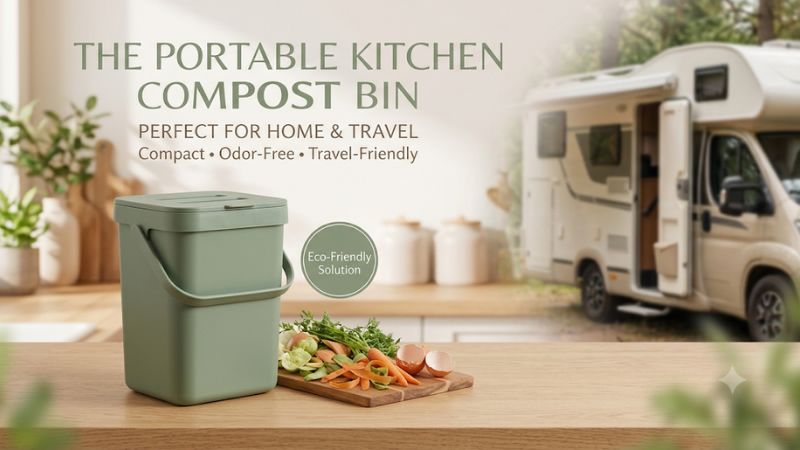
A compost bin for kitchen for travel can help you collect suitable food scraps while staying in an RV, camper, vacation rental, or temporary kitchen. The best option is compact, easy to carry, and simple to empty without spills. More importantly, it should match the waste collection rules at your destination rather than creating a container of scraps with nowhere appropriate to go.
- Quick Answer: What Type of Travel Compost Bin Is Best?
- Why Travel Compost Collection Needs a Different Approach
- How to Choose a Portable Kitchen Compost Bin
- Which Travel Compost Bin Format Makes Sense?
- Practical Setups for Different Travel Situations
- Food Scraps to Collect and Items to Keep Separate
- Travel Composting Mistakes to Avoid
- Frequently Asked Questions
- Conclusion
Quick Answer: What Type of Travel Compost Bin Is Best?
For most travel situations, a small food-scrap collector with a secure lid, manageable handle, and washable interior is more useful than a large countertop compost bucket. If you have access to a community compost drop-off or an approved collection service, a compact caddy can make food-waste separation practical. If disposal options are uncertain, planning where scraps will go is more important than buying a specialized bin.
Recommended features for travel
- Compact capacity appropriate to the trip.
- Reliable closure that resists accidental opening.
- Convenient carrying handle.
- Smooth, washable interior.
- Lightweight construction.
- Minimal components that can trap food residue.
- Suitable storage away from food and personal belongings.
- Clear separation between approved organics and ordinary trash.
A two- or three-liter collector can be sufficient for short stays when scraps are removed frequently. A four-liter container may be more convenient for a family preparing several meals in an RV.
However, capacity alone should not drive the purchase.
A larger bucket becomes inconvenient when it needs to be carried through a campground or transported in a small vehicle.
The most useful setup also considers the final disposal point, local wildlife rules, the availability of washing water, and whether the kitchen can accommodate the container safely.
Why Travel Compost Collection Needs a Different Approach
At home, a compost caddy usually stays in one place and follows an established emptying routine. During travel, the collection container may be moved repeatedly, exposed to temperature changes, and used in unfamiliar facilities. This changes the priorities. Portability, reliable closure, and knowing where the contents can be disposed of become especially important.
Typical travel situations
- RV road trips.
- Campervan cooking.
- Vacation rental stays.
- Extended-stay accommodations.
- Cabin holidays.
- Camping with approved organics collection.
- Temporary housing with compost pickup.
- Transporting food scraps to a community drop-off point.
Not all of these situations justify carrying a dedicated compost container.
If the accommodation already provides an approved food-waste bin, using that system may be simpler.
If the campsite prohibits leaving food waste outdoors because of wildlife, a portable countertop caddy must not replace the required animal-resistant storage method.
A travel compost bin is best understood as one component of a complete waste-handling plan.
How to Choose a Portable Kitchen Compost Bin
Choosing a collection container for travel involves evaluating how much waste you produce, where it will be stored, how you will move it, and whether the destination provides a suitable collection service. A compact container that fits a vehicle perfectly may still be inconvenient if it leaks or is difficult to clean without a full kitchen. The criteria below explain how to make a practical purchasing decision.
Start With Your Travel Destination and Disposal Plan
Before selecting any container, confirm whether the destination has an approved system for organic waste. Some vacation rentals provide separate food-scrap bins, while others have only general trash collection. Certain campgrounds offer centralized organics collection, but acceptance rules vary. A portable bin is useful only when the collected material can be transferred to an appropriate destination.
Questions to ask before traveling
- Does the property provide food-scrap collection?
- Is there a local compost drop-off?
- Does the campground have an organics station?
- Which food scraps are accepted?
- Are compostable liners permitted?
- Is waste separation mandatory?
- Are there wildlife-related food-storage restrictions?
- How often can scraps be emptied?
For example, an RV traveler visiting several parks may encounter different disposal rules at each stop.
A container filled with vegetable peels in one location may not have an approved organics destination in the next.
If no appropriate collection option exists, follow local waste rules rather than leaving scraps in the environment.
Do not bury food waste at a campsite or assume it can be added to someone else’s compost pile without permission.
Buying recommendation: Verify the disposal route first, then choose a container that supports it.
Choose Capacity Around Cooking Frequency
Travel kitchens often generate different amounts of food waste from home kitchens. A couple making simple breakfasts in a campervan may collect only coffee grounds and occasional fruit peels, while a family preparing full meals in an RV may produce several times as much. The container should accommodate the ordinary scrap load without becoming awkward or encouraging long storage periods.
Capacity planning
- 1–2 liters: Small amounts of scraps, frequent disposal.
- 2–3 liters: Short stays and simple daily meals.
- Around 4 liters: More substantial cooking for a small group.
- 5 liters or more: Higher-volume preparation with reliable disposal access.
These ranges are practical guidelines rather than strict rules.
Consider the dimensions and weight of the filled container as well as its volume.
Wet food scraps can be surprisingly heavy, especially when several meals produce coffee grounds, fruit pulp, and vegetable trimmings.
A large bucket may be inconvenient to carry from a campsite kitchen to a distant waste station.
Buying recommendation: Choose the smallest capacity that comfortably handles normal use between planned emptying points.
Prioritize a Secure Lid for Transport
A compost caddy that works well on a stationary countertop may be unsuitable for movement inside a vehicle. Some kitchen bins have loose lids designed for convenient opening rather than secure transportation. These can release scraps if tipped during driving or while being carried through a narrow campsite path.
Closure features to evaluate
- Positive latch or secure closing mechanism.
- Lid that remains attached during transport.
- Stable container shape.
- Handle that can be used while the lid is closed.
- Resistance to accidental opening.
- Simple cleaning around the lid.
- Manufacturer instructions for portable use.
Do not assume that a product described as odor resistant is leakproof.
An odor filter and a liquid-tight seal serve different purposes.
Similarly, a stay-open lid can be convenient during preparation but may be inappropriate if the container must be placed in a moving vehicle.
When transporting food scraps, use a secure secondary containment arrangement if necessary and permitted.
Keep the container upright and separate from luggage, food, and other personal items.
Buying recommendation: Choose a travel-capable closure rather than relying on ordinary countertop-lid convenience.
Select Lightweight and Easy-to-Clean Materials
Portable kitchen storage should be easy to handle when empty and practical to wash after use. Plastic food-waste caddies are often lighter than metal buckets, while stainless steel containers can provide a rigid traditional design. Neither material is universally superior because weight, lid construction, cleaning requirements, and intended use all vary by model.
Material comparison
| Material | Advantage | Consideration |
|---|---|---|
| Plastic | Usually lightweight | Check durability and cleaning instructions |
| Stainless steel | Rigid construction | May be heavier and show water marks |
| Plant-based composite | Alternative material choice | Care and disposal requirements vary |
| Flexible silicone | Useful in compact designs | Not all products are suitable for wet scraps |
| Removable inner bucket | Easier to empty | Adds another component to wash |
The best interior has few difficult-to-reach corners.
Food pulp and coffee grounds can collect around seams, handles, and filter housings.
A smooth bucket is usually easier to rinse in a small accommodation sink.
However, washing facilities may be limited at certain campsites.
Consider whether the product can be wiped, rinsed, and thoroughly dried using the facilities available.
Buying recommendation: Favor a lightweight, washable container with minimal cleaning complexity.
Plan for Odors During Warm Weather
Travel often involves warm vehicles, outdoor cooking, and irregular disposal schedules. Food scraps can deteriorate quickly in heat, making odor management important. A charcoal filter may reduce some odors, but it cannot prevent decomposition, and a sealed bucket can still develop unpleasant smells if scraps remain inside for too long.
Odor-management priorities
- Empty scraps frequently.
- Keep the container out of direct sunlight.
- Avoid placing it beside hot appliances.
- Drain excess liquid from acceptable scraps when appropriate.
- Clean the interior after emptying.
- Replace odor filters according to instructions.
- Use a cooler or freezer only when the container and storage arrangement are appropriate.
- Follow wildlife and campsite storage rules.
Some travelers prefer freezing appropriate scraps before disposal when freezer space is available.
This can help manage temporary collection, but it requires a container and appliance arrangement suitable for that use.
Do not put a leaking waste bucket beside uncovered food.
Also remember that ventilation can improve airflow but does not guarantee protection against insects.
Buying recommendation: Prioritize frequent emptying and suitable storage conditions before paying extra for odor-control accessories.
Consider Handles and Carrying Convenience
Carrying food scraps is a different task from moving a container a few inches across a counter. A good travel caddy should be comfortable to lift, stable during walking, and manageable when the user has limited mobility or must carry other supplies. Handles and container geometry therefore matter alongside capacity.
Useful carrying features
- Comfortable integrated handle.
- Stable center of gravity.
- Lid that does not interfere with the grip.
- Reasonable filled weight.
- Smooth surfaces without sharp edges.
- Easy-to-identify orientation.
- Compact shape that fits the intended storage area.
A tall narrow bucket may look space efficient but become unstable when loaded unevenly.
A low wide container may be more stable but occupy too much floor space in a campervan.
Test how the bucket would fit in a vehicle storage compartment or vacation rental kitchen.
If the container will be carried outdoors regularly, make sure the handle is intended to support the loaded weight.
Buying recommendation: Evaluate the full carrying process, not just the appearance of the empty bin.
Check Local Compost Rules Before Choosing Liners
Compostable bags can simplify cleaning, but the term compostable does not guarantee acceptance by a municipal organics program. Some facilities accept certified compostable liners, while others reject all plastic-like bags because they create contamination concerns. Backyard composting systems also may not process commercial compostable plastics effectively.
Liner questions
- Does the destination accept compostable bags?
- Are specific certifications required?
- Are paper liners permitted?
- Can the caddy be used without a liner?
- Does the chosen liner fit the container?
- Is the material suitable for wet scraps?
- Are replacement liners readily available?
A removable bare bucket may be the easiest option when acceptance rules are unclear.
Rinse it after emptying and allow it to dry.
If using paper, recognize that very wet scraps can weaken the liner and create leaks.
Avoid assuming that a generic shopping bag belongs in compost collection.
Buying recommendation: Choose a liner system based on local rules rather than marketing claims.
Which Travel Compost Bin Format Makes Sense?
Portable collection needs vary between camping, RV travel, and temporary residential stays. A compact kitchen caddy may be convenient at a vacation rental, while a more secure sealed container can be preferable when scraps must be carried to a distant disposal point. The following table compares common formats without implying that every product in a category is appropriate for transportation.
| Travel Situation | Useful Container Format | Benefit | Main Limitation |
|---|---|---|---|
| Weekend rental | Small countertop caddy | Simple food-scrap separation | Depends on available collection |
| RV with regular stops | Compact handled bucket | Easy carrying | Must be secured while driving |
| Campervan | Small lidded container | Saves space | Limited capacity |
| Campground kitchen | Approved portable collector | Convenient prep station | Wildlife rules may restrict use |
| Extended stay | Medium kitchen caddy | Supports more frequent cooking | Requires consistent emptying |
| Community drop-off trips | Secure transport container | Moves scraps to collection point | Closure and leak control critical |
The best format is the one that matches your destination and movement requirements.
Do not buy a decorative countertop composter solely because it has a filter if your main need is carrying scraps in a vehicle.
Practical Setups for Different Travel Situations
A portable compost routine should be adapted to the accommodation rather than copied from a permanent home kitchen. A vacation rental with curbside collection offers different options from an RV campground or a remote cabin. The examples below show how to organize scraps without creating an unnecessary burden during travel.
Weekend Vacation Rental With a Small Kitchen
A short rental stay may involve preparing breakfast, simple lunches, and a few dinners. A compact handled caddy can collect fruit peels and vegetable trimmings if the rental provides an approved organics service. The most important step is confirming that the property actually separates food scraps and provides instructions for doing so.
Suggested setup
- Confirm the collection rules with the host or property instructions.
- Use the provided caddy when available.
- Choose a small washable container if bringing your own.
- Keep the bucket near food preparation while cooking.
- Empty the contents before departure.
- Clean and dry the container.
- Avoid leaving wet scraps behind for the next guest.
If the rental has no approved compost option, follow its waste instructions.
Do not leave a full organic-waste container in the accommodation simply because the scraps could theoretically be composted elsewhere.
RV Road Trip With Regular Disposal Stops
An RV kitchen may have enough room for a small compost bucket but limited secure storage during driving. The container should remain upright and should not be allowed to move freely inside the vehicle. Where suitable organics collection is available, a compact handled container can help separate scraps from general waste between stops.
Suggested setup
- Choose a compact container with a secure lid.
- Identify a stable storage location.
- Keep the bucket away from pantry food.
- Avoid placing it beside a heater.
- Empty scraps at approved collection points.
- Clean the container regularly.
- Secure it before driving.
A magnetic docking system may be convenient when compatible equipment is installed, but it should not be assumed to meet transportation safety requirements.
The moving vehicle creates conditions that differ from ordinary countertop use.
Camping With Wildlife Restrictions
Food scraps can attract wildlife, including animals that may be dangerous or become habituated to human food. A campsite may require food waste to be stored in designated animal-resistant containers or removed from the camping area. A simple lidded kitchen caddy is not automatically wildlife resistant, even if it has a tight-fitting lid or odor filter.
Suggested setup
- Read campsite food-storage rules.
- Use required animal-resistant storage systems.
- Never leave food scraps unattended outdoors.
- Keep the preparation area clean.
- Avoid pouring food waste onto the ground.
- Use authorized waste disposal facilities.
- Do not leave a bucket accessible overnight if prohibited.
A countertop compost bucket is only a temporary collection aid in this environment.
It does not replace required campsite waste management.
Food Scraps to Collect and Items to Keep Separate
Travel composting should remain consistent with the final facility’s acceptance rules. Fruit and vegetable scraps and coffee grounds are commonly accepted by many compost systems, while meat, dairy, packaging, and certified compostable products may have different requirements. The local destination determines what belongs in the container, not the label printed on the bucket.
Commonly collected organic materials
- Fruit peels.
- Vegetable trimmings.
- Coffee grounds.
- Accepted paper coffee filters.
- Plant-based food preparation scraps.
- Approved eggshells.
Check before including
- Meat and fish scraps.
- Dairy products.
- Cooking grease.
- Compostable cutlery.
- Compostable plastic liners.
- Coated food packaging.
- Paper cups with plastic linings.
- Pet waste.
For a traditional backyard compost pile, meat, dairy, and greasy foods are generally unsuitable.
Commercial organics facilities may have different acceptance rules.
Keep plastics and produce stickers out unless the receiving program specifically permits them.
Travel Composting Mistakes to Avoid
Travel makes simple household chores more complicated because storage, transportation, and disposal conditions change. A container that appears suitable at home may be awkward inside a moving vehicle, and a composting plan may fail if no approved destination exists. Avoiding these mistakes can prevent spills, odors, wildlife problems, and unnecessary purchases.
Common mistakes
- Buying a container before checking the destination’s compost options.
- Assuming a loose lid is secure during transport.
- Allowing scraps to remain in a hot vehicle.
- Using a caddy as wildlife-resistant storage.
- Leaving waste at an unauthorized location.
- Treating compostable bags as universally accepted.
- Mixing cleaning chemicals or trash into food scraps.
- Carrying a much larger bucket than needed.
- Neglecting cleaning after emptying.
- Assuming an odor filter eliminates the need for disposal.
- Using a container with difficult-to-clean seams.
- Packing a food-waste bucket beside personal food supplies.
A good routine keeps the collection period short and the disposal plan clear.
If the trip involves uncertain facilities, a simpler waste system may be safer and easier than transporting decomposing scraps between locations.
Frequently Asked Questions
Travel composting raises questions about transportation, campsite rules, liners, and whether a regular kitchen caddy is suitable outside the home. The answers below explain the differences between temporary food-scrap collection and approved waste disposal, while emphasizing the practical limitations that matter in RVs, rental kitchens, and campgrounds.
Can I Take a Kitchen Compost Bin on an RV Trip?
Yes, a suitable food-scrap container can be useful in an RV when it is securely stored, easy to clean, and emptied through an approved disposal system. However, ordinary countertop compost bins may have lids that are not designed for vehicle movement. Check the container’s closure and carrying arrangement before traveling.
Keep the bucket upright and separate from food.
Secure it during driving and avoid exposing scraps to excessive heat.
Is a Compost Bin Useful for Camping?
A small collection caddy can help separate food scraps during campground cooking, but its usefulness depends on available disposal facilities and local wildlife rules. A normal kitchen caddy is not an animal-resistant container and should never replace required campsite food-storage equipment.
Follow the campground’s instructions.
If no authorized compost collection exists, use the designated waste disposal system instead.
Can I Bring a Compost Bucket Through an Airport?
An empty, clean container may be transportable depending on airline baggage policies, airport security requirements, and its dimensions. Transporting decomposing food scraps is a different matter and may raise sanitation, agricultural, and customs restrictions. Rules vary by route and jurisdiction.
For ordinary flights, it is generally simpler to use approved waste systems before departure rather than transport collected food scraps.
Check the relevant airline and border rules for the exact journey.
What Size Compost Bin Is Best for a Campervan?
A small two- to four-liter container is often a practical planning range for a campervan because space is limited and disposal should occur frequently. However, the right size depends on the number of travelers, cooking frequency, and availability of approved collection points.
Measure the intended storage compartment.
Choose a container that remains stable when secured and is comfortable to empty and clean.
Do Compostable Bags Work in Travel Compost Bins?
They can be useful when the receiving compost program accepts them, but acceptance is not universal. Some programs reject compostable plastic products, even when they are certified for industrial composting. A liner may also fail to prevent leaks if it is overloaded with wet food waste.
Check the disposal rules at the destination.
When uncertain, use a washable unlined bucket and empty the contents directly into the approved collection system.
Conclusion
A compost bin for kitchen for travel use should be compact, easy to clean, secure during movement, and matched to an approved disposal route. Small handled caddies are practical for vacation rentals and RVs with reliable organics collection, while campgrounds require additional attention to wildlife rules and food-waste storage. Choose capacity around your cooking habits rather than maximum volume, and do not assume a charcoal filter or loose countertop lid makes a container safe for transportation. A clear disposal plan is more important than any single product feature.






Write Your Review
No reviews yet. Be the first to share your experience!