
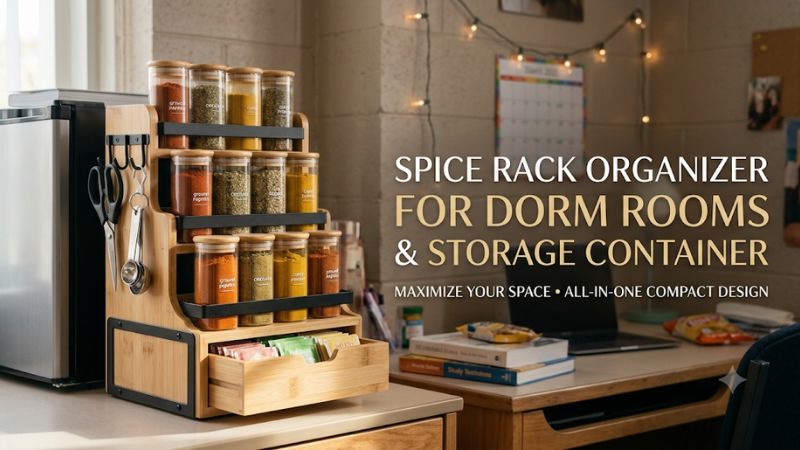
A spice rack organizer for dorm rooms should fit limited storage, move easily, and work within residence hall rules. The right setup keeps a few useful seasonings close at hand without crowding a desk, damaging a wall, or exposing spices to heat and moisture. Start by choosing a safe location, then match the organizer to your actual containers.
- Quick Answer: What Works Best in a Dorm Room?
- Understand the Space and Residence Hall Rules First
- Compare the Most Practical Organizer Styles
- Build a Useful Kit Without Buying Too Many Containers
- Set Up the Organizer in One Careful Session
- Costs, Durability, and Moving-Day Considerations
- Frequently Asked Questions
- Conclusion
Quick Answer: What Works Best in a Dorm Room?
The best dorm spice setup is usually a small removable caddy, an upright bin inside a permitted storage cabinet, or a magnetic holder on a suitable metal surface. These choices are inexpensive to rearrange and easy to carry during room changes. A permanent wall rack is rarely the first choice because rental restrictions, limited preparation areas, and shared spaces make flexibility more valuable than a large display.
- For four to eight seasonings: Use a compact handled caddy or small divided bin.
- For mixed packet and bottle sizes: Choose a standing basket with internal dividers.
- For verified magnetic surfaces: Consider a few magnetic tins or a lightweight magnetic shelf that is rated for its load.
- For a shared kitchenette: Keep spices in a labeled portable container rather than leaving them unattended.
- For prohibited cooking equipment: Store seasonings for approved food preparation only; organization does not override residence policies.
A dorm-room organizer should reduce daily friction, not make a tiny room look like a full-size kitchen. Before paying for a rack, check whether you actually need twelve identical bottles. A collection of paprika, cinnamon, black pepper, garlic powder, chili flakes, and one favorite blend may cover your meals more effectively than a twenty-four-slot system. Buy capacity for your present habits and leave a little room to grow.
Understand the Space and Residence Hall Rules First
Dorm rooms vary considerably in their available outlets, counters, sinks, appliances, furniture, and shared kitchen arrangements. A storage solution that fits neatly beside a mini refrigerator in one building may block ventilation or conflict with the rules in another. Your first decision is therefore not which rack looks best, but which locations are permitted, stable, dry, accessible, and practical to clean.
Check Whether the Organizer Can Be Placed Where You Plan
Residence hall policies may restrict wall adhesives, screws, hot plates, extension cords, cooking, and items attached to university furniture. Some buildings permit only a microwave or an approved shared kitchen; others have more flexibility. Because the policy is specific to your school and room assignment, read it before choosing a mounting system or installing any storage accessory.
- Look for rules covering adhesives, hooks, screws, removable fixtures, and refrigerator attachments.
- Keep ventilation openings around appliances unobstructed according to their manuals.
- Avoid blocking doors, exits, electrical panels, and access to outlets.
- Confirm whether a shared kitchenette offers a shelf or locker for individually owned food.
- Choose a freestanding organizer if the rules are uncertain or change between semesters.
An organizer that avoids mounting hardware is generally easier to return to its original condition. Even removable adhesive can damage paint or veneer, particularly when a loaded holder is pulled sideways. If your residence hall allows adhesive mounting, verify the surface and weight limitations independently rather than assuming the package claim applies to textured walls. Avoid placing spice storage directly on top of warm appliances, because persistent heat can reduce aroma and flavor.
Measure the Actual Storage Space, Not the Furniture Exterior
Measure usable width, depth, and height inside the drawer, cubby, or shelf where the rack will live. Door hinges, internal supports, outlet strips, and the arc of a refrigerator door may reduce clearance. Measurements taken from the outside of a cabinet or mini-fridge enclosure often exaggerate the space available for a container that must be removed during daily use.
- Width: Leave clearance for fingers and handles on both sides.
- Depth: Make sure a bin can slide out without striking the opposite furniture.
- Height: Measure with bottle caps and an easy-grip allowance included.
- Access: Confirm the drawer or door still opens fully with the organizer inside.
- Portability: Test whether the loaded item can be carried in one hand without tipping.
Try a cardboard outline before ordering a fixed rack. Place your actual spice bottles on the outline, leaving the labels visible, and test a mock retrieval during normal meal preparation. The most important dimension is often not total capacity but how comfortably you can lift a bottle without moving several others. If most of the collection is in packets, reserve a second compartment rather than forcing flexible packets into round-bottle slots.
Choose a Location That Protects Spice Quality
Dried herbs and spices lose aroma more quickly when exposed to heat, moisture, air, and intense light. That matters especially in dorms, where an organizer may be placed by a sunny window, on a mini fridge, or near a kettle. The most visually impressive position is not necessarily the best for keeping seasonings flavorful throughout the semester.
- Prefer a cool, dry shelf or interior cabinet away from steam.
- Keep jars tightly closed after each use.
- Do not shake a spice jar directly over a steaming pot; measure into a spoon or dry dish instead.
- Avoid sunlight on clear jars, particularly for rarely used seasonings.
- Keep the spice kit separate from cleaning agents and personal-care chemicals.
A refrigerator side can provide useful magnetic real estate, but a sunlit or unusually warm location is a poor place for long-term storage. Test the actual surface with a small household magnet before buying. Stainless-looking panels are not always magnetic, and magnetic strength can vary from one part of an appliance to another. If the surface is unsuitable, use a freestanding caddy instead of improvising a heavy attachment.
Compare the Most Practical Organizer Styles
A dorm-friendly rack is better judged by its fit, stability, portability, cleaning effort, and ability to accommodate mismatched containers than by appearance alone. Each format solves a different problem: caddies make shared-kitchen trips easier, drawers hide clutter, magnetic solutions reclaim a suitable vertical surface, and compact stepped racks provide fast visibility when a small shelf is available.
Portable Caddies and Handled Storage Baskets
A portable caddy makes sense when the room is for storage but cooking happens in a communal kitchenette. You can load a small set of seasonings, a measuring spoon, and a few packets into one container, carry it to the kitchen, and bring everything back afterward. Look for a washable surface, a stable flat base, and a handle that will not interfere with bottle height.
Best for: Residents who cook outside their rooms or move frequently.
- Advantages: Easy transport, no installation, flexible bottle shapes, straightforward cleaning.
- Limitations: Bottles can shift unless compartments or dividers are provided.
- Buy if: You use shared facilities and need one grab-and-go kit.
- Skip if: Your seasonings must remain in a slim drawer with no room for a handle.
An open caddy also solves the problem of duplicate ingredients scattered between a room, lounge, and kitchenette. However, do not choose a deep box simply because it holds more. When short jars disappear beneath taller bottles, you lose the visibility that makes an organizer useful. A shallow container with a few dividers often performs better than a large, feature-heavy carryall.
Narrow Freestanding Shelf and Two-Tier Mini Racks
A slim freestanding rack can use the back of a permitted desk shelf or storage cubby without drilling holes. A stepped arrangement makes back-row labels easier to see, while a simple one-level tray is easier to lift out and clean. The choice depends on how much vertical clearance you have and whether the shelf is sturdy enough for the combined weight of the organizer and glass bottles.
Best for: A dedicated storage shelf with enough headroom.
- Advantages: Clear visibility, no special jars required, simple access.
- Limitations: Tiered designs may create wasted space behind or below rows.
- Buy if: You can identify each spice without moving other jars.
- Skip if: Your shelf is very shallow, subject to vibration, or used for several purposes.
Look closely at the support surface. Thin wire steps can allow narrow bottles to wobble, while broad solid steps support a wider range of packaging. A fixed-height rack may fit bottles but not the space necessary for your fingers to remove them. For a dorm, a smaller rack that permits fast access is usually more helpful than a tall display that maximizes theoretical capacity.
Magnetic Tins and Fridge-Side Spice Storage
Magnetic spice containers can free an interior shelf by moving a small assortment onto an appropriate metal panel. Some sets use magnets attached to metal tins; others use glass jars with magnetic lids or bases. These differences affect how the jar is removed, how heavy it is, and whether the attachment is appropriate for a frequently opened mini refrigerator.
Best for: A confirmed magnetic surface away from excessive heat and direct sunlight.
- Advantages: Uses otherwise empty vertical space; individual jars remain visible.
- Limitations: Requires suitable metal, dependable magnets, tight closures, and sufficient clearance.
- Buy if: You have tested the surface and can mount the loaded jars securely.
- Skip if: The panel is nonmagnetic, sunlit, hot, or near a path where jars may be knocked off.
For a shared residence space, adhesive-mounted metal plates and heavy magnetic arrays introduce an avoidable risk of damage. Start with a few lightweight containers and verify stability during normal refrigerator-door movement. Transparent lids are convenient for identifying contents but should not replace written labels. Similar-looking powdered seasonings are easy to confuse, especially when the collection grows over time.
Drawer Trays, Flat Bins, and Packet Organizers
When a dorm desk or allowed storage unit has an unused drawer, low-profile trays can keep spices out of view and away from sunlight. A shallow bin suits packets and small jars, while an angled spice insert suits a predictable set of similarly sized bottles. Measure the usable inside height with the drawer closed before selecting either option.
Best for: Students who prefer uncluttered surfaces and have a clean, dry drawer.
- Advantages: Hidden storage, reduced light exposure, easy categorization.
- Limitations: Jar height and drawer clearance can be restrictive.
- Buy if: The drawer allows bottles to be lifted without snagging the upper frame.
- Skip if: The drawer also stores damp items, toiletries, or loose cleaning supplies.
A drawer organizer works especially well when you choose one label position and use it consistently. Top-facing labels are effective when jars lie flat, but side-facing labels may be easier with upright bottles. Mix-and-match packaging is manageable with small bins rather than rigid circular cutouts. Rechecking the drawer clearance after adding labels and shaker caps can prevent a frustrating return.
Build a Useful Kit Without Buying Too Many Containers
The ideal dorm spice collection should reflect what you are allowed to prepare and how often you eat meals that benefit from seasoning. Students who mostly assemble sandwiches or microwave approved foods need fewer spices than residents who regularly cook in a shared kitchen. Concentrating on frequent-use ingredients keeps the organizer compact, reduces forgotten duplicates, and makes refilling easier.
Start With a Small Practical Spice Inventory
A modest starter assortment can season eggs, noodles, beans, vegetables, soups, rice, and reheated meals, although actual cooking choices depend on permitted equipment. Instead of copying a decorative matching jar collection, identify the foods you eat repeatedly and choose one seasoning for each important flavor profile. This avoids buying a full spice rack that becomes decorative clutter.
Consider a starting set such as black pepper, garlic powder, paprika, cinnamon, chili flakes, dried oregano, and one blend you genuinely like. Salt can remain in its existing practical container if the size is convenient. If a recipe calls for an occasional specialty seasoning, buy a smaller amount or share a purchase with a roommate rather than dedicating permanent storage to something you will rarely use.
- Group everyday seasonings in the most reachable positions.
- Reserve a small compartment for infrequently used spices.
- Write the purchase or refill month on a discreet label.
- Keep duplicate jars only for ingredients used quickly.
- Reassess the collection after several weeks of actual meals.
Decide Whether Decanting Into Matching Jars Is Worthwhile
Matching jars can make an irregular collection fit more neatly, but transferring spices creates work and can waste perfectly serviceable original packaging. In a dorm, you may lack a large clean counter, a funnel, or a dishwasher that is appropriate for every container component. Decant only when the storage benefit outweighs the extra cleaning, labeling, and moving effort.
- Good reason to decant: Your organizer requires a consistent bottle footprint.
- Poor reason to decant: You want uniform appearance but already have adequate space.
- Before transfer: Confirm food-contact suitability, dry every container completely, and label its contents.
- After transfer: Keep supplier or ingredient information where relevant for blends or allergies.
Avoid filling a very large jar with a seasoning used once a month. Large clear containers look tidy at first but may keep a small quantity of powder exposed to more air over time. Prefer sizes that reflect real consumption. Never assume decorative magnetic tins are leakproof during travel: pack them upright inside a sealed bag when moving between buildings or carrying them in luggage.
Choose Labels That Work During Fast Meal Preparation
Labels are useful only when they are legible from the angle at which you normally see the jars. In a shallow drawer, large top labels can be more practical than decorative side text. In a caddy, front-facing labels may help, while magnetic jars displayed on a metal surface often benefit from labels that remain visible regardless of the arrangement.
Use straightforward names such as “Smoked Paprika” rather than a cryptic abbreviation that another roommate cannot identify. For blends, preserve ingredient information for allergy awareness instead of treating a generic name as sufficient. If you refill an original jar with a different blend, remove or cover the old label fully and clean the container before reuse. In shared spaces, place your name on the outer caddy rather than writing ownership on every jar.
Set Up the Organizer in One Careful Session
Installing a dorm spice setup should be simple enough to reverse at the end of the semester. Gather your jars, a tape measure, mild cleaning supplies suitable for the storage surface, labels, and the organizer before beginning. Cleaning and testing the location first makes it easier to identify fitting problems before you have transferred spices or committed to adhesive or hardware.
A Five-Step Setup That Avoids Common Mistakes
Start by emptying the planned storage spot and checking for crumbs, dampness, dust, and nearby heat sources. Lay out the spices by how frequently you use them, then place the largest containers in positions that will not block smaller ones. This dry run is more useful than an idealized arrangement shown in a product advertisement because it accounts for your own labels, hands, and daily routines.
- Verify permission and fit. Confirm residence rules and measure the exact location.
- Clean and dry the area. Remove dust and moisture from the surface and containers.
- Test the organizer empty. Check door movement, drawer clearance, and wobble.
- Load the heaviest items low. Keep labels oriented toward the usual viewing angle.
- Simulate daily use. Retrieve three common seasonings, replace them, and test for slipping.
A good setup should remain stable without careful choreography. If removing one spice causes two others to slide or tip, reduce the load or change the layout. If a refrigerator-mounted system shifts when the door closes, it is not yet a reliable storage solution. Return to a freestanding design rather than relying on stronger slams, additional tape, or improvised attachments.
Make Shared-Kitchen Trips Fast and Hygienic
A shared kitchenette can turn a poorly organized spice collection into a recurring inconvenience. Carrying loose jars in a backpack risks leaking powder, cracked glass, and confusion about what belongs to whom. A small caddy with a secure handle and enough clearance for bottle tops provides a more dependable transport system while keeping the room itself uncluttered.
Keep a small clean measuring spoon in a separate washable compartment and avoid touching spice openings with hands used to handle raw ingredients. Never leave food containers on an unclean countertop or store them beside dish soap and cleaning chemicals. Bring the caddy back to the room after cooking, wipe off condensation, and verify that each cap is closed. This routine protects spice quality and reduces the chance of losing jars in a shared space.
Costs, Durability, and Moving-Day Considerations
Dorm storage purchases should be evaluated across more than one semester. A cheap rack that breaks during move-out, creates a wall-repair problem, or fits only one residence hall can be more expensive in practice than a simple basket. Portability and replacement ease often matter more than premium finishes, particularly when your future room layout is unknown.
Know Where to Spend and Where to Save
Spend first on food-safe containers with reliable closures and an organizer that fits the available space. Uniform decorative labels, elaborate wall systems, and a large assortment of matching jars are optional upgrades. A budget-friendly plan can begin with existing spice bottles in a divided tray; add dedicated storage only after you see what prevents you from finding or transporting ingredients.
- Worth prioritizing: Stable base, easy cleaning, clear labels, adequate closures.
- Often optional: Matching finishes, decorative wall plates, oversized capacity.
- Potential extra costs: Replacement lids, additional dividers, mounting materials, and move-out repairs.
- Long-term value: A container that also works in a future apartment kitchen.
Consider fragility as well as price. Glass offers visibility and is easy to identify as a food container, but broken jars are inconvenient during travel. Thin metal tins may be lightweight but can dent or develop lid problems if packed carelessly. Washable plastic bins protect the jars without replacing the spice containers themselves. Pick materials and a form factor based on how often you expect to carry the set.
Pack Spices Safely When Changing Rooms
Move-out is the moment when a complex setup becomes inconvenient. Racks that require extensive disassembly or special mounting hardware can be left behind, while small divided bins often pack as a single unit. Empty shelves before moving heavy furniture and protect individual glass containers from impacts by wrapping and separating them rather than leaving them loose in a moving box.
Check caps one by one, place powder containers in a secondary sealed bag, and avoid transporting spices where they may overheat. Label the outside of the storage box so it is unpacked early in the next room. Remove adhesive mounts only according to their instructions and residence rules; trying to pry them off quickly can damage the finish. If a product has no clear removal procedure, avoid mounting it in the first place.
Frequently Asked Questions
Dorm spice storage usually raises questions about refrigerator magnets, approved cooking, bottle sizes, and whether it is sensible to buy a permanent rack for a temporary space. The answers depend on the actual room layout, residence hall restrictions, and how often seasonings are used. These checks can help you reject an attractive organizer that would become inconvenient after the first week.
Can I Put Magnetic Spice Jars on a Mini Fridge?
Magnetic spice jars may work if the specific refrigerator panel is magnetic, the finish permits attachments, and the magnets securely hold the fully loaded containers. Test the actual location, not just the appearance of the metal. Avoid vents, door edges, excessive heat, and positions where jars can be knocked loose while opening the door. Do not assume a manufacturer approves added accessories without checking applicable instructions.
How Many Spices Should a College Student Keep?
Start with the seasonings you use frequently rather than an organizer’s maximum advertised capacity. For many students, a compact group of roughly four to eight ingredients covers familiar meals, while regular shared-kitchen cooks may need more. The ideal number follows your recipes, permitted appliances, and refilling habits. Add specialty spices only when you have a concrete plan to use them before their flavor fades.
Are Adhesive Spice Racks Safe for Dorm Walls?
An adhesive rack should be considered only when residence rules explicitly allow it and the manufacturer approves the surface and loaded weight. Paint, wallpaper, veneer, textured panels, and temperature variations affect adhesion and removal. A seemingly removable strip may still damage an institutional finish. Freestanding caddies and drawer bins are lower-commitment alternatives when permission, wall materials, or future room assignments remain uncertain.
Should I Store Spice Jars Above a Microwave?
Avoid placing dried spices immediately over an appliance that produces heat or releases steam into that area. Heat and humidity can accelerate loss of flavor and may encourage clumping. Also avoid blocking ventilation openings or stacking a storage unit where it might fall. A cool, dry cabinet or separate stable shelf is generally preferable, provided it does not interfere with the appliance manufacturer’s required clearances.
What Is Easier to Clean: A Rack or a Caddy?
A simple removable caddy is typically easier to empty, wipe, and carry than a fixed mounted rack with multiple rails or deep corners. However, the materials and construction matter: an open metal frame can be easy to dust, while a poorly sealed woven basket may trap powder. Choose a model whose surfaces can be cleaned according to its manufacturer instructions and whose jars can be removed without dismantling the whole system.
Conclusion
A spice rack organizer for dorm rooms should solve a real storage problem without creating new ones. Measure the available space, read residence rules, store seasonings away from heat and moisture, and begin with only the jars you routinely use. A portable caddy is the most adaptable choice for shared kitchens, while a narrow freestanding tray or carefully verified magnetic setup can work when the room permits it. Prioritize access, stability, and easy moving over maximum capacity.







Write Your Review
No reviews yet. Be the first to share your experience!