
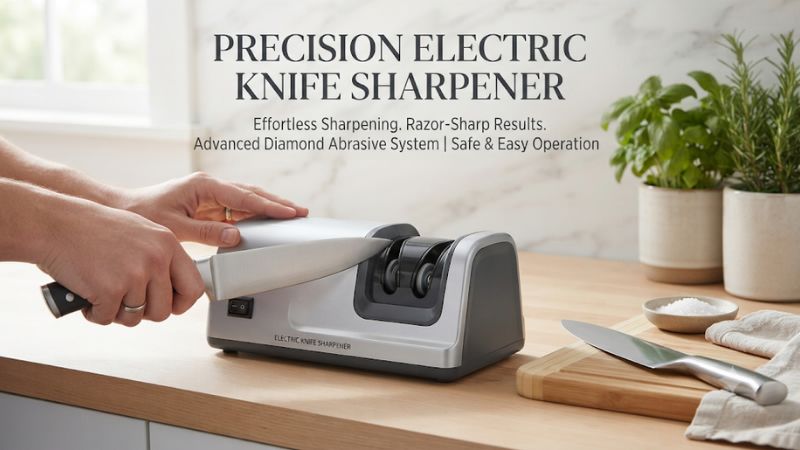
An effective electric knife sharpener simplifies blade maintenance through powered abrasives and controlled sharpening guidance. This roundup compares seven models for different kitchen needs, examining edge compatibility, sharpening stages, operating convenience, ownership costs, and long-term maintenance.
- Best Electric Knife Sharpener Models at a Glance
- How We Evaluated the Best Electric Knife Sharpeners
- Detailed Electric Knife Sharpener Reviews
- How Electric Knife Sharpeners Work
- How to Choose the Best Electric Knife Sharpener
- Electric Versus Manual Sharpening Systems
- How to Maintain an Electric Knife Sharpener
- Common Electric Knife Sharpening Mistakes
- Frequently Asked Questions
- Conclusion
Best Electric Knife Sharpener Models at a Glance
Electric sharpening appliances offer an appealing solution for households that want to maintain kitchen cutlery without developing advanced manual sharpening skills. Their powered abrasive mechanisms and guided designs can simplify routine maintenance, although the performance and suitability of each machine depend heavily on blade compatibility.
Some models focus on common fixed-angle configurations, while others provide several sharpening options or replaceable abrasive components. Choosing the correct appliance requires understanding these differences rather than assuming every powered sharpener performs the same function.
| Product | Sharpening Configuration | Best For |
|---|---|---|
| Chef’sChoice Trizor 15XV | Three-stage, 15-degree class | Frequent household use |
| Chef’sChoice AngleSelect 1520 | Dual-angle electric | Mixed knife collections |
| Chef’sChoice Model 120 | 20-degree class | Traditional Western knives |
| Presto EverSharp 08800 | Two-stage electric | Budget buyers |
| Presto Professional EverSharp 08810 | Three-stage electric | Flexible household maintenance |
| Work Sharp Kitchen Electric E2 | Compact electric | Small kitchens |
| Work Sharp Professional Kitchen Electric | Programmable electric | Premium convenience |
The best overall appliance for a particular household is the one that supports its existing knife geometry and makes appropriate maintenance convenient.
How We Evaluated the Best Electric Knife Sharpeners
Electric sharpening equipment should restore a functional cutting edge while minimizing unnecessary material removal. Although powered operation can simplify maintenance, incorrect blade compatibility or inappropriate abrasive selection may still produce undesirable results.
This comparison uses manufacturer specifications and practical application analysis. The recommendations do not represent independent laboratory measurements or firsthand product testing.
Blade Compatibility and Sharpening Angles
The original geometry of a kitchen knife strongly influences which sharpening appliance should be used. Many conventional kitchen blades have approximately 15-degree or 20-degree per-side edges, although these configurations are not universal.
We considered whether each recommended product provides appropriate guidance for compatible blades and whether buyers can choose between multiple maintenance configurations.
Important evaluation factors include:
- Supported sharpening angles.
- Manufacturer compatibility recommendations.
- Availability of alternative sharpening configurations.
- Limitations involving specialty blades.
- Potential changes to original cutting geometry.
A machine that preserves the intended geometry of your existing cutlery generally represents a more practical investment than one selected exclusively for sharpening speed.
Abrasive Construction and Stage Progression
Electric sharpening appliances use different abrasive mechanisms, including diamond-coated surfaces, abrasive wheels, and replaceable components. Their construction influences maintenance efficiency and how the blade is refined.
Multiple sharpening stages can help users distinguish substantial restoration from lighter maintenance. However, the number of stages alone does not guarantee better results.
We considered the practical usefulness of each system’s maintenance configuration and the availability of clear manufacturer instructions.
Ease of Operation
One of the main reasons buyers select electric sharpeners is convenience. A useful machine should provide an approachable operating process without creating unnecessary confusion about blade positioning or sharpening stage selection.
Our evaluation considers:
- Integrated blade guidance.
- Setup requirements.
- Operating controls.
- Suitability for beginners.
- Cleaning and maintenance procedures.
- Storage convenience.
Electric operation should simplify the maintenance experience rather than introduce unnecessary complexity for ordinary household users.
Long-Term Ownership Value
Electric appliances may require replacement abrasives, cleaning, or other maintenance over time. The availability of replacement components and manufacturer support can influence overall ownership value.
A machine that supports several compatible household knives may justify a larger initial investment. A more affordable appliance may be sufficient when the household only occasionally maintains basic kitchen cutlery.
Detailed Electric Knife Sharpener Reviews
The following models provide different approaches to powered knife maintenance. Each product should be evaluated according to blade compatibility, maintenance frequency, available storage, and the importance of additional operating features.
Chef’sChoice Trizor 15XV – Best Overall
The Chef’sChoice Trizor 15XV is designed around a guided three-stage sharpening process focused on compatible 15-degree-class kitchen knives. Its construction makes it particularly appealing to households seeking a structured maintenance appliance that reduces dependence on manual angle-control skills.
The system is appropriate for buyers who maintain several compatible knives and want a convenient way to restore and refine their cutting edges.
Key Specifications
- Sharpening method: Electric.
- Edge configuration: 15-degree class.
- Number of stages: Three.
- Abrasive construction: Diamond-based sharpening stages.
- Blade guidance: Integrated guides.
Practical Performance Considerations
The multistage arrangement allows users to follow a structured maintenance process according to the knife’s condition and manufacturer instructions.
The primary consideration is that the system’s intended edge configuration may differ from the original geometry of certain knives. Buyers should understand whether they want to preserve an existing edge or establish a compatible 15-degree-class configuration.
This appliance is particularly attractive to cooks who prioritize convenience over manual sharpening customization.
Advantages
- Convenient powered operation.
- Integrated sharpening guidance.
- Separate sharpening and finishing functions.
- Useful for regularly maintained compatible knives.
- Approachable for users without advanced sharpening skills.
Disadvantages
- Requires electrical power.
- May change original edge geometry.
- Not universally compatible with specialty blades.
- Larger storage footprint than basic manual tools.
Best For
Home cooks who frequently maintain compatible kitchen knives and prefer structured electric sharpening.
Buy If
Your knife collection supports the machine’s intended sharpening geometry and you value convenient maintenance.
Skip If
You require adjustable sharpening angles or need to preserve incompatible specialized blade profiles.
Chef’sChoice AngleSelect 1520 – Best Dual-Angle Model
The Chef’sChoice AngleSelect 1520 provides greater flexibility for households with knives manufactured using different common edge configurations. Its dual-angle design supports compatible 15-degree and 20-degree-class blades, reducing the potential need for separate sharpening appliances.
This model is particularly relevant for buyers who have assembled their kitchen knife collection gradually and own products from several different manufacturers.
Key Specifications
- Sharpening method: Electric.
- Supported configurations: 15 and 20 degrees.
- Number of stages: Three.
- Abrasive construction: Diamond-based stages.
- Blade positioning: Integrated guides.
Practical Performance Considerations
The selectable angle configurations allow users to maintain different compatible blades while preserving their intended geometry more effectively than a single-angle machine that does not support those configurations.
However, users must identify the correct sharpening arrangement before operating the appliance. The machine’s flexibility does not automatically determine the appropriate edge angle for every knife.
For mixed household collections, this additional versatility can justify the larger initial investment.
Advantages
- Supports multiple common edge angles.
- Convenient for mixed knife collections.
- Structured sharpening stages.
- Reduces the potential need for separate machines.
- Appropriate for frequently maintained compatible blades.
Disadvantages
- Requires correct configuration selection.
- More complex than basic single-angle products.
- Does not support every specialty geometry.
- Requires suitable storage and operating space.
Best For
Households maintaining compatible knives with both 15-degree and 20-degree-class edges.
Buy If
You need greater flexibility than a conventional single-angle electric sharpener provides.
Skip If
Your knife collection uses one consistent geometry and does not require multiple sharpening configurations.
Chef’sChoice Model 120 – Best for Traditional Western Knives
The Chef’sChoice Model 120 focuses on a traditional 20-degree-class sharpening configuration. Its design makes it particularly relevant to households that own compatible Western-style knives and want to preserve their intended edge characteristics.
Rather than offering several selectable angles, the Model 120 emphasizes structured maintenance within its primary sharpening configuration.
Key Specifications
- Sharpening method: Electric.
- Edge configuration: 20-degree class.
- Number of stages: Three.
- Abrasive system: Diamond-based sharpening.
- Intended application: Compatible conventional kitchen knives.
Practical Performance Considerations
The Model 120 may provide greater suitability than a 15-degree-focused machine when the household wants to maintain compatible traditional 20-degree-class edges.
Its integrated stages provide a structured approach to sharpening and finishing. Users should select the appropriate maintenance procedure according to blade condition and manufacturer guidance.
The main limitation is reduced flexibility compared with dual-angle alternatives. Households that later purchase knives with different geometry may require another maintenance solution.
Advantages
- Suitable for compatible traditional knife geometry.
- Convenient electric operation.
- Multiple sharpening stages.
- Integrated positioning guidance.
- Practical for households with consistent blade configurations.
Disadvantages
- Limited angle flexibility.
- Not appropriate for incompatible thin or specialized blades.
- Requires electrical power.
- May be unnecessary for occasional knife maintenance.
Best For
Home cooks who primarily own compatible traditional Western kitchen knives.
Buy If
Your frequently used kitchen knives have appropriate 20-degree-class geometry.
Skip If
You own several knives with different manufacturer-specified edge angles.
Presto EverSharp 08800 – Best Budget Electric Sharpener
The Presto EverSharp 08800 provides an approachable powered sharpening option for buyers seeking straightforward maintenance without investing in a premium multiconfiguration appliance. Its two-stage construction focuses on maintaining compatible kitchen knives through a relatively simple operating process.
This model can be particularly attractive to occasional home cooks who want electric convenience but do not require advanced sharpening customization.
Key Specifications
- Model: 08800.
- Sharpening method: Electric.
- Number of stages: Two.
- Abrasive mechanism: Powered sharpening wheels.
- Electrical configuration: 120-volt US model.
Practical Performance Considerations
The two-stage design provides an accessible maintenance process for compatible blades. Users who find premium sharpening appliances unnecessarily complicated may appreciate the simpler configuration.
However, buyers should carefully evaluate the types of knives supported by the machine. Basic electric sharpeners are not automatically appropriate for premium Japanese knives, genuine ceramic blades, or unusual specialty geometry.
The EverSharp is best viewed as a practical household maintenance appliance rather than a universal precision sharpening station.
Advantages
- Approachable operating design.
- Convenient electric sharpening.
- Suitable for basic compatible kitchen knives.
- Relatively simple maintenance configuration.
- Attractive for budget-conscious households.
Disadvantages
- Fewer configuration options.
- Limited advanced customization.
- Compatibility must be verified for specialized knives.
- Less flexible than premium dual-angle models.
Best For
Budget-conscious households maintaining basic compatible kitchen cutlery.
Buy If
You want a straightforward powered sharpener without paying for advanced features you rarely use.
Skip If
You own premium specialty knives requiring precise adjustable geometry.
Presto Professional EverSharp 08810 – Best Affordable Three-Stage Option
The Presto Professional EverSharp 08810 expands on the concept of approachable electric sharpening by providing a three-stage configuration. It is particularly relevant to buyers who want additional maintenance flexibility while remaining within the category of household-oriented electric appliances.
Its construction makes it attractive to families that maintain several compatible knives and prefer a structured maintenance process without purchasing a more expensive premium sharpening station.
Key Specifications
- Model: 08810.
- Sharpening method: Electric.
- Number of stages: Three.
- Blade support: Guided sharpening arrangement.
- Electrical configuration: 120-volt US model.
Practical Performance Considerations
The additional maintenance stage provides more flexibility than a basic two-stage configuration. Buyers may find this useful when different knives require different levels of restoration or refinement.
Nevertheless, the presence of three stages does not automatically guarantee suitability for every blade. Users must still evaluate manufacturer recommendations and follow the appropriate procedure for each knife.
This model is most appealing to households that want a more comprehensive maintenance process than an entry-level electric appliance provides.
Advantages
- Three-stage maintenance configuration.
- Convenient powered operation.
- Practical for multiple compatible knives.
- More maintenance flexibility than basic two-stage models.
- Appropriate for household sharpening requirements.
Disadvantages
- Requires correct stage selection.
- Larger than some compact sharpening alternatives.
- Specialty blade compatibility is not universal.
- Less customizable than advanced adjustable systems.
Best For
Families seeking a more flexible household electric sharpener without moving directly to premium equipment.
Buy If
You maintain several compatible kitchen knives and want additional abrasive-stage flexibility.
Skip If
You need extensive angle customization or maintain specialized blades requiring professional methods.
Work Sharp Kitchen Electric E2 – Best Compact Electric Sharpener
The Work Sharp Kitchen Electric E2 is designed for buyers seeking an approachable electric sharpening experience within a compact kitchen-oriented appliance. Its relatively manageable dimensions make it appealing to apartment residents and households that prefer to store sharpening equipment between uses.
Rather than emphasizing numerous advanced configurations, the E2 focuses on convenient maintenance for appropriate everyday kitchen knives.
Key Specifications
- Product designation: Kitchen Electric E2.
- Sharpening method: Electric.
- Design: Compact kitchen appliance.
- Abrasive components: Replaceable abrasive options.
- Intended application: Compatible culinary cutlery.
Practical Performance Considerations
Compact construction can improve storage convenience, particularly when the sharpener is used occasionally rather than left permanently on the countertop.
The availability of replacement abrasive components also introduces a long-term ownership advantage. Instead of automatically replacing the entire appliance when its abrasive surfaces become worn, users may be able to maintain it using compatible replacement parts.
Buyers should verify the precise sharpening configuration and supported blade types before purchasing.
Advantages
- Compact construction.
- Convenient powered operation.
- Suitable for space-conscious households.
- Replacement abrasive options.
- Kitchen-oriented operating design.
Disadvantages
- Replacement abrasives may introduce ongoing costs.
- Limited flexibility compared with advanced professional systems.
- Requires electrical power.
- Specialty blade compatibility should be checked.
Best For
Apartment residents and households seeking convenient powered maintenance with manageable storage requirements.
Buy If
You want a compact electric sharpener that supports your existing everyday kitchen knives.
Skip If
You need extensive sharpening customization or frequently maintain specialized blade profiles.
Work Sharp Professional Kitchen Electric – Best Premium Programmable Option
The Work Sharp Professional Kitchen Electric Sharpener is positioned toward buyers who prioritize convenience and a more advanced powered maintenance experience. Its programmable operation can be attractive to cooking enthusiasts who want structured sharpening without relying entirely on manual control.
This model is particularly relevant for households where kitchen knife maintenance is a regular activity and premium equipment can provide meaningful long-term value.
Key Features
- Electric kitchen sharpening system.
- Programmable operating functionality.
- Kitchen-focused construction.
- Compatible replacement and upgrade accessories.
- Designed for structured culinary knife maintenance.
Practical Performance Considerations
Programmable operation can simplify aspects of routine maintenance by providing defined sharpening procedures. This may be particularly valuable to buyers who want repeatable operation without manually managing every component of the process.
However, premium equipment still requires appropriate blade compatibility and manufacturer-guided operation. Buyers should evaluate whether the additional functionality addresses their actual maintenance requirements.
Someone who only occasionally sharpens a basic chef’s knife may find a more affordable electric appliance sufficient.
Advantages
- Premium kitchen-focused construction.
- Programmable maintenance features.
- Convenient powered operation.
- Replacement and upgrade accessory support.
- Attractive for frequent kitchen knife maintenance.
Disadvantages
- Higher initial investment.
- Additional features may be unnecessary for occasional users.
- Requires suitable storage and electrical access.
- Compatibility must still be verified.
Best For
Cooking enthusiasts seeking a premium powered sharpening experience for compatible kitchen cutlery.
Buy If
You maintain knives regularly and value programmable operation and long-term accessory support.
Skip If
You only require basic occasional sharpening and prefer a simpler, more affordable appliance.
How Electric Knife Sharpeners Work
Electric sharpening appliances use motor-driven abrasive components to perform blade maintenance. Their integrated guides help establish appropriate positioning for compatible knives, reducing some of the difficulties associated with maintaining consistent geometry manually.
Different products use different abrasive constructions and maintenance stages. Understanding these components helps buyers select equipment that addresses their actual sharpening requirements.
Coarse Abrasive Stages
Coarse abrasives are generally intended for appropriate restoration tasks involving significantly deteriorated cutting performance. They remove material more aggressively than finer maintenance surfaces.
Using a coarse stage unnecessarily can shorten the useful lifespan of a knife by removing more material than required.
Users should follow the sharpening appliance’s instructions and evaluate blade condition before selecting the most aggressive maintenance stage.
Fine Sharpening Stages
Fine abrasives can help refine the cutting edge after appropriate initial restoration. In some systems, finer stages may also provide routine maintenance when the blade does not require substantial material removal.
The appropriate stage depends on knife geometry, abrasive construction, and current edge condition.
Do not assume every sharpening session must begin with the coarsest available stage.
Finishing and Polishing Functions
Finishing stages address aspects of edge refinement according to the machine’s design. They may help produce a more refined cutting surface after appropriate sharpening.
However, not every kitchen knife benefits from an extremely polished edge. The intended cutting application and manufacturer recommendations should influence maintenance decisions.
Buyers should evaluate finishing functionality according to practical usefulness rather than assuming that more stages automatically produce superior cutting performance.
How to Choose the Best Electric Knife Sharpener
Selecting an electric sharpener requires balancing convenience, blade compatibility, abrasive configuration, and long-term maintenance requirements. A machine that supports the correct geometry can provide years of useful service, while an incompatible model may unnecessarily alter or damage existing cutlery.
Begin by evaluating the knives you already own rather than selecting an appliance solely because it has attractive features or a discounted price.
Identify Your Existing Sharpening Angles
Kitchen knives may use a variety of cutting-edge configurations. Although 15-degree and 20-degree per-side angles are common, manufacturer specifications remain the most reliable starting point for determining compatibility.
Before purchasing, identify:
- The original edge angle.
- Blade material.
- Single-bevel or double-bevel construction.
- Manufacturer maintenance instructions.
- Whether specialized sharpening methods are required.
A fixed-angle electric appliance can be appropriate when it matches the intended geometry of your knives. Mixed collections may benefit from compatible dual-angle systems.
Determine Whether Specialty Knives Are Supported
Electric sharpeners are not universally suitable for every type of kitchen cutlery. Specialty knives may require different abrasives, guidance systems, or professional maintenance.
Pay particular attention to:
- Genuine ceramic kitchen knives.
- Serrated bread knives.
- Single-bevel Japanese knives.
- Flexible fillet knives.
- Unusually thick blades.
- Premium knives with specialized geometry.
Always check the sharpening appliance manufacturer’s instructions and the knife manufacturer’s maintenance recommendations.
Evaluate the Cost of Replacement Abrasives
Some electric sharpeners use replaceable abrasive components, while others have different servicing arrangements. Replacement part availability can affect long-term ownership costs.
Before purchasing, determine whether replacement components are available and whether they can be installed or serviced according to manufacturer instructions.
A machine with accessible replacement parts may offer better long-term value when used frequently.
Consider Storage and Electrical Requirements
Electric sharpening appliances require suitable operating surfaces and appropriate electrical access. Buyers should verify product dimensions, cord arrangement, and working clearance before purchasing.
In the United States, select equipment with an electrical configuration appropriate for the household’s power supply.
Store the appliance safely when not in use and follow manufacturer instructions concerning electrical disconnection and cleaning.
Electric Versus Manual Sharpening Systems
Electric sharpening systems emphasize powered convenience, while manual systems offer different combinations of portability, flexibility, and user control. The appropriate method depends on blade compatibility and the household’s maintenance preferences.
Neither category is automatically superior across every application.
| Consideration | Electric Sharpener | Manual Sharpener |
|---|---|---|
| Operating method | Motor-driven | Hand-operated |
| Angle guidance | Often integrated | Varies |
| Maintenance speed | Often convenient | Technique-dependent |
| Electrical power | Required | Not required |
| Storage | Product-dependent | Often more compact |
| Noise | Motor operation | Generally quieter |
| Customization | Model-dependent | Potentially extensive |
| Initial investment | Often higher | Broad price range |
When Electric Sharpening Is the Better Choice
Electric equipment can provide excellent practical value when households maintain several compatible knives regularly. Its guided operation may reduce the effort required to perform appropriate sharpening and encourage more consistent maintenance.
Electric models are particularly appealing to users who prioritize convenience rather than developing traditional sharpening techniques.
However, the appliance must support the knives being maintained. Convenience should never override compatibility.
When Manual Sharpening Makes More Sense
Manual systems can be preferable for buyers who require specialized angle control, compact storage, or greater involvement in the maintenance process.
Traditional sharpening stones and adjustable guided systems may provide flexibility beyond some fixed-angle electric machines.
Occasional cooks may also find that a compact manual sharpener provides sufficient functionality without requiring an additional electrical appliance.
How to Maintain an Electric Knife Sharpener
Proper appliance maintenance helps preserve operating performance and can extend the useful lifespan of compatible sharpening equipment. Different machines have different cleaning procedures and replacement requirements, so manufacturer instructions should guide the maintenance process.
Routine care should focus on keeping the appliance clean, protecting abrasive components, and avoiding damage during storage.
Clean According to Manufacturer Instructions
Sharpening can create small particles of removed blade material and abrasive debris. Some appliances include dedicated collection areas or cleaning mechanisms.
Follow the manufacturer’s recommended procedure for removing accumulated material. Disconnect the appliance from electrical power before performing cleaning tasks when instructed.
Do not immerse motorized equipment in water or use unsuitable cleaning substances.
Inspect Replaceable Abrasive Components
Machines that use replaceable abrasives may require periodic maintenance as those components become worn. Replacement frequency depends on usage and the construction of the system.
Use only compatible replacement parts and follow the manufacturer’s installation instructions.
Avoid attempting unauthorized modifications that could interfere with blade guidance, motor operation, or electrical safety.
Store the Appliance Properly
Electric sharpeners should remain protected from excessive moisture, accidental impacts, and damage to electrical cords.
A designated cabinet or shelf can provide practical storage for occasional-use equipment.
Before storing the appliance, complete the required cleaning procedure and arrange the cord according to manufacturer instructions.
Common Electric Knife Sharpening Mistakes
Electric sharpening appliances can simplify maintenance, but they do not eliminate the need for appropriate operating practices. Incorrect use can remove unnecessary blade material or produce an edge configuration that differs from the knife’s intended geometry.
Understanding common mistakes helps users preserve both their cutlery and sharpening equipment.
Using the Coarsest Stage Every Time
Repeated aggressive sharpening may unnecessarily remove blade material. A knife that only needs light maintenance may not require the same abrasive progression as a substantially dull blade.
Choose the recommended stage according to edge condition and the appliance’s operating instructions.
Applying Excessive Pressure
Motor-driven abrasives are designed to perform sharpening through their intended operating mechanism. Applying unnecessary force may interfere with blade guidance and increase material removal.
Follow the specified operating pressure and allow the machine to perform its intended function.
Sharpening Incompatible Specialty Blades
A blade that physically fits inside a sharpening slot is not necessarily compatible with the machine.
Ceramic, serrated, single-bevel, and other specialized knives may require different maintenance equipment. Always verify suitability before use.
Ignoring the Original Knife Geometry
Using an electric sharpener with an incompatible angle can change the knife’s cutting edge. This may alter its intended performance and require additional maintenance to correct.
Identify original geometry before selecting a sharpening configuration.
Frequently Asked Questions
Electric sharpeners generate several common questions involving safety, compatibility, performance, and long-term ownership. Understanding these practical considerations helps buyers select appropriate maintenance equipment and avoid unnecessary damage to valuable kitchen knives.
Are Electric Knife Sharpeners Worth Buying?
Electric sharpeners can provide excellent value for households that frequently maintain compatible kitchen knives. Their primary advantage is convenient, guided operation rather than universal blade compatibility.
Can Electric Sharpeners Damage Expensive Kitchen Knives?
Yes. Incorrect sharpening geometry, incompatible abrasives, or inappropriate operation can damage premium blades. Always follow knife and sharpening appliance manufacturer recommendations.
Can an Electric Sharpener Maintain Ceramic Knives?
Only machines specifically designed and approved for genuine ceramic blades should be used. Conventional electric steel knife sharpeners are not automatically suitable.
Is a Three-Stage Sharpener Better Than a Two-Stage Model?
Not necessarily. Three-stage systems may provide additional maintenance flexibility, but overall suitability depends on abrasive quality, blade compatibility, and operating design.
How Frequently Should Electric Sharpeners Be Used?
Sharpening frequency depends on knife usage and actual cutting performance. Maintain blades when appropriate rather than following an unnecessarily aggressive fixed schedule.
Do Electric Knife Sharpeners Need Replacement Parts?
Some models use replaceable abrasive components, while others have different maintenance arrangements. Check the manufacturer’s servicing information before purchasing.
Conclusion
The best electric knife sharpener delivers convenient maintenance while preserving compatible blade geometry. Chef’sChoice provides versatile sharpening systems, while Presto and Work Sharp offer budget-friendly and compact alternatives. Prioritize blade compatibility, abrasive quality, and reliable operation.









Write Your Review
No reviews yet. Be the first to share your experience!