
Choosing a knife honing rod for small spaces requires balancing compact storage, suitable working length, and reliable blade maintenance. This guide explains how to evaluate steel, ceramic, and abrasive rods while organizing your kitchen efficiently and maintaining compatibility with everyday cutlery.
- Why Compact Honing Rods Are Useful in Small Kitchens
- How to Choose a Knife Honing Rod for Small Spaces
- Best Honing Rod Materials for Compact Kitchens
- Choosing Honing Rods for Different Small Kitchen Layouts
- Honing Rods Versus Compact Knife Sharpeners
- How to Store a Honing Rod in a Small Kitchen
- Frequently Asked Questions
- Conclusion
Why Compact Honing Rods Are Useful in Small Kitchens
Small kitchens frequently require careful management of drawer space, countertop clearance, and utensil storage. Maintaining kitchen knives remains important, but large sharpening equipment may be inconvenient when available working areas are limited.
A suitably sized honing rod can provide convenient maintenance without requiring a permanent countertop appliance.
However, choosing a compact rod should not mean sacrificing blade compatibility or appropriate operating clearance.
Understanding the Storage Advantages of Honing Rods
Honing rods generally have a narrow profile compared with many electric sharpening appliances. Their construction can make them particularly convenient for storage inside suitable drawers, cabinets, or compatible knife blocks.
Potential advantages include:
- Narrow storage footprint.
- No electrical power requirement.
- Straightforward retrieval.
- Minimal setup.
- Convenient routine maintenance.
The complete length of the rod, including its handle and hanging loop, should be considered before purchasing.
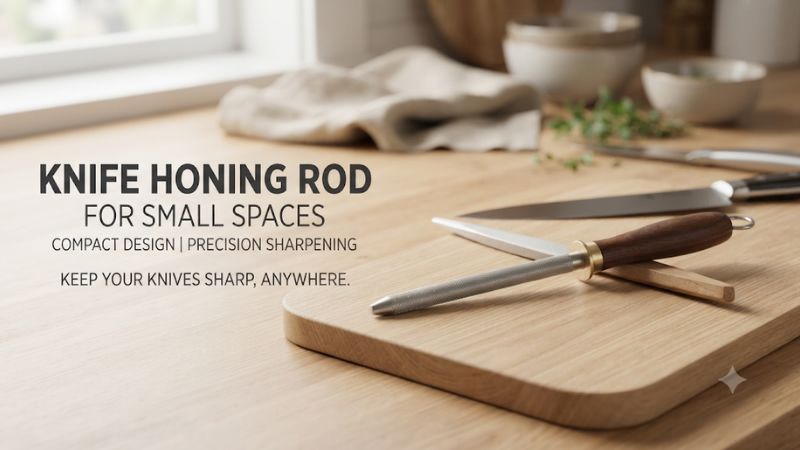
Why the Shortest Rod Is Not Always the Best Choice
An extremely short rod may appear attractive when storage is limited, but its working surface might be unsuitable for longer kitchen knives.
The correct rod length depends on the blades being maintained and the intended maintenance method.
A slightly longer product may provide better control while still fitting comfortably inside an appropriately sized drawer.
How to Choose a Knife Honing Rod for Small Spaces
The most practical product should provide sufficient working length, suitable blade compatibility, comfortable handling, and efficient storage.
Begin by identifying the knives you use most frequently rather than selecting a rod exclusively according to its advertised dimensions.
Measure the Actual Storage Area
Kitchen drawers frequently contain organizers, dividers, and other utensils that reduce their available internal dimensions.
Measure:
- Internal drawer length.
- Available width.
- Vertical clearance.
- Existing organizer compartments.
- Space occupied by other cutlery.
Remember that the advertised rod length may exclude the handle. A ten-inch maintenance surface can produce a substantially longer overall tool.
Match Rod Length to Existing Knives
A honing rod should provide an appropriate working surface for the blades it is intended to maintain.
| Rod Length | Typical Household Application |
|---|---|
| 6 inches | Compatible small utility knives |
| 8 inches | Compact household knife collections |
| 10 inches | Many everyday kitchen knives |
| 12 inches | Longer compatible culinary blades |
These categories provide general buying guidance rather than universal compatibility rules.
Check the manufacturer’s recommendations for the intended knife length and maintenance procedure.
Choose a Comfortable Handle
Compact sharpening tools sometimes reduce handle dimensions to minimize overall size. This can create an undesirable compromise when the gripping area becomes difficult to hold securely.
Look for comfortable handle geometry, reliable grip characteristics, and appropriate separation between the hand and blade movement.
A comfortable handle should take priority over saving a small amount of drawer space.
Evaluate the Rod Material
Traditional steel, ceramic, and diamond rods serve different maintenance purposes. Selecting an unsuitable material may result in unnecessary blade wear or ineffective maintenance.
Traditional steel rods can be appropriate for compatible conventional kitchen knives. Ceramic rods provide abrasive refinement, while diamond products are more clearly associated with material-removing sharpening.
Check blade compatibility before prioritizing rod size.
Best Honing Rod Materials for Compact Kitchens
The ideal rod material depends on existing knife construction and the maintenance function required. Small kitchens do not create unique abrasive compatibility requirements, but storage conditions can influence the practical advantages of different materials.
Traditional Steel Honing Rods
Steel rods provide a conventional maintenance option for compatible kitchen cutlery. Their relatively durable construction can make them practical for households that want a straightforward storage arrangement.
Advantages
- Conventional maintenance design.
- Relatively straightforward storage.
- Suitable for compatible Western-style knives.
- No electrical requirements.
Disadvantages
- Limited suitability for specialized blades.
- Does not replace substantial sharpening.
- Requires appropriate technique.
Compact Ceramic Rods
Ceramic rods provide abrasive maintenance within a narrow tool profile. They may appeal to buyers who maintain compatible harder steel kitchen knives and prefer a refining surface rather than conventional steel construction.
However, ceramic material requires careful protection from accidental impacts.
Store ceramic rods separately from heavy cookware and loose metal utensils.
Diamond-Coated Rods
Diamond rods provide abrasive sharpening capability in a relatively compact format. Their construction can be useful for buyers who specifically need controlled material removal.
They are not automatically suitable for routine daily honing.
Choose diamond construction only when its abrasive characteristics correspond to the maintenance requirements of your knives.
Choosing Honing Rods for Different Small Kitchen Layouts
Small kitchens vary considerably in their storage arrangements and working surfaces. A compact apartment, shared kitchen, and narrow galley kitchen may each benefit from a different maintenance tool configuration.
Evaluating your household layout helps ensure the selected rod remains convenient to retrieve, operate, and store.
For Studio Apartments
Studio apartments often provide limited drawer space and relatively compact food preparation areas. A suitably sized honing rod can be more convenient to store than a larger sharpening appliance.
Prioritize an appropriate working length, comfortable handle, and protected storage.
A compact steel rod may provide sufficient maintenance functionality for compatible ordinary kitchen knives.
For Shared Apartment Kitchens
Shared kitchens introduce organizational challenges because several household members may use the same utensils and preparation areas.
A dedicated honing rod stored alongside individually owned cutlery can help maintain equipment without occupying communal countertop space.
Make sure household members understand which knives are compatible with the rod before allowing shared use.
For Narrow Galley Kitchens
Galley kitchens may offer long countertops with limited depth. Although honing rods occupy relatively little space during storage, their operation still requires sufficient clearance.
Identify a stable working surface away from nearby appliances, dishes, and other people.
Avoid performing maintenance in a crowded area simply because the rod itself is compact.
For Small Kitchens With Premium Japanese Knives
Owners of specialized Japanese cutlery should prioritize maintenance compatibility rather than selecting a traditional steel rod exclusively for its compact dimensions.
Some harder steel knives may be more appropriately maintained using a compatible ceramic rod or sharpening stone.
Specialized blade geometry may require professional maintenance.
Honing Rods Versus Compact Knife Sharpeners
Honing rods and compact sharpeners perform related but different maintenance functions. Choosing between them requires understanding the condition of your knives and the type of maintenance needed.
| Feature | Honing Rod | Compact Sharpener |
|---|---|---|
| Storage shape | Long and narrow | Shorter housing |
| Maintenance function | Depends on rod material | Generally sharpening |
| Power requirement | None | Manual or electric |
| Working clearance | Requires blade and rod space | Depends on design |
| Compatibility | Material-dependent | Angle and blade-dependent |
When a Honing Rod Is the Better Option
A honing rod can provide practical maintenance when compatible kitchen knives primarily require routine edge attention rather than substantial sharpening.
Its narrow construction may make it particularly convenient to store alongside other elongated utensils.
When a Compact Sharpener Makes More Sense
A compact sharpener may be preferable when the household frequently needs to restore dull cutting edges or wants integrated sharpening guidance.
Traditional honing rods cannot necessarily restore substantially deteriorated knife edges.
Some households benefit from owning both an appropriate honing rod and a separate compatible sharpening system.
How to Store a Honing Rod in a Small Kitchen
Appropriate storage helps protect the maintenance surface, reduce clutter, and prevent unnecessary contact with exposed knife edges.
The best storage arrangement depends on rod material, overall dimensions, and available kitchen organization.
Use a Dedicated Drawer Compartment
A narrow drawer compartment can provide a practical storage location for a honing rod. Keep the tool separated from heavy utensils that may damage its surface.
Ceramic rods require particularly careful protection from impact.
Make sure the rod is clean and appropriately dry before storage.
Consider a Compatible Knife Block
Some knife blocks incorporate dedicated openings for suitable maintenance rods.
Check the opening dimensions and depth before purchasing a rod intended for block storage.
Do not force an incompatible product into a storage opening.
Evaluate Hanging Storage
Certain steel rods include a hanging loop that may support appropriate wall-mounted storage.
This arrangement can preserve drawer space, provided the tool is securely supported and inaccessible to children.
Avoid hanging fragile ceramic rods in locations where they could be knocked onto hard surfaces.
Frequently Asked Questions
What Is the Best Honing Rod Length for Small Kitchens?
An eight- or ten-inch rod may provide a practical balance between storage efficiency and working length, depending on the knives being maintained.
Is a Six-Inch Honing Rod Too Small?
It may be suitable for certain compact knives but inconvenient for longer kitchen blades. Check compatibility before purchasing.
Are Ceramic Honing Rods Suitable for Drawer Storage?
Yes, when protected from accidental impacts and contact with heavy utensils. Ceramic rods require more careful storage than many steel alternatives.
Can a Honing Rod Replace a Knife Sharpener?
Not necessarily. Traditional honing rods maintain compatible edges, while sharpening equipment restores cutting geometry when more substantial maintenance becomes necessary.
Do Honing Rods Require Permanent Countertop Space?
No. Most rods can be stored in suitable drawers, cabinets, or compatible knife blocks between maintenance sessions.
Conclusion
A knife honing rod for small spaces should balance compact storage, suitable working length, and comfortable handling. Choose steel, ceramic, or diamond construction according to blade compatibility and maintenance needs. Measure your available storage and prioritize reliable operation over the smallest possible design.










Write Your Review
No reviews yet. Be the first to share your experience!