
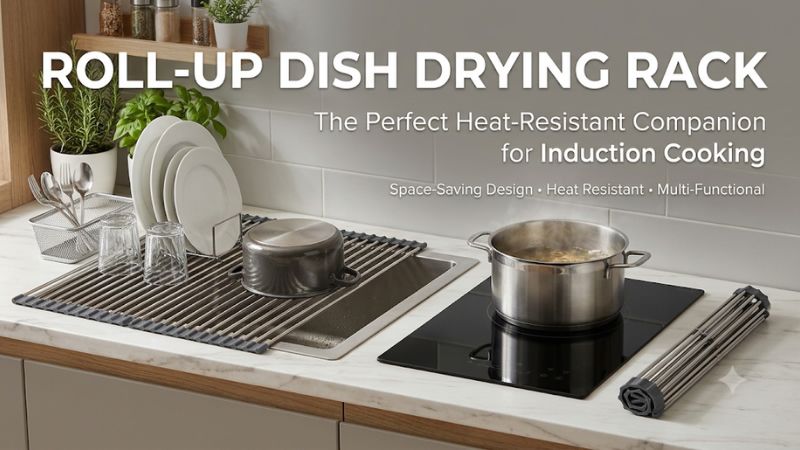
A roll up dish drying rack for induction cooking can be a useful addition to a kitchen where efficient cleanup and limited counter space are everyday concerns. Although induction cooking does not require a special type of dish rack, choosing the right over-sink design can make washing cookware, drying utensils, and keeping food preparation areas organized easier.
- Quick Answer: Does Induction Cooking Require a Special Drying Rack?
- How a Roll Up Drying Rack Fits an Induction Kitchen
- How to Choose the Right Roll Up Dish Drying Rack
- Roll Up Rack Options for Different Induction Kitchen Layouts
- Practical Kitchen Setups
- How to Clean and Store the Rack After Cooking
- Common Mistakes to Avoid
- Frequently Asked Questions
- Conclusion
Quick Answer: Does Induction Cooking Require a Special Drying Rack?
No. Induction cooking does not require a special roll-up dish drying rack because the rack is normally positioned over the sink rather than on the cooktop. The important factors are sink compatibility, materials, cleaning requirements, support capacity, and safe placement away from hot cooking zones. A suitable rack can help organize cookware cleanup without occupying valuable countertop space.
Recommended buying priorities
- Choose a rack designed for use over a sink.
- Measure the actual sink opening.
- Verify that both ends rest securely on appropriate supports.
- Check the manufacturer’s load rating.
- Select materials suitable for regular washing and drying.
- Keep the rack away from active induction cooking zones.
- Follow model-specific heat limitations.
- Choose a design that rolls away when not needed.
For many induction kitchens, a stainless steel and silicone roll-up drying rack is a reasonable general-purpose choice.
However, the materials alone do not establish compatibility with every application.
A rack designed to support dishes over a sink should not be treated as cookware, an induction cooktop accessory, or a heatproof work surface unless the manufacturer specifically approves the intended use.
The main advantage is efficient kitchen organization, not a direct effect on induction heating.
How a Roll Up Drying Rack Fits an Induction Kitchen
Induction cooktops generate heat in suitable cookware through electromagnetic induction rather than relying on an exposed gas flame. This can influence how the cooking area is organized, but it does not change the basic requirements of dish drying. A roll-up rack remains a separate sink accessory, useful for draining washed cookware and reducing clutter during meal preparation.
An induction kitchen often includes several types of equipment:
- Magnetic-base cookware suitable for induction.
- Stainless steel or other compatible saucepans.
- Nonstick frying pans with induction-compatible bases.
- Glass cookware lids.
- Heat-resistant cooking utensils.
- Reusable food containers.
- Cutting boards and preparation accessories.
These items may create significant cleanup needs after cooking.
A roll-up rack can provide a temporary area for compatible dishes and cookware while allowing water to drain into the sink.
However, it should not be used to support heavy cookware beyond its capacity.
It must also be kept away from the induction cooktop during cooking and while the glass surface remains hot.
How to Choose the Right Roll Up Dish Drying Rack
A useful buying decision should focus on the kitchen’s physical layout and normal cleaning routine. The type of stove is relevant mainly because the drying rack should not interfere with cooking, hot cookware handling, or the work surfaces surrounding the induction cooktop. The following criteria explain how to choose a practical product without confusing dish-rack specifications with cookware compatibility.
Start With Sink Measurements, Not Cooktop Dimensions
The primary compatibility requirement is the size and shape of the sink where the rack will be used. Although induction cooktops come in different widths and configurations, their dimensions do not determine which drying rack fits. A roll-up rack must instead span the sink securely, rest on suitable supports, and remain accessible when dishes are added or removed.
Measurements to record
- Sink opening width.
- Sink front-to-back dimension.
- Usable rim or countertop support.
- Position of the faucet.
- Available space beneath the rack.
- Distance between sink and cooking area.
- Storage space for the rolled rack.
For example, a household may have a wide induction cooktop and a relatively narrow sink.
In this situation, a large drying rack chosen to match the cooktop’s width would make little sense.
The sink dimensions should determine the drying rack size.
Also consider whether the rack will obstruct the faucet or make washing large induction-compatible pans difficult.
Buying recommendation: Select the rack by supported sink dimensions and normal dishwashing requirements, not by stove width.
Understand the Difference Between Drying and Cooking Surfaces
A roll-up rack is normally designed to support dishes over a sink, where water can drain away. An induction cooktop is a separate appliance intended for heating compatible cookware. These surfaces should not be treated as interchangeable simply because both may contain metal components or appear flat when not in use.
Important distinctions
- A drying rack supports appropriate kitchen items during drainage.
- An induction cooktop heats compatible cookware.
- A roll-up rack is not a cooking vessel.
- A stated heat limit does not establish induction-cooktop compatibility.
- A rack’s load capacity applies only under supported use conditions.
- Heat resistance does not mean direct burner use is safe.
Do not position a roll-up rack across an active cooking zone.
The cooktop may retain residual heat from a hot pan even after the heating control is turned off.
Metal parts or silicone components could also be damaged when exposed to conditions beyond their intended use.
If a manufacturer describes the rack as a trivet, follow the exact limits and placement instructions.
Buying recommendation: Treat the rack as a sink accessory and use separate manufacturer-approved cooking and heat-protection equipment.
Choose Materials Suitable for Frequent Cleaning
Induction cooking does not require a particular dish-rack metal, but material still matters for hygiene, durability, and maintenance. Many roll-up racks combine stainless steel rods with silicone connectors or coatings. Other designs use coated steel. These materials can be practical around the sink, but their exact care requirements depend on the product construction.
Material comparison
| Material | Practical Benefit | Important Limitation |
|---|---|---|
| Stainless steel | Rigid rod construction | Grade and care vary by model |
| Silicone | Flexible connections and nonslip contact | Heat resistance is model-specific |
| Silicone-coated steel | Protective contact surfaces | Coatings should be inspected |
| Powder-coated steel | Structured construction | Damaged finish needs attention |
| Plastic accessories | Lightweight components | Cleaning and temperature restrictions vary |
A rack used for dishes and rinsed vegetables should be easy to clean thoroughly.
Residue can accumulate between bars and around flexible connections, especially when the product is frequently rolled and unrolled.
If food-contact uses are intended, check that the exact product is suitable for them.
Buying recommendation: Prioritize documented cleaning instructions and suitable material construction over generic claims such as completely rustproof or universally heatproof.
Consider the Weight of Induction-Compatible Cookware
Induction-compatible cookware varies widely in construction and weight. Some pans have substantial multilayer bases, while others are relatively lightweight. A large filled stockpot can place far more weight on a rack than an empty mug or bowl. The drying surface and the supporting sink structure must both be suitable for the intended load.
Weight considerations
- Empty cookware weight.
- Size of the largest saucepan.
- Number of items placed simultaneously.
- Distribution of weight across the bars.
- Manufacturer-stated rack capacity.
- Supporting sink rim strength.
- Stability during loading and unloading.
The Kraus KRM-10, for example, has a published manufacturer load rating of up to 85 pounds.
The Kohler K-28929 has a published rating of up to 100 pounds.
These figures are not interchangeable with other racks and do not guarantee safety on an unsuitable sink.
A more lightly rated product may be better reserved for cups, plates, and small cookware.
Buying recommendation: Check the rack’s supported load and use heavy cookware only when the entire installation is appropriate.
Keep the Rack Away From Hot Cooking Zones
Induction cooktops can heat compatible pans quickly, and the cookware itself can become extremely hot. The glass cooking surface may also retain heat transferred from the cookware. A drying rack placed too close to the active cooking area could be exposed to heat, splashes, or accidental contact with hot pots, even if the rack is not directly on a burner.
Safety precautions
- Keep the drying rack at its intended sink location.
- Do not cover induction cooking zones.
- Avoid contact with hot cookware unless specifically approved.
- Keep silicone components away from excessive heat.
- Do not place wet dish racks on hot glass.
- Allow cookware to cool appropriately before storage.
- Follow appliance and cookware instructions.
- Keep electrical controls and ventilation areas unobstructed.
A published temperature rating can be relevant to an approved trivet application, but it does not make the rack suitable for every induction cooking situation.
Do not interpret a high heat rating as permission to use a rack directly on an operating cooktop.
Buying recommendation: Choose a location that provides convenient dishwashing access while maintaining clear separation from hot cooking equipment.
Look for Compact Storage and Easy Removal
One of the main advantages of a roll-up rack is that it can be removed when the sink is needed for other activities. This is valuable in kitchens where the sink supports rinsing produce, washing cookware, cleaning preparation tools, and filling pots. A bulky permanent drying rack may occupy too much of the available area.
Useful storage features
- Flexible roll-up construction.
- Compact storage dimensions.
- No complicated assembly.
- Easy access to cleaning surfaces.
- Lightweight handling.
- Simple repositioning.
- No permanent cabinet modifications.
For a kitchen with one sink, a removable rack can preserve flexibility during cooking.
For example, you may use the rack to dry breakfast mugs, then remove it to wash a large induction-compatible stockpot later in the day.
A compact design also helps keep the countertop clear when meal preparation begins.
Buying recommendation: Prioritize roll-up storage when preserving sink access is one of the main reasons for purchasing the accessory.
Evaluate Drainage and Airflow
The primary function of a dish drying rack is allowing clean items to drain and dry. Open metal rods can provide spaces for water to flow into the sink, but the orientation of dishes remains important. A bowl placed with its opening facing upward may trap water even when supported by an open rack.
Drainage features to consider
- Adequate gaps between rods.
- Stable contact points.
- Open surface beneath dishes.
- Enough room for air circulation.
- Easy access to the sink basin.
- No unnecessary enclosed water pockets.
- Simple removal for cleaning.
Roll-up racks are particularly convenient for items that can rest securely on their flat surfaces.
They are less specialized for upright plate storage than traditional dish drainers.
A household with many dinner plates may still benefit from a separate structured drying rack.
Buying recommendation: Choose a flat roll-up surface when it matches your actual dish shapes and drying requirements.
Roll Up Rack Options for Different Induction Kitchen Layouts
Induction kitchens range from compact apartment setups to large family cooking areas, and their drying needs vary accordingly. A household with a small sink and two induction burners may benefit from a compact rack, while a larger workstation kitchen could use a wider multipurpose accessory. Matching the rack to the whole kitchen layout is more useful than focusing on cooktop technology alone.
| Kitchen Setup | Suitable Rack Type | Main Advantage | Important Check |
|---|---|---|---|
| Small apartment induction kitchen | Compact roll-up rack | Saves sink and counter space | Sink span |
| Family kitchen | Larger general-purpose rack | More usable drying surface | Load and support |
| Workstation sink | Compatible workstation rack | Coordinated fit | Exact sink model |
| Minimalist kitchen | Folding rack | Adjustable drying area | Published load limit |
| Heavy cookware household | Properly rated metal-and-silicone rack | Supports appropriate larger items | Structural compatibility |
The table reflects storage requirements rather than any direct effect of induction heating.
A rack that works over a standard sink is not automatically appropriate for an induction cooktop, and no special induction certification should be inferred from a product’s steel construction.
Practical Kitchen Setups
A roll-up rack can support different workflows depending on how the cooktop, sink, refrigerator, and preparation surfaces are arranged. The goal is to create a predictable location for clean dishes while keeping wet items away from cooking equipment. The following examples illustrate sensible arrangements for common induction kitchens.
Setup One: Small Apartment With a Two-Burner Induction Cooktop
A compact apartment kitchen may have a narrow sink beside a two-burner induction cooktop and very little free counter space. In this situation, a smaller roll-up rack can create temporary drying space above the sink without adding a permanent countertop fixture. The main priority is keeping the cooking zone free while maintaining enough access to the faucet.
Suggested setup
- Measure the sink before purchasing.
- Choose a compact rack with stable support.
- Position it entirely over the intended sink area.
- Keep cookware away from hot cooktop surfaces.
- Dry washed items appropriately.
- Roll the rack away when the sink is needed.
This layout is particularly useful when breakfast or lunch generates only a modest number of dishes.
A full-size traditional rack may occupy too much of the limited workspace.
Setup Two: Family Kitchen With Several Induction-Compatible Pans
A family kitchen may use multiple saucepans, skillets, and stockpots during dinner preparation. The drying arrangement should accommodate normal dishwashing without encouraging heavy cookware to be balanced unsafely. A properly rated roll-up rack can provide temporary support for suitable items when the sink and rack meet the manufacturer’s requirements.
Suggested setup
- Identify the heaviest cookware normally washed.
- Confirm rack load capacity.
- Check support at both ends.
- Avoid uneven loading.
- Keep large handles from overhanging unstable areas.
- Separate drying and active cooking activities.
- Remove the rack when washing large pots.
If cookware is too heavy or awkward for the rack, use another appropriate drying arrangement.
Convenience should never take priority over safe support.
Setup Three: Workstation Sink Beside an Induction Cooktop
A workstation sink may include ledges for a cutting board, colander, drying rack, and other accessories. This arrangement can create a flexible preparation zone near an induction cooktop, but the individual accessories must be compatible with the sink’s intended system. A generic roll-up rack may not fit the ledge spacing or allow other accessories to move correctly.
Suggested setup
- Identify the exact sink model.
- Check manufacturer-approved accessories.
- Confirm ledge compatibility.
- Keep dirty dishes separate from food preparation.
- Clean the drying rack before food-contact applications.
- Avoid covering the cooktop with sink accessories.
- Store unused accessories securely.
A coordinated workstation system may offer a more convenient workflow when every component is selected for the correct sink.
How to Clean and Store the Rack After Cooking
A roll-up drying rack is frequently exposed to rinse water, soap residue, and food particles. In kitchens where cookware is washed after frying or sautéing, grease may also reach the rack. Proper cleaning prevents buildup around rods and flexible connections and helps keep the accessory suitable for its intended uses.
Recommended maintenance routine
- Remove all dishes and cookware.
- Check the rack for visible food residue.
- Clean according to the manufacturer’s instructions.
- Pay attention to silicone connections.
- Rinse appropriately.
- Dry completely.
- Inspect for damaged rods or coatings.
- Roll gently without forcing connections.
- Store away from heat and moisture.
Do not use harsh abrasives unless approved for the selected product.
If the rack is dishwasher-safe, follow any placement instructions provided by the manufacturer.
Clean the sink rim where the rack rests, especially if the accessory is used during food preparation.
Common Mistakes to Avoid
The biggest mistake is assuming that a roll-up drying rack becomes an induction cooking accessory simply because it contains metal and can tolerate some heat. Other common mistakes involve choosing the wrong size, exceeding supported loads, or placing a wet rack near a hot cooktop. Avoiding these errors helps maintain a safe and practical kitchen workflow.
Mistakes to avoid
- Selecting rack dimensions based on cooktop width.
- Placing the rack over an active cooking zone.
- Assuming silicone components are safe at unlimited temperatures.
- Using a drying rack as induction cookware.
- Ignoring residual heat on the cooktop.
- Exceeding rack load restrictions.
- Using unsupported sink edges.
- Storing wet cookware on a rack indefinitely.
- Allowing grease to accumulate around the rods.
- Confusing trivet ratings with cooktop compatibility.
- Buying a workstation accessory without checking the sink model.
A roll-up rack should be treated as a useful sink organization tool with specific supported applications.
Keeping those applications clear prevents unnecessary safety risks.
Frequently Asked Questions
Induction cooking can create confusion when shoppers see terms such as stainless steel, magnetic metal, heat resistant, and multipurpose in drying rack descriptions. These characteristics refer to different properties and should not be treated as equivalent. The answers below clarify what matters for safe use, sink compatibility, and selecting a practical drying accessory.
Can You Use a Roll Up Dish Drying Rack With an Induction Cooktop?
You can use a roll-up dish drying rack in a kitchen that has an induction cooktop, provided the rack is used in its intended location and according to its manufacturer’s instructions. The rack normally belongs over the sink, not on the cooking surface.
Induction cooking does not require a specialized dish rack.
Do not place a drying rack across an active burner or use it as a substitute for cookware.
Will a Stainless Steel Drying Rack Work on an Induction Stove?
A stainless steel drying rack is not designed to function as induction cookware. The fact that it contains metal does not establish suitability for heating on an induction appliance. Cookware compatibility depends on the construction of the vessel and the cooktop manufacturer’s requirements.
Do not attempt to heat or use a drying rack on an induction cooking zone.
Keep the accessory at the sink or in another approved storage location.
Can I Place Hot Induction Cookware on a Roll Up Rack?
Only when the specific rack is approved for the intended heat exposure and loading conditions. Some manufacturers publish heat-resistance and trivet-use specifications, while others do not. Even with a published rating, the supporting surface and load must be appropriate.
A hot pan can transfer substantial heat to nearby materials.
Follow the rack and cookware manufacturers’ instructions rather than relying on generic claims of heat resistance.
Is Silicone Safe Near an Induction Cooktop?
Silicone components have product-specific temperature limitations, and the material’s presence does not guarantee safety in every high-temperature situation. A roll-up drying rack should be kept away from hot cooking zones unless the manufacturer approves the exact application.
Avoid placing silicone parts against hot cookware beyond their stated limits.
The safest approach is to maintain separate cooking and drying areas.
What Size Roll Up Rack Should I Buy?
Choose the size that spans your sink securely with appropriate support at both ends. Measure the actual opening and compare it with the manufacturer’s dimensions. Also consider faucet clearance and whether the rack will obstruct washing large pots.
A rack that is too short or poorly supported should not be used.
The dimensions of the induction cooktop do not determine rack size.
Conclusion
A roll up dish drying rack for induction cooking kitchens should be selected according to sink dimensions, intended dish loads, material construction, and ease of cleaning. Induction appliances do not require specialized drying racks, and a product described as heat resistant should not automatically be used on a cooktop. A well-fitted stainless steel and silicone rack can provide temporary drainage space for dishes and compatible cookware while keeping the countertop clear. Choose a model with documented specifications, respect load limits, and maintain safe separation between the sink and hot cooking surfaces.










Write Your Review
No reviews yet. Be the first to share your experience!