
Choosing a pancake pan for limited counter space requires balancing cooking area, storage dimensions, and everyday versatility. A compact skillet or low-sided griddle can prepare excellent breakfasts without occupying an entire countertop. This guide explains which pan sizes, materials, handle designs, and cooking techniques work best in smaller kitchens.
- Quick answer: What pancake pan works best in a small kitchen?
- Choosing the right pancake pan size
- Best pancake pan materials for compact kitchens
- Features that save space without sacrificing cooking quality
- Pancake pan versus electric griddle in a small kitchen
- How to cook pancakes efficiently in a small kitchen
- Common mistakes when buying compact pancake cookware
- Frequently Asked Questions
- Conclusion
Quick answer: What pancake pan works best in a small kitchen?
For most small kitchens, an 8- to 10-inch nonstick frying pan or compact round griddle offers a useful balance between pancake cooking and everyday versatility. The ideal choice depends on burner size, storage depth, and the number of servings you usually prepare. A specialized electric griddle may cook more pancakes simultaneously but requires additional countertop or cabinet space.
A dedicated pancake pan does not have to remain on the countertop between uses. In fact, cookware that fits in a shallow drawer or stacks safely with existing pans may be more practical than a countertop appliance.
Before purchasing, measure the space available on your stovetop and inside your cabinets. Consider the full pan dimensions, including the handle, rather than focusing only on the advertised diameter.
For one person, an 8-inch skillet often provides adequate cooking space. A household of two may appreciate a 10-inch pan, while families can prepare pancakes in batches rather than purchasing an oversized griddle that rarely fits comfortably in the kitchen.
Choosing the right pancake pan size
Pan size influences how easily you can cook pancakes, move the cookware, and store it after breakfast. A larger surface provides room for additional pancakes, but it also requires more burner coverage and washing space. Smaller pans are easier to handle, although preparing several servings may take longer.
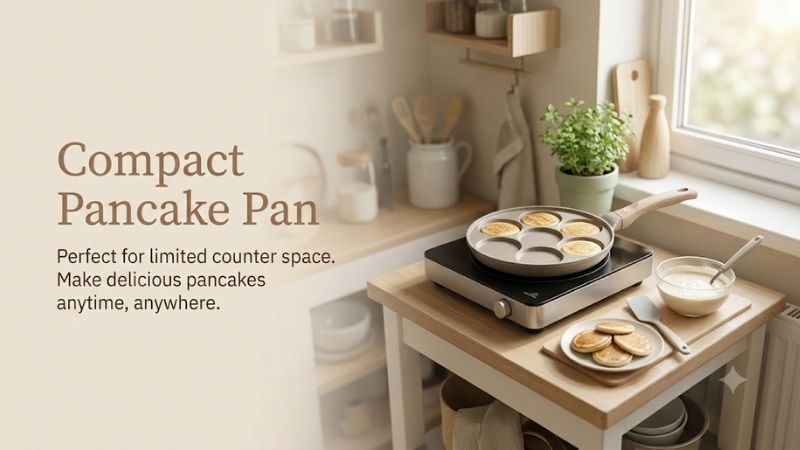
Eight-inch pans for one-person breakfasts
An 8-inch frying pan can be a practical choice when preparing one large pancake or a small number of mini pancakes at a time. Its compact cooking area, manageable weight, and relatively small storage footprint make it attractive for studio apartments, dorm-style kitchens, and households with limited cabinet space.
The GreenPan Lima 8-Inch Frypan illustrates this format. It uses hard-anodized aluminum with a ceramic nonstick coating and weighs approximately 1.17 pounds according to the manufacturer’s published specifications.
That relatively low weight can make the pan convenient to lift, wash, and reposition.
However, an 8-inch nominal diameter does not mean the entire surface is flat and usable. Sloped sidewalls reduce the effective cooking area, so buyers should check interior dimensions when available.
For breakfast sandwiches, single servings, and occasional pancakes, this compact size can be sufficient.
The main disadvantage is cooking capacity. Large family breakfasts may require numerous batches, making a slightly larger pan more convenient.
Ten-inch pans for versatility and storage
A 10-inch frying pan offers additional cooking space while remaining manageable in many small kitchens. It can accommodate ordinary pancakes, fried eggs, and other breakfast foods, making it a practical choice for buyers who want one piece of cookware to perform several tasks rather than storing separate specialty pans.
The All-Clad HA1 Expert 10-Inch Fry Pan and Tramontina Pots & Pans 10-Inch Nonstick Fry Pan are examples of general-purpose options.
Both use nonstick cooking surfaces, although their materials, construction, and stove compatibility differ.
A 10-inch pan can provide more flexibility when preparing multiple small pancakes or larger individual portions.
The disadvantage is that some models have handles that increase their total length substantially.
Measure cabinet or drawer depth before purchasing. A pan that fits the stovetop comfortably may still be awkward to store because of its handle.
Compact round griddles
A round griddle provides a broad cooking area with relatively low sides, which can make pancakes easier to turn than when using a deep frying pan. A compact round format also avoids the substantial footprint of rectangular electric griddles, making it suitable for households that want convenient pancake access without permanent countertop equipment.
The Lodge 10.5-Inch Round Cast Iron Griddle represents a traditional low-sided option.
Its flat cooking profile works for pancakes, tortillas, and several other foods.
The shallow rim makes it easier to slide a spatula beneath the pancake and turn it without interference from high sidewalls.
However, cast iron is considerably heavier than many aluminum frying pans.
It also requires appropriate cleaning, drying, and seasoning care.
A compact round griddle is therefore worth considering when low sidewalls and multipurpose cooking matter more than lightweight handling.
Best pancake pan materials for compact kitchens
Material selection affects how much the pan weighs, how quickly it responds to heat, how easily pancakes release, and how much maintenance it requires. Space-constrained buyers should consider these factors together because a pan that is convenient for cooking may still be frustrating to wash or store.
Nonstick aluminum pans
Nonstick aluminum pans are often a practical option for small kitchens because they can combine relatively light construction with a cooking surface that releases pancakes conveniently. Aluminum transfers heat efficiently, while the coating reduces direct adhesion between cooked batter and the pan when it is used within the manufacturer’s operating limits.
For occasional breakfasts, this combination can reduce preparation and cleanup time.
A conventional frying pan can also handle eggs, vegetables, and sandwiches, limiting the need for additional cookware.
However, coating durability depends on temperature control, utensils, and washing practices.
Avoid overheating an empty nonstick pan, and use cleaning tools recommended by the manufacturer.
If the household has an induction stove, verify compatibility separately. Aluminum cookware requires a suitable magnetic base to work with induction.
Ceramic-coated pans
Ceramic nonstick frying pans provide another coated cookware option for people who want a smooth cooking surface and relatively simple cleanup. These products commonly use an aluminum body with a sol-gel ceramic-based coating, although exact construction and performance vary by manufacturer and model.
The GreenPan Lima collection is one example.
The manufacturer states that the coating is made without intentionally added PFAS, but buyers should distinguish that specific statement from unsupported claims that cookware is universally safe or free of every potentially concerning substance.
Ceramic nonstick surfaces require appropriate care to maintain their food-release characteristics.
Excessive heating, abrasive cleaning, and unsuitable utensils can reduce performance over time.
For small kitchens, a lightweight ceramic-coated frying pan can be convenient when its burner compatibility matches the stove.
Cast iron griddles
Cast iron griddles provide substantial heat retention and a durable cooking surface without a conventional manufactured nonstick coating. Their low-sided geometry is useful for pancakes, but the weight and seasoning requirements may make them less convenient for households that frequently move cookware between cabinets and the stove.
A properly seasoned cast iron surface can release pancakes effectively with suitable heat management and cooking fat.
The material retains heat once preheated, which can support consistent batches when burner settings are controlled.
However, cast iron does not respond immediately to temperature reductions.
If the pan becomes too hot, later pancakes may brown excessively.
Choose cast iron when you already enjoy using and maintaining it, rather than assuming its durability automatically makes it the best small-space option.
Carbon steel crepe pans
Carbon steel crepe pans have low sides and relatively broad cooking surfaces that can support thin pancakes and crepes. Their metal construction can develop a seasoned surface through use, making them attractive for buyers who prefer traditional cookware and are comfortable with maintenance requirements.
The de Buyer MINERAL B Crepe & Tortilla Pan is an example.
Its low rim facilitates spatula access and controlled batter distribution.
A carbon steel pan may also serve several recipes beyond pancakes, including tortillas and flatbreads.
However, proper drying and seasoning maintenance are essential.
Buyers should also consider handle length, because specialized crepe pans may have long metal handles that complicate storage in shallow cabinets.
Features that save space without sacrificing cooking quality
Compact cookware should make practical use of available kitchen space rather than merely appearing small in product photographs. Handle dimensions, stacking compatibility, sidewall height, weight, and cleaning requirements all affect whether a pancake pan fits naturally into a small household’s daily routine.
Short handles and compact storage profiles
A frying pan’s total storage length includes its handle, which may extend several inches beyond the cooking surface. This can make an otherwise compact pan difficult to fit in a drawer or shallow cabinet, especially when other cookware is stored alongside it.
Check the product’s overall dimensions before buying.
Short handles can reduce storage requirements but may position the user’s hand closer to the cooking surface.
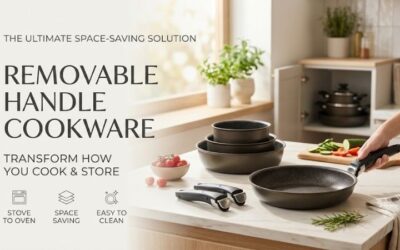
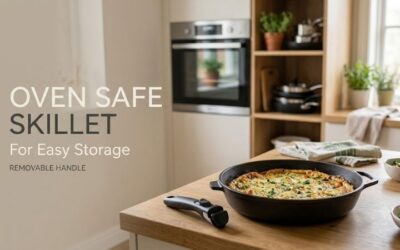
Some pans offer removable handles, although compatibility and locking mechanisms must be verified for the exact product.
Avoid buying unfamiliar detachable-handle cookware without checking the manufacturer’s safety instructions.
For ordinary home cooking, a lightweight pan with a conventional handle may still be the simplest choice.
Stackable cookware and surface protection
Stacking pans can save cabinet space, but the arrangement must protect their cooking surfaces and prevent unstable piles. Nonstick coatings can be scratched by direct contact with other cookware, while heavy cast iron placed on delicate coated surfaces may cause avoidable damage.
Use suitable pan protectors when stacking.
Place heavier cookware at the bottom.
Avoid stacking so many items that removing one pan becomes difficult or unsafe.
Consider whether a vertical rack would provide better access than a deep pile of pans.
A compact kitchen benefits from storage that is easy to maintain, not simply the highest number of items placed in one cabinet.
Low sides and easy pancake turning
Low-sided cookware makes it easier to slide a spatula beneath pancakes, especially when cooking large or delicate portions. A deep frying pan can still work, but its sidewalls may restrict the angle at which the spatula enters the cooking surface.
A compact griddle offers convenient turning access.
However, very shallow rims provide less containment for liquid batter.
The best shape depends on pancake thickness and portion size.
For standard American pancakes, a shallow frying pan or round griddle generally provides adequate control.
For crepes, a purpose-built low-rim pan may offer additional convenience.
Pancake pan versus electric griddle in a small kitchen
Electric griddles offer larger cooking surfaces and independent temperature controls, but they occupy countertop space during use and require separate storage afterward. A stovetop pancake pan is typically more compact and versatile, making it attractive to small households that do not prepare large pancake batches frequently.
| Feature | Stovetop pancake pan | Electric griddle |
|---|---|---|
| Countertop use | Uses existing stove | Needs dedicated space |
| Storage | Often fits with cookware | May require separate cabinet |
| Cooking capacity | Usually smaller | Often larger |
| Versatility | Can cook many skillet foods | Best for flat-surface cooking |
| Cleaning | Depends on material | Depends on plate and electrical design |
| Power source | Existing stove | Electrical outlet |
An electric griddle may make sense for frequent family breakfasts.
However, in a compact apartment, buying a separate appliance solely for occasional pancakes may create more inconvenience than it solves.
How to cook pancakes efficiently in a small kitchen
A compact kitchen benefits from organized cooking because the available workspace may not accommodate numerous ingredients, bowls, and utensils at once. Preparing batter before heating the pan, choosing consistent portions, and keeping the stovetop organized can help reduce clutter and improve cooking results.
Prepare ingredients before heating the pan
Pancake batter should be mixed before the cooking surface reaches its operating temperature. This prevents the pan from remaining hot while ingredients are measured or mixed and helps the cook keep the limited workspace organized.
Measure dry ingredients first.
Prepare wet ingredients separately when required by the recipe.
Combine them according to the recipe’s mixing instructions.
Avoid unnecessary overmixing, which can produce tougher pancakes.
Place the batter bowl, portioning utensil, and spatula where they can be reached without crossing over a hot burner.
Use moderate heat and consistent portions
Moderate cooking temperatures help pancakes develop browning without burning before the center cooks. A small pan may heat quickly, particularly on a powerful induction or electric burner, so careful adjustment is more useful than relying on maximum heat.
Preheat gradually.
Add cooking fat when appropriate.
Use a consistent batter quantity for each pancake.
Leave enough space to turn the pancake without contacting nearby cookware.
If the underside browns too rapidly, reduce the heat.
Remember that cast iron may take longer to cool after adjusting the burner.
Organize repeated cooking batches
Small pans often require several batches to prepare breakfast for multiple people. An organized process helps maintain consistent cooking conditions and prevents clutter from building up around the stove.
Use the same batter portion for similarly sized pancakes.
Observe the first batch and adjust the temperature as needed.
Remove finished pancakes with suitable utensils.
Keep raw batter away from ready-to-eat food.
If pancakes need to be held warm, follow safe food-holding practices and avoid leaving them at room temperature for extended periods.
Common mistakes when buying compact pancake cookware
Small-kitchen buyers sometimes focus exclusively on advertised diameter without considering handle length, burner compatibility, storage height, or the number of meals the pan must prepare. These oversights can result in cookware that is technically compact but inconvenient for normal use.
Choosing the smallest pan without considering capacity
The smallest possible pan may appear ideal for a crowded kitchen, but preparing several family portions in tiny batches can become frustrating. A slightly larger pan may offer better daily usability without creating a significant storage problem.
Consider how many pancakes you cook most often.
Evaluate whether a 10-inch pan can replace other cookware.
Avoid purchasing a mini pancake pan unless its specialized format is genuinely useful.
Ignoring burner coverage
A pancake pan should sit securely on the available cooking surface. If the base extends far beyond the burner, heating may become uneven, while an excessively small pan may not work properly with certain induction burner detection systems.
Check stove instructions and cookware dimensions.
Confirm induction compatibility for the exact model.
Do not assume all flat-bottom pans work on every burner.
Buying a dedicated appliance without storage space
An electric pancake maker or griddle may appear convenient, but its practical value declines when it must remain on the countertop permanently. Separate electrical equipment also creates another item to clean and store.
Before purchasing, decide where the appliance will go after use.
If no suitable location exists, a versatile stovetop pan is usually the more practical option.
Frequently Asked Questions
People cooking in compact kitchens often need to balance pan size, storage flexibility, and meal preparation time. These questions address the practical concerns that determine whether a dedicated pancake pan is worthwhile or whether existing cookware can perform the same function with fewer storage demands.
What size pancake pan is best for a small apartment?
An 8- to 10-inch pan is a practical starting point for many small apartments. An 8-inch model suits individual servings, while a 10-inch pan provides more flexibility for multiple pancakes and additional breakfast recipes.
Choose based on cabinet dimensions and your regular cooking portions.
Can I cook pancakes in a regular nonstick skillet?
Yes. A regular nonstick skillet can make pancakes successfully when it offers enough flat cooking space and suitable temperature control. A specialized pancake pan is not required for most home recipes.
A conventional skillet may also be more versatile.
Is a cast iron griddle worth the storage space?
A cast iron griddle is worthwhile when you frequently prepare pancakes, tortillas, and other flat foods and appreciate traditional cookware. However, its weight and cleaning requirements should be considered before buying.
For occasional pancakes, a general-purpose nonstick skillet may be more convenient.
Are removable-handle pans safe for pancakes?
Removable-handle cookware can be suitable when its locking mechanism and cooking-surface construction are designed for the intended use. Compatibility, weight limits, heat restrictions, and the manufacturer’s handling instructions must be followed.
Avoid assuming that detachable handles are interchangeable between brands or models.
How do I store a nonstick pancake pan safely?
Clean and dry the pan before storage. If stacking is necessary, use suitable protectors between cooking surfaces and avoid placing heavy cookware directly against delicate coatings.
Keep the storage arrangement stable and accessible.
Conclusion
The best pancake pan for limited counter space is usually a compact, versatile stovetop pan that fits both your burner and storage area. An 8-inch nonstick skillet works well for individual servings, while a 10-inch pan provides greater flexibility for couples and small families. A low-sided cast iron or carbon steel griddle is another useful option for cooks who prefer traditional surfaces. Measure total dimensions, account for handle length, and prioritize manageable cleaning over unnecessary specialty features. The most effective small-kitchen purchase is cookware you can use regularly without permanently sacrificing valuable workspace.

Write Your Review
No reviews yet. Be the first to share your experience!