
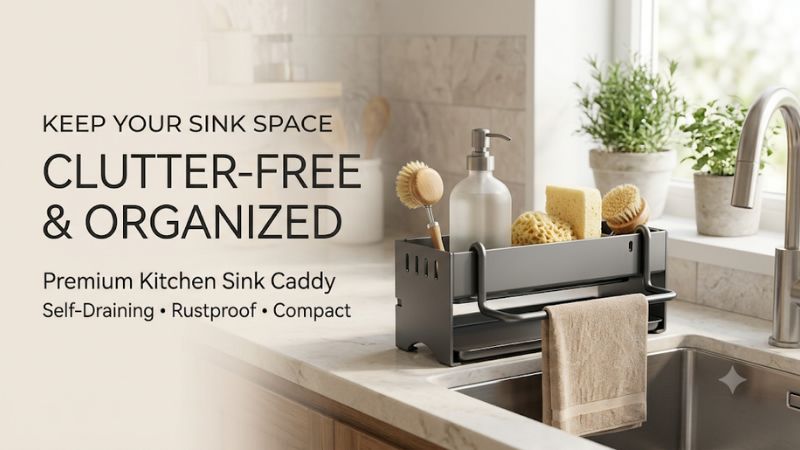
A good sink caddy keeps dish soap, sponges, brushes, and cleaning cloths organized instead of leaving wet supplies scattered around the kitchen sink. The right design should provide drainage, keep frequently used tools accessible, and be easy to clean. This guide compares six practical options for countertops, sink walls, and compact kitchens.
Quick Verdict: Which Sink Caddy Should You Buy?
A sink caddy may seem like a simple accessory, but different designs solve different problems. A countertop caddy can organize several tools, while a suction-mounted basket frees space around the sink rim. Flexible hanging holders are suitable for smaller setups, and tiered organizers provide separate compartments for bottles, brushes, and sponges. The most useful choice depends on your cleaning supplies, available space, and drainage needs.
Our six recommended products:
- Best Overall Countertop Caddy: OXO Good Grips Stainless Steel Sink Caddy.
- Best In-Sink Suction Design: OXO Good Grips StrongHold Suction Sink Caddy.
- Best Sink-Wall Organizer: simplehuman Sink Caddy.
- Best Everyday Plastic Organizer: Joseph Joseph Caddy Sink Tidy.
- Best Tiered Stainless Steel Design: Joseph Joseph Surface Stainless-Steel Tiered Sink Tidy.
- Best Flexible Compact Option: Umbra Sling Flexible Sink Caddy.
The OXO stainless steel model provides a practical combination of separated storage, ventilation, and a removable drip tray.
For households that prefer to keep the countertop clear, the OXO StrongHold suction design offers an alternative location inside a compatible sink.
The simplehuman Sink Caddy also uses the sink wall, combining suction cups with an additional wire ledge hanger.
Joseph Joseph offers countertop organization in both a conventional plastic caddy and a tiered stainless steel design.
Umbra’s Sling is a compact flexible solution that can bend around suitable sink walls or faucet configurations.
There is no single best caddy for every kitchen. A countertop organizer may be more convenient for multiple cleaning bottles, while an in-sink sponge holder may be more appropriate when preserving counter space is the main priority.
Quick Comparison Table
Comparing sink caddies is easier when the main differences are presented by placement, capacity, drainage, and maintenance requirements. A larger organizer may accommodate more supplies but use valuable countertop space, while a smaller hanging holder may keep sponges accessible without providing room for a soap bottle. The following table emphasizes real design distinctions rather than unsupported performance rankings.
| Product | Best For | Key Features | Main Advantage | Trade-Off |
|---|---|---|---|---|
| OXO Stainless Steel Sink Caddy | Everyday cleaning supplies | Removable divider, ventilation, drip tray | Organized countertop storage | Requires counter space |
| OXO StrongHold Suction Caddy | In-sink storage | Lever-operated suction, removable basket | Keeps counter clear | Requires suitable suction surface |
| simplehuman Sink Caddy | Sink-wall organization | Four suction cups, wire ledge hanger | Multiple attachment supports | Sink geometry matters |
| Joseph Joseph Caddy Sink Tidy | Soap, brush, and sponge | Multiple compartments, cloth rail | Simple everyday layout | Base needs regular cleaning |
| Joseph Joseph Surface Tiered | Multiple cleaning tools | Tiered compartments, stainless steel body | Good separation of supplies | Larger countertop footprint |
| Umbra Sling Flexible Caddy | Compact sponge storage | Flexible construction, drainage openings | Adapts to suitable sink walls | Limited bottle capacity |
The table shows that sink caddies are best evaluated according to the tools they must hold.
A household using one sponge may not need a large stainless steel organizer, while a kitchen with multiple brushes and a dish soap bottle may benefit from separate compartments.
How We Selected These Sink Caddies
These recommendations focus on identifiable products with manufacturer-supported design features and practical kitchen applications. The evaluation considers mounting methods, storage capacity, drainage, cleaning accessibility, material construction, and compatibility with different sink layouts. The product comparisons are editorial assessments based on documented characteristics rather than claims of independent laboratory testing or personal product ownership.
Selection criteria
- Placement: Countertop, sink wall, or faucet area.
- Drainage: Whether water can escape from the stored tools.
- Ventilation: Space for sponges and brushes to dry.
- Capacity: Suitability for soap bottles, sponges, and utensils.
- Material: Plastic, stainless steel, and flexible coated construction.
- Cleaning: Removable trays, dividers, and accessible surfaces.
- Installation: Freestanding, suction-mounted, or flexible hanging.
- Stability: Resistance to movement during everyday use.
- Practicality: How easily supplies can be retrieved and returned.
We also considered whether a caddy supports the normal cleaning routine.
A product that organizes sponges but traps water underneath them may require more attention than a ventilated design.
However, no caddy should be treated as a substitute for proper sponge and cleaning-tool hygiene.
Detailed Reviews of Six Sink Caddies
The six products below represent different ways to organize cleaning supplies around the sink. Each recommendation explains the intended use, important construction features, practical benefits, and limitations that may affect daily satisfaction. The reviews also distinguish between countertop organizers and products that attach directly to the sink, since these require different compatibility checks.
OXO Good Grips Stainless Steel Sink Caddy — Best Overall
The OXO Good Grips Stainless Steel Sink Caddy is a countertop organizer designed to hold sponges, dish brushes, and other washing tools in one defined location. Its removable divider provides flexible internal storage, while ventilation holes and a detachable drip tray help manage moisture. The stainless steel body offers a structured appearance suited to kitchens where cleaning supplies remain visible beside the sink.
Best For
- Everyday kitchen cleaning.
- Multiple dish brushes.
- Sponges and scrubbers.
- Countertop organization.
- Households preferring separated compartments.
Key Specifications
- Brand: OXO Good Grips.
- Product: Stainless Steel Sink Caddy.
- Main material: Stainless steel.
- Internal organization: Removable divider.
- Ventilation: Openings in the divider.
- Drip management: Detachable drip tray with pour spout.
- Cleaning: Hand wash only.
Why We Picked It
The most useful feature is the removable divider.
Some households use several brushes and sponges, while others prefer one larger open compartment.
The ability to change the layout makes the caddy more adaptable than a fixed organizer.
Its detachable drip tray is also important because wet cleaning tools can release water onto the countertop.
Features and Benefits
- Removable divider: Adjusts the interior layout.
- Ventilation holes: Improve airflow around stored tools.
- Detachable tray: Collects excess water.
- Pour spout: Simplifies emptying the drip tray.
- Stainless steel construction: Provides a defined storage station.
Performance and Practical Use
A practical arrangement is to store sponges in the ventilated compartment and dish brushes in the remaining space.
The manufacturer describes the divider as suitable for holding two sponges and two brushes, depending on their dimensions.
The drip tray should be emptied regularly rather than allowing water to remain collected beneath the tools.
The caddy is intended for hand cleaning, so it should not automatically be placed in the dishwasher.
What Makes It Different
The combination of adjustable internal storage and a dedicated draining tray distinguishes it from simpler open sponge holders.
It is especially relevant to households that want several cleaning tools organized together.
Pros
- Flexible interior configuration.
- Separate drip management.
- Ventilated design.
- Suitable for several tools.
- Structured countertop appearance.
Cons
- Requires countertop space.
- Drip tray needs regular emptying.
- Handwashing is required.
Buy If
You use multiple cleaning tools and want a countertop organizer with separated storage and manageable drainage.
Skip If
You have almost no space beside the sink or prefer a holder that attaches directly to the basin.
OXO Good Grips StrongHold Suction Sink Caddy
The OXO Good Grips StrongHold Suction Sink Caddy is designed to hold dishwashing supplies inside a compatible sink rather than on the countertop. It uses a lever-operated suction mechanism and includes a removable ventilated basket. A stainless steel front hook provides additional storage for a dish brush or sponge. This arrangement is particularly useful for small kitchens where the sink rim is already crowded.
Best For
- Limited countertop space.
- Compatible smooth sink walls.
- Sponges and scrub brushes.
- Households wanting concealed storage.
- Users who prefer removable baskets.
Key Specifications
- Brand: OXO Good Grips.
- Product: StrongHold Suction Sink Caddy.
- SKU: 13273600.
- Materials: Stainless steel and plastic.
- Attachment: StrongHold suction cup with locking lever.
- Storage: Removable ventilated basket.
- Additional support: Stainless steel front hook.
- Cleaning: Manufacturer describes dishwasher-safe construction.
Why We Picked It
A sink-wall organizer changes where cleaning tools are stored.
Instead of occupying the countertop, it uses an appropriate surface within the sink.
The locking lever provides a defined attachment method, while the removable basket allows access for cleaning.
Features and Benefits
- Lever-operated suction: Helps secure the caddy to compatible surfaces.
- Removable basket: Simplifies access and maintenance.
- Ventilation: Allows water and air to circulate.
- Front hook: Provides storage for a brush or sponge.
- In-sink placement: Preserves counter space.
Performance and Practical Use
Suction performance depends on the sink material, surface condition, and installation method.
The caddy should be mounted only where the manufacturer approves the attachment system.
Before installation, clean the mounting area and follow the manufacturer’s fitting instructions.
Test the attachment gently before loading.
A removable basket is useful when the sink needs to be thoroughly cleaned.
However, the caddy should not be positioned where it obstructs the drain or is repeatedly struck by large cookware.
What Makes It Different
The StrongHold mechanism is more specialized than an ordinary loose countertop holder.
It combines suction mounting with a separate removable storage basket.
Pros
- Saves countertop space.
- Lever-operated mounting.
- Removable basket.
- Ventilated storage.
- Additional front hook.
Cons
- Requires suitable suction surface.
- Can interfere with sink space.
- Attachment should be inspected periodically.
Buy If
You want cleaning supplies inside the sink and have a compatible mounting surface.
Skip If
Your sink surface is unsuitable for suction or you frequently need the entire basin unobstructed.
simplehuman Sink Caddy — Best Sink-Wall Organizer
The simplehuman Sink Caddy is designed to keep sponges and cleaning tools accessible on the inside wall of a compatible sink. It combines four suction cups with a wire ledge hanger to improve attachment support. Ventilation holes and elevated sponge compartments help promote airflow around wet tools, making the caddy relevant to households that want a defined sponge-storage position without adding countertop clutter.
Best For
- Kitchen sink walls.
- Dish sponges and scrubbers.
- Households prioritizing drainage.
- Small countertops.
- Compatible sink ledges.
Key Specifications
- Brand: simplehuman.
- Product: Sink Caddy, Standard.
- SKU: KT1116.
- Attachment: Four suction cups.
- Additional support: Wire ledge hanger.
- Storage: Elevated sponge compartments.
- Ventilation: Multiple openings.
- Manufacturer-stated warranty: Five years.
Why We Picked It
Sink-wall storage can be convenient, but attachment reliability depends on more than the number of suction cups.
The simplehuman design combines suction with a supporting wire hanger.
This makes it a distinct alternative to products that rely on one suction mechanism alone.
Features and Benefits
- Four suction cups: Provide several attachment points.
- Wire ledge hanger: Adds another support mechanism.
- Elevated sponge positions: Help separate tools from collected water.
- Ventilation openings: Support airflow.
- Standard format: Suitable for everyday sink cleaning supplies.
Performance and Practical Use
The caddy is intended to keep commonly used washing tools close to the work area.
For example, a sponge and scrub brush can remain in their designated locations instead of being left on the sink bottom.
The attachment system must be compatible with the sink’s material and rim shape.
A recessed sink or unusual ledge may prevent the wire hanger from sitting correctly.
Cleaning the caddy regularly remains important because soap residue and food particles can accumulate around suction cups.
What Makes It Different
The combination of suction cups and a wire ledge hanger is the defining feature.
It offers a different attachment arrangement from a lever-operated single-suction holder.
Pros
- Multiple attachment points.
- Additional ledge support.
- Ventilated compartments.
- Saves countertop space.
- Identifiable manufacturer specifications.
Cons
- Requires compatible sink geometry.
- Suction areas need maintenance.
- Occupies some interior sink space.
Buy If
You want an in-sink organizer with multiple supporting elements and suitable ventilation.
Skip If
Your sink does not provide an appropriate ledge or compatible suction surface.
Joseph Joseph Caddy Sink Tidy — Best Everyday Plastic Organizer
The Joseph Joseph Caddy Sink Tidy is a countertop organizer intended to keep dish soap, sponges, brushes, and cleaning cloths in one convenient location. Its design separates the different categories of cleaning tools while providing a rail for cloth storage and a base that can be cleaned. This makes it particularly relevant to households that want a simple organized washing station without mounting accessories.
Best For
- Everyday sink cleaning supplies.
- Dish soap bottles.
- Sponges and brushes.
- Cleaning cloths.
- Households avoiding permanent installation.
Key Specifications
- Brand: Joseph Joseph.
- Product family: Caddy.
- Product: Kitchen Sink Tidy.
- Placement: Countertop.
- Organization: Separate sections for cleaning tools.
- Cloth storage: Dedicated hanging rail.
- Cleaning: Removable components depending on the selected version.
- Available versions: Multiple colors and related sizes.
Why We Picked It
The Caddy design addresses the common problem of cleaning supplies spreading across the sink area.
Instead of storing a sponge on the faucet, a brush behind the soap bottle, and a cloth across the counter, the organizer creates defined places for each item.
This improves consistency in a shared kitchen.
Features and Benefits
- Separate storage areas: Keep different tools organized.
- Cloth rail: Provides a designated location for a dishcloth.
- Countertop placement: Avoids sink-wall compatibility concerns.
- Compact organization: Groups washing supplies.
- Removable components: Support cleaning where provided.
Performance and Practical Use
The caddy works best when its compartments match the cleaning supplies normally used.
A large soap bottle may require more room than a compact refillable dispenser.
Measure the intended bottle before purchasing.
The cloth rail should also allow the dishcloth to hang without being compressed against other damp items.
Regular cleaning is essential because water can collect around the base.
Do not assume that a tidy appearance means the sponge or cloth is hygienically dry.
What Makes It Different
The Caddy provides a straightforward multipurpose countertop arrangement without the installation requirements of suction-mounted systems.
It is a practical choice for households seeking conventional sink organization.
Pros
- Simple organization.
- Separate compartments.
- Dedicated cloth rail.
- No mounting required.
- Suitable for common cleaning supplies.
Cons
- Occupies countertop space.
- Bottle fit depends on dimensions.
- Base requires regular cleaning.
Buy If
You want one countertop station for soap, sponges, brushes, and cloths.
Skip If
You have no free countertop area or only need a small sponge holder.
Joseph Joseph Surface Stainless-Steel Tiered Sink Tidy
The Joseph Joseph Surface Stainless-Steel Tiered Sink Tidy uses an angled arrangement of compartments to organize dish soap, brushes, and sponges. Its stainless steel body has a fingerprint-resistant coating, while the internal structure separates cleaning tools and directs excess water into the base. The product can be dismantled for cleaning, making maintenance a central feature of its design.
Best For
- Households with multiple washing tools.
- Visible countertop organization.
- Cleaning supply separation.
- Kitchens with adequate sink-side space.
- Users wanting easy access to different compartments.
Key Specifications
- Brand: Joseph Joseph.
- Collection: Surface.
- Product: Stainless-Steel Tiered Sink Tidy.
- SKU: 851646.
- Dimensions: Approximately 4.5 × 7 × 4.5 inches.
- Main material: Stainless steel.
- Finish: Fingerprint-resistant coating.
- Design: Angled tiered compartments.
- Cleaning: Dismantles for handwashing.
Why We Picked It
A tiered design can make different cleaning supplies easier to see and retrieve.
Rather than storing every item at the same height, the Surface caddy separates compartments in a more structured arrangement.
This is useful for households that use a bottle, several brushes, and multiple sponges.
Features and Benefits
- Angled compartments: Improve access to stored tools.
- Separate sections: Organize soap, brushes, and sponges.
- Stainless steel body: Provides a structured outer surface.
- Removable construction: Supports thorough cleaning.
- Nonslip feet: Help maintain countertop placement.
Performance and Practical Use
The tiered arrangement is convenient when several different supplies are used during dishwashing.
However, a more structured design also creates additional corners and surfaces where soap residue may accumulate.
The manufacturer’s ability to dismantle the product helps address this issue.
The caddy should be washed and dried by hand according to the published care instructions.
Before buying, compare its dimensions with the available countertop area and the size of the soap bottle.
What Makes It Different
The tiered design provides more defined organization than a simple open basket.
It is also distinguishable from the standard Joseph Joseph Caddy by its stainless steel construction and angled compartments.
Pros
- Separate tiered compartments.
- Stainless steel construction.
- Fingerprint-resistant coating.
- Dismantles for cleaning.
- Nonslip feet.
Cons
- Requires countertop space.
- Handwashing is necessary.
- Internal sections may not fit unusually large bottles.
Buy If
You use several cleaning tools and want a structured stainless steel countertop organizer.
Skip If
You prefer a simple open sponge holder or need an organizer that attaches inside the sink.
Umbra Sling Flexible Sink Caddy — Best Compact Option
The Umbra Sling Flexible Sink Caddy is designed to bend around suitable sink walls or faucet configurations, offering an alternative to rigid suction-mounted baskets. It combines a wire frame with a flexible molded coating and includes openings for brushes and drainage. This makes it particularly attractive for households that want a compact sponge holder without placing another container on the countertop.
Best For
- Small kitchen sinks.
- Dish sponges.
- Compact scrub brushes.
- Faucet-adjacent storage.
- Households seeking flexible placement.
Key Specifications
- Brand: Umbra.
- Product family: Sling.
- Product: Flexible Sink Caddy.
- Construction: Wire frame with molded flexible coating.
- Placement: Suitable sink walls or faucet configurations.
- Drainage: Perforated base.
- Additional feature: Cutouts for scrubbing brushes.
- Installation: Flexible hanging arrangement.
Why We Picked It
The flexible design is the central advantage.
Many rigid sink caddies require a specific smooth surface for suction cups or a particular ledge shape for hooks.
The Sling uses a bendable construction intended to accommodate several placement possibilities.
Features and Benefits
- Flexible frame: Adapts to suitable sink configurations.
- Molded coating: Helps provide grip.
- Drainage openings: Allow water to escape.
- Brush cutouts: Organize small cleaning tools.
- Compact design: Reduces countertop clutter.
Performance and Practical Use
The Sling is especially useful for storing a sponge or small scrubber close to the sink.
Its flexibility does not mean it will fit every faucet or sink geometry equally well.
A large faucet neck, unusual mixer tap, or restricted basin opening may affect placement.
The caddy should be positioned so it does not interfere with operating the faucet or washing dishes.
Because the product is flexible, avoid placing excessive weight on it.
It is intended primarily for small washing tools rather than multiple heavy soap bottles.
What Makes It Different
Unlike rigid countertop or suction-mounted caddies, the Sling uses flexible construction to adapt to suitable shapes.
It is most appealing when a small sponge-storage solution is more important than maximum capacity.
Pros
- Flexible construction.
- Compact footprint.
- Drainage openings.
- Brush storage.
- No large countertop organizer required.
Cons
- Limited storage capacity.
- Faucet and sink geometry affect placement.
- Not intended for heavy bottles.
Buy If
You want a compact flexible caddy for a sponge and small brush.
Skip If
You need room for multiple soap bottles, cloths, and larger cleaning accessories.
Buying Guide: How to Choose the Best Sink Caddy
A sink caddy should be selected around the cleaning tools you actually use and the space available beside or inside the sink. A product that looks compact may be too small for your soap bottle, while a larger organizer can occupy valuable preparation space. Drainage, ventilation, placement, materials, and cleaning effort all affect whether the caddy remains useful after the initial purchase.
Choose Between Countertop and In-Sink Storage
Countertop caddies provide convenient access to bottles and brushes, while in-sink holders free valuable space around the faucet. The better choice depends on sink size and household cleaning habits. A large single-basin sink may accommodate a mounted sponge basket, whereas a small sink may become inconvenient if a holder takes up too much washing space.
Countertop caddies are useful for:
- Dish soap bottles.
- Several brushes.
- Cleaning cloths.
- Larger washing-tool collections.
- Households that prefer easy relocation.
In-sink caddies are useful for:
- Sponges.
- Compact scrubbers.
- Small dish brushes.
- Limited countertop space.
- Concealed storage.
Measure the available area before purchasing.
An organizer that fits beside the sink while empty may be inconvenient after loading a large soap bottle.
Prioritize Drainage and Ventilation
Sponges and brushes are frequently wet, making drainage an important part of caddy design. Ventilation openings, elevated storage compartments, and removable drip trays can help manage excess moisture. However, these features do not eliminate the need to clean and replace washing tools appropriately.
Useful drainage features
- Perforated base.
- Ventilated compartments.
- Raised sponge positions.
- Removable drip tray.
- Accessible water collection area.
- Separate cloth rail.
- Easy cleaning access.
A countertop caddy may collect water in its base, while an in-sink basket may allow water to drain directly into the basin.
Both arrangements can work when maintained properly.
Do not leave water standing inside a drip tray for extended periods.
Check Mounting and Surface Compatibility
Sink-mounted caddies commonly use suction cups, hooks, flexible frames, or combinations of attachment systems. Their effectiveness depends on the surface and installation conditions. Suction cups may not adhere properly to every sink finish, while hanging holders may require a particular rim or faucet geometry.
Mounting checklist
- Identify sink material.
- Check surface smoothness.
- Measure available ledges.
- Confirm faucet compatibility.
- Follow manufacturer mounting instructions.
- Inspect attachment security.
- Avoid excessive loads.
- Remove the caddy for cleaning when necessary.
Do not assume that every suction-mounted model works on textured or curved surfaces.
If the installation cannot be made secure, choose a compatible countertop organizer instead.
Select Materials That Are Easy to Maintain
Sink caddies are exposed to water, soap, food residue, and repeated handling. Stainless steel can provide a structured appearance, while plastic and flexible coated designs may be lighter. However, the ease of cleaning depends on the complete product construction rather than the material alone.
Material considerations
- Stainless steel: Common in rigid countertop organizers.
- Plastic: Often lightweight and easy to shape into compartments.
- Flexible coated wire: Useful for adaptable hanging holders.
- Silicone components: May provide grip and flexibility.
- Nonslip feet: Help stabilize countertop units.
- Removable trays: Improve cleaning access.
Check the care instructions for the exact product.
A stainless steel body does not necessarily mean the organizer is dishwasher-safe.
Match the Caddy to Your Cleaning Supplies
A household using only a sponge and a bottle of dish soap has different storage requirements from one using several brushes, scrubbers, cloths, and cleaning products. The best caddy keeps the regular supplies organized without forcing the user to crowd incompatible items into the same compartment.
Count the items you use
- Dish soap bottle.
- Sponge.
- Scrub brush.
- Bottle brush.
- Cleaning cloth.
- Small scrub pad.
- Specialized cleaning tool.
- Additional refill bottle.
Measure any unusually large accessories.
A compact holder may work beautifully for two items but become overloaded when several cleaning tools are added.
Choose sufficient capacity without buying unnecessary compartments.
Consider Hygiene and Tool Replacement
A sink caddy can help separate cleaning tools and reduce clutter, but it does not automatically make sponges hygienic. Sponges may retain moisture and food residue, especially when used for cleaning raw-food preparation surfaces or heavily soiled dishes. Appropriate washing, drying, and timely replacement remain important.
Practical hygiene habits
- Remove food debris after use.
- Rinse cleaning tools appropriately.
- Allow airflow around damp items.
- Empty collected water.
- Clean the caddy regularly.
- Replace deteriorated sponges.
- Avoid mixing food-preparation tools with dirty cleaning equipment.
- Follow relevant kitchen sanitation guidance.
Do not rely on ventilation claims as proof that bacterial growth is eliminated.
The caddy is a storage accessory, not a sanitation device.
Practical Sink Organization Setups
A useful sink organization system depends on household size, sink placement, and the number of cleaning supplies used regularly. Some kitchens benefit from a large countertop organizer, while others need only a compact sponge holder. The following setups illustrate how different arrangements can simplify dishwashing without creating unnecessary clutter or hygiene concerns.
Setup One: Small Apartment Kitchen
A small apartment may have one sink, limited countertop space, and only a few cleaning tools. In this environment, an in-sink caddy can preserve the preparation area while keeping a sponge close to the faucet. The main consideration is ensuring the holder does not interfere with washing dishes or filling pots.
Suggested arrangement
- One compact sponge holder.
- One nearby dish soap bottle.
- Minimal unnecessary accessories.
- Clear access to the faucet.
- Regular cleaning of the holder.
A flexible caddy or compatible suction-mounted basket can be a practical option.
Avoid adding a large countertop organizer when the household uses only one sponge.
Setup Two: Family Kitchen With Multiple Cleaning Tools
A family kitchen may use several brushes, sponges, and dish soap products throughout the day. A countertop caddy with divided compartments can keep these supplies separated while making them easy to identify. The organizer should also accommodate a cleaning cloth without trapping moisture against other items.
Suggested arrangement
- Separate compartment for brushes.
- Designated sponge position.
- Stable dish soap storage.
- Cloth hanging area.
- Removable drip management.
- Regular cleaning routine.
An OXO or Joseph Joseph countertop model may be appropriate when adequate space is available.
Setup Three: Minimalist Sink Area
A minimalist kitchen often prioritizes clear counters and a limited number of visible accessories. A compact suction-mounted or flexible caddy can keep the sponge near the sink without introducing a large organizer. However, compact storage should not come at the expense of safe placement or convenient washing.
Suggested arrangement
- Choose only essential cleaning supplies.
- Keep bottles grouped neatly.
- Use an appropriate compact holder.
- Maintain access to the basin.
- Avoid clutter around the faucet.
- Clean the storage area frequently.
A smaller caddy works best when the household is willing to maintain a simple supply collection.
Common Sink Caddy Mistakes to Avoid
A sink caddy can make the washing area more organized, but unsuitable placement or neglected maintenance can create new problems. Common mistakes include leaving water in a drip tray, overloading a suction-mounted basket, choosing an organizer that blocks the faucet, and assuming that a ventilated holder eliminates the need to clean sponges.
Mistakes to avoid
- Buying without measuring the available space.
- Choosing a caddy too small for the soap bottle.
- Overloading suction attachments.
- Ignoring sink material compatibility.
- Leaving standing water inside a drip tray.
- Keeping damp cloths compressed together.
- Blocking the faucet with hanging accessories.
- Failing to clean removable compartments.
- Treating ventilation as sanitization.
- Storing dirty tools next to clean food-preparation equipment.
- Choosing appearance over daily usability.
- Ignoring loose or damaged mounting components.
A suitable caddy should make cleaning tools easier to access and maintain.
If it creates additional moisture problems or obstructs washing, another design may be more appropriate.
Frequently Asked Questions
Sink caddies differ significantly in placement, drainage, and intended storage capacity. Buyers often want to know whether countertop or suction-mounted options are better, how frequently the organizer should be cleaned, and whether ventilation keeps sponges sanitary. The following answers address these practical concerns without assuming that one product works in every kitchen.
What Is the Best Sink Caddy for a Small Kitchen?
A compact suction-mounted or flexible hanging caddy is often useful in a small kitchen because it can preserve countertop space. However, the sink must have a suitable attachment surface or geometry, and the holder should not obstruct normal washing activities.
A small countertop organizer may be preferable when the sink itself has limited space.
Choose according to the cleaning supplies you actually use.
Are Stainless Steel Sink Caddies Better Than Plastic?
Stainless steel provides a structured appearance and is used in several premium sink organizers, while plastic can be lightweight and convenient for molded compartments. Neither material is universally better. Cleaning access, drainage, construction, and manufacturer care instructions are more important than material alone.
A poorly maintained stainless steel caddy can still collect residue.
Choose a design that is easy to keep clean.
Do Suction Cup Sink Caddies Stay Attached?
Suction-mounted products can remain secure when used on compatible surfaces and installed correctly, but performance depends on sink material, cleanliness, shape, and loading. Some products use additional supports or locking mechanisms to improve attachment.
Follow the manufacturer’s installation instructions.
If the holder repeatedly slips, choose a different mounting format rather than relying on unsafe improvisations.
How Often Should I Clean a Sink Caddy?
Clean the caddy whenever soap residue, food debris, or standing water accumulates. Empty drip trays regularly and inspect hidden areas beneath dividers and around mounting components. The appropriate cleaning frequency depends on how often the household uses the sink.
Follow the product-specific cleaning instructions.
Allow the caddy to dry appropriately after washing.
Do Sink Caddies Help Sponges Dry Faster?
Ventilated compartments and elevated storage positions can improve airflow and allow excess water to drain away. However, actual drying depends on room conditions, sponge thickness, placement, and how much water remains inside the sponge.
A caddy does not guarantee that a sponge is hygienically dry.
Clean and replace washing tools appropriately.
Conclusion
The best sink caddy should keep washing supplies organized, accessible, and easy to maintain without crowding the kitchen sink. OXO’s stainless steel model is a strong countertop option, while its StrongHold suction design and the simplehuman Sink Caddy help preserve counter space. Joseph Joseph offers practical organizers for both straightforward and tiered storage, and Umbra Sling provides a compact flexible alternative. Measure the available area, check mounting compatibility, prioritize drainage and ventilation, and clean the organizer regularly to keep the sink area functional.






Write Your Review
No reviews yet. Be the first to share your experience!