
A dish organizer rack for apartments helps keep plates, bowls, and serving dishes accessible without taking over a compact kitchen. The right design depends on cabinet size, dinnerware weight, and whether permanent installation is allowed. This guide explains space-saving rack styles, renter-friendly options, accurate measurements, and simple ways to organize dishes safely in a small home.
- Quick Answer: Start With a Compact Freestanding Plate Rack
- Why Apartment Kitchens Benefit From Better Dish Storage
- Types of Dish Organizer Racks for Small Apartments
- How to Measure Apartment Cabinets Correctly
- Choose Materials That Suit Apartment Living
- How to Organize Dishes in a Small Apartment Kitchen
- Avoid Confusing Dish Storage With Dish Drying
- Budget and Rental-Friendly Buying Decisions
- Common Apartment Dish Storage Mistakes
- Frequently Asked Questions
- Conclusion
Quick Answer: Start With a Compact Freestanding Plate Rack
For most apartment kitchens, a small freestanding plate organizer is the simplest starting point because it does not require drilling or permanent cabinet changes. A vertical stand can separate plates for easy retrieval, while a low shelf organizer may suit cabinets with limited height. The best configuration should accommodate your existing dinnerware without making other kitchen storage less usable.
Recommended choices:
- Best overall: Compact freestanding plate stand.
- Best for narrow cabinets: Slim vertical organizer with stable support.
- Best for deep drawers: Adjustable holder for stacked plates.
- Best for low cabinet shelves: Short horizontal dish organizer.
- Best for renters: Removable rack without mounting hardware.
- Best for mixed kitchen equipment: Adjustable divider rack.
- Best for occasional serving dishes: Separate compact platter organizer.
A small apartment does not automatically need more organizers. If a cabinet already holds four dinner plates and four bowls comfortably, adding a bulky rack may reduce usable storage.
Choose accessories that solve an actual problem involving access, stability, or visibility.
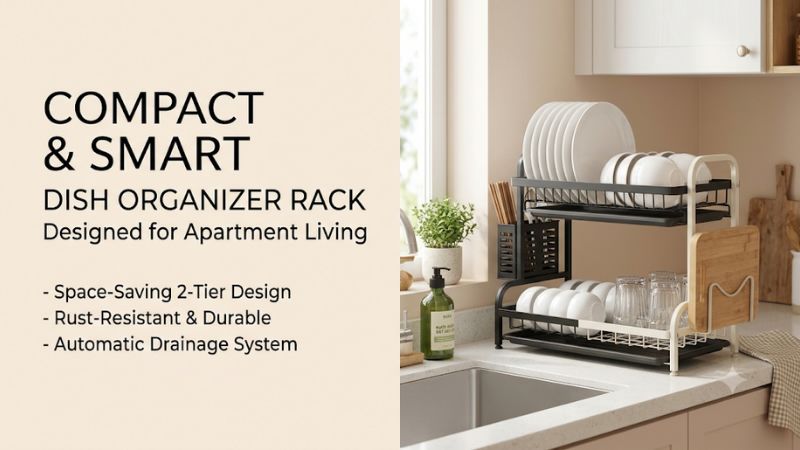
Why Apartment Kitchens Benefit From Better Dish Storage
Apartments often have fewer cabinets, narrower shelves, and less flexibility to modify the kitchen. Dinner plates, bowls, mugs, cookware, food containers, and small appliances may compete for the same limited areas. A well-chosen dish organizer can reduce awkward stacking and make frequently used items easier to retrieve, but the rack must justify the space it occupies.
Reduce the Need to Lift Heavy Plate Stacks
Stacking plates directly on a cabinet shelf is simple, but it can become inconvenient when different sizes and shapes are mixed together. A smaller side plate may end up beneath several heavy dinner plates, requiring users to lift the entire stack to retrieve it.
A vertical organizer separates suitable plates so individual pieces are more accessible.
Practical benefits:
- Easier retrieval of individual plates.
- Better visibility of different sizes.
- Less unnecessary lifting.
- More consistent storage positions.
- Potentially easier organization for shared kitchens.
- Reduced need to move several dishes at once.
However, vertical storage requires stable support and sufficient clearance.
A heavy ceramic plate should not be placed upright in a lightweight rack that is not designed for its weight.
The goal is safer, easier access rather than simply changing the orientation of dishes.
Make Better Use of Narrow Cabinet Shelves
Many apartment cabinets have enough depth for plates but limited width. A traditional horizontal stack may occupy the entire useful shelf area while leaving some vertical space unused. A compact rack can sometimes create a more practical arrangement by separating plates or allowing related items to be grouped.
The correct solution depends on the cabinet’s geometry.
Useful approaches:
- Vertical plate stands for suitable narrow shelves.
- Low shelf separators for limited cabinet height.
- Deep-drawer plate holders when available.
- Compact adjustable dividers for serving platters.
- Separate small bins for lightweight kitchen accessories.
Avoid installing several racks before measuring the remaining space for bowls, mugs, and other dishes.
A visually neat cabinet may become less useful if every item requires its own bulky organizer.
Maintain Flexibility in Rental Properties
Renters may not be permitted to drill into cabinets, add permanent shelf brackets, or modify drawer structures. Even when modifications are allowed, a highly specialized installation may be difficult to reuse after moving to another apartment.
Freestanding dish organizers are therefore particularly attractive.
Rental-friendly advantages:
- No mounting holes.
- Easy removal.
- Portable between homes.
- Simple cabinet cleaning.
- Flexible arrangement.
- Potential reuse for other flat kitchen items.
Check the organizer’s feet and contact points to make sure they do not scratch cabinet surfaces.
A product that is easy to move is useful only when it remains stable during ordinary use.
Types of Dish Organizer Racks for Small Apartments
Dish storage accessories vary in orientation and purpose. Some hold plates upright, others support a grouped stack, and adjustable racks can accommodate platters or lids. Apartment buyers should begin by identifying the items they use most frequently and how much space the rack can occupy without interfering with other kitchen essentials.
Compact Vertical Plate Stands
Vertical plate stands use fixed dividers or shaped supports to hold dishes upright. They can be convenient when several plate sizes share one cabinet and the user wants to remove a single plate without lifting a stack. Compact bamboo and steel designs are common, but compatibility depends on plate dimensions and rack strength.
Best For: Small collections of everyday plates.
Key Features:
- Vertical storage positions.
- Freestanding base.
- Fixed dividers.
- Bamboo or metal construction.
- No permanent installation.
Pros:
- Individual plate access.
- Compact footprint on suitable shelves.
- Straightforward daily use.
- Easy relocation.
Cons:
- Requires enough vertical space.
- Fixed spacing may not suit thick plates.
- Heavy dishes need substantial support.
- Some racks have low load ratings.
Buy If: You own a few suitable plates and want to avoid mixed stacks.
Skip If: The cabinet is too low or the dinnerware is unusually heavy.
For most renters, this is an easy format to evaluate because the rack can be placed and removed without altering the cabinet.
However, stability and weight must remain the deciding factors.
Adjustable Plate Holders for Deep Drawers
Adjustable plate holders support a grouped stack of plates rather than separating every piece vertically. They are useful in kitchens with sufficiently deep drawers, where dishes can be stored lower and retrieved from above. Some designs feature adjustable supports intended for particular plate diameter ranges.
Best For: Apartments with deep lower drawers and matching dinnerware stacks.
Key Features:
- Adjustable plate-diameter support.
- Defined base.
- Grouped plate storage.
- Removable arrangement.
- Suitable for compatible deep drawers.
Pros:
- Keeps plate stacks together.
- Useful for matching dinnerware sets.
- Can reduce uncontrolled shifting.
- Convenient in suitable drawers.
Cons:
- Bottom plates still require lifting others.
- Heavy stacks remain heavy.
- Requires sufficient drawer dimensions.
- Not suitable for all plate shapes.
Buy If: You want a stable place for a group of matching plates inside a deep drawer.
Skip If: You need individually accessible vertical positions.
An adjustable holder is a different storage concept from a vertical rack.
Choose according to how you retrieve dishes rather than assuming one format is automatically more efficient.
Low Horizontal Dish Organizers
Low horizontal organizers create separated storage areas on suitable cabinet shelves. They can help divide different plate stacks or make use of otherwise awkward shelf space. This approach may suit apartments where upper cabinets have limited height and upright plates would interfere with the cabinet above.
Best For: Low-clearance cabinets and separated plate groups.
Key Features:
- Low-profile frame.
- Horizontal organization.
- Defined support surfaces.
- Freestanding placement.
- Suitable materials for dry cabinet storage.
Pros:
- Does not require tall vertical clearance.
- Can separate dish categories.
- Simple access for some layouts.
- No permanent modifications.
Cons:
- Still requires lifting from stacks.
- Wide models use substantial shelf width.
- Load capacity may be limited.
- Not every rack supports heavy dishes.
Buy If: You have a wide but relatively low cabinet and want to organize several plate stacks.
Skip If: Your main problem is reaching the bottom plate without lifting other dishes.
Measure both the rack’s height and the height of the dishes stored on it.
A low rack can still become too tall once a substantial stack is added.
Adjustable Divider Racks for Platters and Flat Dishes
Adjustable divider racks can hold serving platters, flat cookware, cutting boards, and selected dishes upright. They are especially useful when the household has several irregular serving items that would not fit a conventional plate stand. Their flexibility comes from movable dividers, but the support system must be suitable for the weight and shape of the intended dishes.
Best For: Mixed flat kitchen equipment and occasional serving platters.
Key Features:
- Repositionable dividers.
- Freestanding base.
- Adjustable compartment widths.
- Multiple flat-item uses.
- Removable installation.
Pros:
- Flexible spacing.
- Useful for irregular items.
- Can adapt when cookware changes.
- Reduces flat stacking.
Cons:
- Not every divider supports heavy ceramic plates.
- Large platters may lean.
- Requires adequate cabinet height.
- More components to arrange.
Buy If: You have several serving platters and other flat tools that need separate storage.
Skip If: You primarily need a compact organizer for a small matching dinnerware set.
A multipurpose rack is worthwhile only when its supported uses match the household’s actual inventory.
Do not treat an adjustable pan organizer as universally compatible with fragile ceramic dishes.
Portable Dish Caddies and Compact Stack Holders
Portable plate caddies are designed to group several dishes together and may include handles or adjustable supports. They can be useful for apartments where dishes are stored in a deep drawer or carried between a cabinet and dining area. However, the total weight of a stack should remain manageable, and a caddy is not a substitute for a secure serving tray.
Best For: Small matching dinnerware sets stored in one group.
Key Features:
- Defined plate-stack support.
- Portable arrangement.
- Handles on selected designs.
- Compact storage footprint.
- Removable construction.
Pros:
- Easy to reposition.
- Helps keep matching plates together.
- No permanent mounting.
- May suit drawer storage.
Cons:
- Heavy stacks can be difficult to carry.
- Plate compatibility varies.
- Individual plates are not always accessible.
- Handles can consume extra space.
Buy If: Your apartment has a suitable drawer and you prefer grouped plate storage.
Skip If: You need easy retrieval of different plate sizes.
A portable caddy should be lifted only within its intended capacity.
Avoid carrying a heavy stack of fragile dishes without appropriate support and a clear path.
How to Measure Apartment Cabinets Correctly
Small kitchen cabinets can have irregular dimensions, internal supports, and door hardware that interfere with storage accessories. An organizer may appear to fit on the shelf but still make dishes difficult to remove through the opening. Measure the actual usable space and test the retrieval movement before buying.
Measure Width, Depth, and Height
Open the cabinet and measure the clear interior width, usable depth, and vertical clearance between shelves. Account for face-frame edges, hinges, and any fixed supports.
Measurement checklist:
- Interior shelf width.
- Usable shelf depth.
- Vertical clearance.
- Clear cabinet opening.
- Hinge protrusions.
- Space for lifting plates.
- Width of neighboring storage items.
- Room for removing the rack.
A compact rack should not be forced against the cabinet walls.
Leave enough space to move it for cleaning and to retrieve dishes comfortably.
Measure Plates Before Choosing a Rack
Dinnerware varies more than many buyers expect. A large dinner plate, small side plate, deep pasta plate, and square serving dish can require very different support.
Measure:
- Plate diameter.
- Maximum width for nonround dishes.
- Plate thickness.
- Rim height.
- Weight.
- Number of pieces in each group.
Compare these measurements with the product’s stated supported range.
A stand intended for six- to eight-inch plates should not be assumed suitable for a heavy twelve-inch dinner plate.
Test the Retrieval Path
A plate may fit upright inside a cabinet but be difficult to remove through a narrow door opening. This is especially important in upper cabinets where the user must lift dishes at an awkward angle.
Create a simple cardboard outline matching the plate diameter.
Test the movement carefully without risking actual dinnerware.
Check whether the rack would need to be moved each time.
If retrieval is inconvenient, consider horizontal storage or a different cabinet.
Check Shelf Strength
Apartment cabinet shelves vary in construction and load capacity.
A rack holding heavy stoneware can create substantial concentrated weight.
Check the cabinet’s condition and avoid loading damaged, sagging, or loose shelves.
Structural considerations:
- Shelf thickness.
- Support brackets.
- Signs of sagging.
- Water damage.
- Position of heavy items.
- Organizer’s published load rating.
- Combined dish weight.
Do not exceed either the organizer’s or cabinet’s safe loading limits.
The less capable component determines the practical restriction.
Choose Materials That Suit Apartment Living
A dish organizer should be easy to maintain and suitable for the storage environment. Bamboo, powder-coated steel, and mixed-material designs have different benefits. Renters may value lightweight portable construction, while households with heavy dinnerware may prioritize a more substantial support frame.
Bamboo Plate Racks
Bamboo organizers can provide a natural appearance and straightforward fixed slots.
Advantages:
- Portable construction.
- No installation.
- Defined plate positions.
- Natural appearance.
- Multipurpose use on selected models.
Limitations:
- Moisture-sensitive care requirements.
- Fixed compartment widths.
- Some designs may not support heavy plates.
- Surface finish requires inspection.
Bamboo is generally best used for appropriately dry storage unless the manufacturer specifically describes another suitable application.
Follow cleaning instructions and avoid prolonged soaking when not permitted.
Powder-Coated Steel Racks
Steel racks can provide slim supports and defined structural shapes. Some manufacturers include silicone stoppers or cushioning materials to reduce unwanted movement.
Advantages:
- Structured plate support.
- Compact steel framing.
- Specific size guidance on some models.
- Available weight ratings.
- No assembly on selected designs.
Limitations:
- Surface coatings can become damaged.
- Metal contact points may mark delicate finishes.
- Some racks have low maximum loads.
- Weight capacity varies substantially.
Do not assume that every metal rack supports heavy dishes.
Inspect the product’s published specifications.
Mixed-Material Adjustable Organizers
Adjustable racks may use polymer bases with metal dividers or other combinations.
Advantages:
- Flexible spacing.
- Portable design.
- Can support varied flat objects.
- Useful when household equipment changes.
Limitations:
- More moving components.
- Divider fit requires attention.
- Not all models suit fragile plates.
- Cleaning may involve multiple pieces.
Choose according to stability and intended use rather than the number of adjustable features.
How to Organize Dishes in a Small Apartment Kitchen
A successful apartment storage system should make dishes easy to find while preserving enough cabinet space for mugs, bowls, cookware, and food containers. Organizing by frequency and type is usually more practical than creating a complex display that only works when everything is perfectly arranged.
Keep Everyday Dinnerware Accessible
Identify the plates and bowls used during normal meals.
For many small households, this may be only four to six of each basic item.
Everyday zone:
- Dinner plates.
- Side plates.
- Common bowls.
- Frequently used mugs.
- Small serving dishes.
Store these items where they can be reached comfortably.
Occasional holiday serving platters can occupy a less accessible but still safe location.
Avoid mixing heavy specialty dishes into the main everyday rack.
Use Separate Zones for Large Serving Items
Oversized platters and unusual dishes can consume disproportionate space when mixed with regular dinnerware.
A dedicated adjustable rack or stable horizontal shelf area may be more appropriate.
Practical options:
- Upright platter organizer.
- Lower cabinet shelf.
- Deep drawer with suitable dividers.
- Separate protected storage.
- Stable horizontal grouping.
Do not store heavy serving dishes above head height when lifting them would be awkward or unsafe.
A compact kitchen should favor accessibility and stability over perfect visual matching.
Reduce Duplicate and Unused Dinnerware
Before buying a storage rack, remove unused dishes from the cabinet and inspect the collection.
Some households accumulate mismatched plates from older sets, promotional gifts, or rarely used serving items.
Decluttering questions:
- How many plates are used daily?
- Are there damaged dishes?
- Is the household keeping unnecessary duplicates?
- Which items are needed only for entertaining?
- Can some dishes be donated or moved to appropriate secondary storage?
Removing unused items may create enough space that a complicated rack is unnecessary.
Organization works best when the inventory is realistic.
Keep the System Easy for Everyone to Use
In shared apartments, an arrangement should be intuitive to roommates or family members.
Establish consistent zones for clean plates, bowls, and serving equipment.
Do not use a rack that requires one person to carefully rebalance dishes every time something is removed.
Shared-kitchen habits:
- Return plates to the correct category.
- Avoid overloading rack compartments.
- Keep damaged dishes out of circulation.
- Store clean, dry dishes.
- Wipe shelves when needed.
- Communicate changes to the layout.
A simple arrangement is easier to maintain than one with many special rules.
Avoid Confusing Dish Storage With Dish Drying
Some apartment shoppers search for a dish organizer because wet plates occupy too much countertop space. Others want to organize completely dry dishes inside cabinets. These are different problems. A cabinet rack may separate plates effectively without providing drainage, while a dedicated drying rack is designed to support wet dishes and manage water.
When a Cabinet Dish Organizer Is the Right Choice
Choose a cabinet organizer when dishes are already clean and dry and the main problem is accessibility.
Suitable goals:
- Separating plates.
- Reducing heavy stacks.
- Organizing dinnerware by size.
- Creating defined shelf positions.
- Improving cabinet retrieval.
Dry dishes should be placed in appropriate storage without trapping moisture against cabinet materials.
When a Drying Rack Is More Appropriate
Choose a dish drying rack when the main task is allowing washed dishes to drain and air-dry.
Useful drying features:
- Drainage tray.
- Direct-to-sink outlet.
- Open airflow.
- Stable plate supports.
- Removable cleaning components.
- Suitable wet-area materials.
A drying rack should also fit the apartment’s countertop and sink layout.
Some compact over-sink and foldable designs can save counter space, but they still require correct placement and cleaning.
Why One Product May Not Solve Both Problems
A plate stand may be described as useful for drying and storage, but that does not guarantee it is appropriate for every wet environment.
A bamboo rack may require drying and moisture care.
A metal stand may lack a drainage system.
Evaluate the manufacturer’s intended use instead of assuming that any upright organizer can serve as a complete dish-drying station.
Budget and Rental-Friendly Buying Decisions
A renter-friendly dish organizer should provide a meaningful improvement without requiring permanent installation or consuming too much storage space. Simple freestanding racks are often easier to reuse when moving between apartments. However, the least expensive product is not necessarily the best value if it cannot safely support the dishes or fit the cabinet.
Start With the Most Important Storage Problem
Before purchasing, identify the single most frustrating cabinet issue.
Examples:
- Dinner plates are stacked too high.
- Small plates are hidden beneath larger ones.
- Serving platters lean against cookware.
- A deep drawer lacks separation.
- Cabinet shelves are difficult to access.
Choose one organizer designed for that problem.
Do not purchase several matching racks before confirming their practical fit.
A single well-chosen product may be enough.
Avoid Permanent Modifications
Many renters prefer storage accessories that can be removed without damage.
Useful features:
- Freestanding placement.
- No drilling.
- Removable components.
- Protective feet.
- Portable dimensions.
- Simple cleaning.
Check lease rules before installing any permanent cabinet hardware.
Avoid adhesives or screws that may damage finishes or interfere with cabinet operation.
Consider Whether the Rack Can Move With You
A highly specialized organizer may fit one apartment perfectly and become unusable in the next.
Compact freestanding racks often offer greater portability.
A multipurpose organizer may also be reused for pot lids or cutting boards when its intended design supports those items.
However, do not compromise current stability merely to gain hypothetical future flexibility.
Choose a product that works safely in the present kitchen.
Common Apartment Dish Storage Mistakes
The most frequent problems involve buying an oversized rack, ignoring plate weight, or selecting a product whose storage orientation conflicts with cabinet clearance. These mistakes can make a cramped kitchen feel even smaller. A careful fit check and a realistic inventory usually prevent unnecessary purchases.
Buying a Rack That Is Too Tall
A vertical organizer may hold plates securely but fail to fit beneath an upper cabinet shelf.
Measure the total height of the rack and dishes.
Consider the additional movement required to remove each plate.
If clearance is limited, a low horizontal organizer may be more practical.
Choosing a Lightweight Stand for Heavy Stoneware
A compact plate rack may be intended for lightweight dishes and have a relatively low weight rating.
Do not load it with heavy ceramic dinnerware without checking suitability.
Use a stronger appropriately rated organizer or a stable horizontal stack.
The fact that plates fit between dividers does not establish that the rack can support them safely.
Filling Every Available Slot
Overloading a rack can make dishes harder to retrieve and increase the risk of contact damage.
Leave enough space for comfortable handling.
Avoid forcing thick plates into narrow slots.
If the kitchen contains more dishes than the rack can reasonably hold, use separate storage zones or reconsider the inventory.
Ignoring Cleaning and Moisture
A cabinet organizer can collect crumbs, dust, and moisture just like an ordinary shelf.
Remove the rack periodically and clean according to its instructions.
Dry both the organizer and dishes before enclosed storage.
Do not leave standing water on moisture-sensitive cabinet surfaces.
Frequently Asked Questions
Apartment dish storage requires balancing safety, space efficiency, portability, and everyday access. Buyers often wonder whether upright plate racks are practical, whether heavy dishes should be stored in drawers, and whether a freestanding organizer is worth purchasing. The best answers depend on the actual kitchen layout and dinnerware collection.
What Is the Best Dish Organizer Rack for a Small Apartment?
A compact freestanding plate holder is often a sensible starting point because it does not require permanent installation. Vertical racks can improve access to individual plates, while horizontal organizers may suit cabinets with limited height. Measure the shelf and plate dimensions, check load capacity, and choose the simplest format that solves the actual storage problem.
Can I Use a Dish Organizer Rack Without Drilling?
Yes. Many bamboo and metal plate racks are freestanding and can be placed directly on suitable shelves or inside drawers. These are especially useful for renters. Confirm that the rack sits securely, does not damage the cabinet surface, and can support the intended dishes. Permanent mounting should be considered only when permitted and necessary.
Are Vertical Plate Racks Safe for Heavy Dishes?
Only when the rack is designed to support the specific plate dimensions and combined weight. Some compact stands have relatively low load ratings and should not be used for heavy stoneware stacks. Check the manufacturer specifications, stability, and cabinet support. A stable horizontal arrangement may be preferable for particularly heavy dinnerware.
Can Dish Organizer Racks Fit Apartment Drawers?
Some products are designed specifically for plate stacks in deep drawers, while upright stands require sufficient closed height. Measure drawer width, depth, height, and opening clearance. Consider the combined weight of the dishes and organizer. Do not assume a rack that fits on an ordinary shelf is automatically appropriate for a moving drawer.
Should I Store Plates Upright or Stacked?
Upright storage can make individual plates easier to retrieve, while stacking may be more compact and stable for matching heavy dishes. The better choice depends on plate weight, cabinet geometry, and frequency of use. Choose the arrangement that provides comfortable access without exceeding rack or shelf limits.
Can I Use a Dish Organizer Rack to Dry Plates?
Only when the manufacturer permits that use and the placement provides appropriate water management. Many cabinet organizers are intended for storing dry dinnerware. A dedicated drying rack is preferable when handling wet dishes because it is designed around drainage and cleaning. Avoid placing wet dishes inside enclosed cabinets without suitable drying.
Conclusion
A dish organizer rack for apartments should make everyday plates easier to access without consuming valuable cabinet space or requiring permanent modifications. Compact freestanding stands suit many renters, adjustable plate holders can organize deep drawers, and low horizontal racks may work better where cabinet height is restricted. Measure the actual dinnerware, respect weight limits, and choose a stable arrangement that is easy to clean and move. The best solution is the smallest practical organizer that improves daily storage without creating new clutter.










Write Your Review
No reviews yet. Be the first to share your experience!