
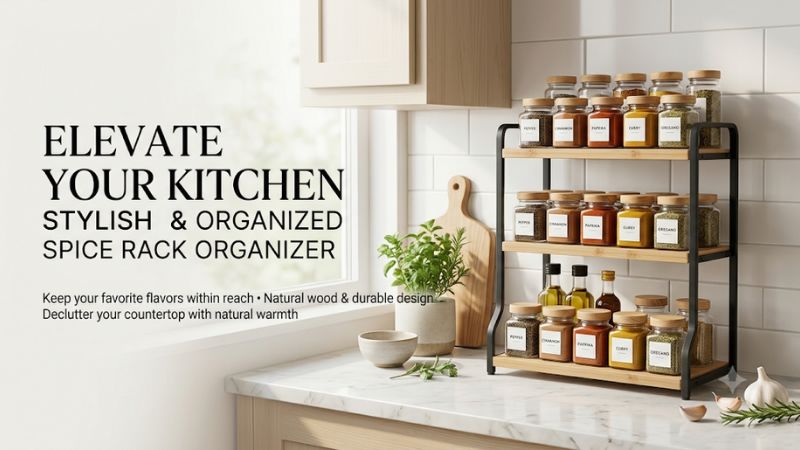
The best spice rack organizer makes your most-used seasonings visible and reachable without turning every dinner into a cabinet search. These six designs solve different space problems, including deep cabinets, narrow pull-outs, shallow drawers, and unused vertical surfaces, so you can choose by the layout of your kitchen instead of appearance alone.
Quick Verdict
Spice racks fail when buyers focus only on bottle count and ignore cabinet doors, drawer depth, unusual jar shapes, and the way people actually cook. A successful system keeps labels readable, prevents a row of jars from hiding another, and allows quick cleanup after a spill. It should also avoid placing seasonings in excessive heat or moisture. Six choices below are presented by best-fit use case rather than by an invented test score. Each recommendation is based on documented product format and the practical fit of that format to common household needs.
- Best cabinet pull-down design: YouCopia SpiceStack, 24 Bottle
- Best flexible drawer option: YouCopia SpiceLiner, 10 Foot
- Best bamboo drawer design: SpaceAid Bamboo Four-Tier
- Best narrow pull-out: Lynk Professional 430421
- Best wall-mounted grouping: SpaceAid Wall-Mount Four-Pack
- Best two-tier slide-out: SpaceAid Two-Drawer Pull-Out
This is not a ranking of six interchangeable step shelves. The SpiceStack keeps many jars inside a cabinet with pull-down access; SpiceLiner and the bamboo organizer turn drawers into spice zones. Lynk and SpaceAid pull-outs reclaim deep cabinet space, and the SpaceAid wall racks create storage outside existing shelves. Your kitchen layout determines the winner.
Spices and dried herbs generally keep their best flavor longer when stored away from direct heat, strong light, and moisture. A rack next to a hot burner may be convenient but exposes bottles to unfavorable conditions. A cooler cabinet or drawer a short step from the cooking zone is usually a better compromise between freshness and accessibility.
Quick Comparison Table
A comparison table is most useful when it makes differences visible without pretending that one unit solves every pantry problem. The capacities and features below describe identified product variants; capacities stated in volume are not automatic promises about the weight of a particular ingredient or the number of unusually sized spice bottles that fit.
| Product | Best For | Key Specifications | Main Advantage | Main Trade-Off |
|---|---|---|---|---|
| YouCopia SpiceStack Adjustable Organizer, 24 Bottle | Cabinet users who want pull-down access to many spices | 24-bottle SpiceStack model | Pull-down drawers improve access to spices behind the front row | Needs adequate depth and front clearance |
| YouCopia SpiceLiner 10-Foot Spice Drawer Organizer | Cooks who want to build a custom spice drawer without hard dividers | 10-foot SpiceLiner drawer organizer roll | Flexible cut-to-fit layout for different drawer widths | Uses valuable drawer real estate |
| SpaceAid Bamboo 4-Tier Drawer Spice Organizer | Drawers that need a stable stepped presentation | Four-tier bamboo drawer organizer format listed by SpaceAid | Structured stepped layout for readable labels | Rigid sizing requires careful measurements |
| Lynk Professional Pull Out Spice Organizer, 430421 | Narrow base cabinets with accessible pull-out mounting space | Lynk model 430421 | Specific dimensions simplify cabinet-fit planning | Mounting and clearance checks required |
| SpaceAid Wall-Mount Spice Rack Organizer, Four-Pack | Small kitchens with open wall or cabinet-door space | SpaceAid markets a four-pack wall-mount spice rack organizer | Uses vertical surfaces rather than shelf area | Installation and mounting surface matter |
| SpaceAid Pull Out Spice Rack, Two-Drawer Two-Tier | Cabinets where a sliding two-level organizer improves reach | SpaceAid markets a heavy-duty pull-out spice rack with two drawers and two tiers | Sliding two-level design uses vertical cabinet space | More demanding clearance requirements |
This is not a ranking of six interchangeable step shelves. The SpiceStack keeps many jars inside a cabinet with pull-down access; SpiceLiner and the bamboo organizer turn drawers into spice zones. Lynk and SpaceAid pull-outs reclaim deep cabinet space, and the SpaceAid wall racks create storage outside existing shelves. Your kitchen layout determines the winner.
How We Selected These Products
These recommendations use verifiable model identities, published product descriptions, and ordinary considerations involved in daily kitchen storage. They are editorial matches to buyer needs, not the result of our own laboratory, durability, leakproof, or cooking tests. When a size or accessory varies by market, the article identifies that uncertainty rather than inventing a universal specification.
- Location: decide cabinet, drawer, wall, or pull-out before browsing designs.
- Jar compatibility: measure your actual tallest, widest, and most irregular bottles.
- Usable clearance: account for hinges, handles, drawer runners, and door swing.
- Installation: distinguish freestanding models from racks requiring mounting.
- Cleaning and visibility: favor systems that expose labels and allow spilled spices to be removed.
Spice racks fail when buyers focus only on bottle count and ignore cabinet doors, drawer depth, unusual jar shapes, and the way people actually cook. A successful system keeps labels readable, prevents a row of jars from hiding another, and allows quick cleanup after a spill. It should also avoid placing seasonings in excessive heat or moisture.
The shortlist deliberately includes different storage formats. A range of formats is more helpful than filling the page with nearly identical sizes of one model, because the main decision is often how the storage works in your home, not which logo appears on the lid. Manufacturer descriptions are treated as descriptions of design, not as independently measured performance.
Detailed Product Recommendations
Below, each recommendation covers the exact product family or model, its intended buyer, the meaningful advantages of its storage design, and the important limitations that a product listing might not emphasize. Read the trade-off as carefully as the headline feature; a container or rack that does not fit your space is not a good purchase regardless of its stated capacity.
The recommendations are ordered to move from straightforward everyday organization to more specialized storage arrangements. They do not imply that the first product has been independently proved superior to the last. Use the comparison table together with the practical examples below.
YouCopia SpiceStack Adjustable Organizer, 24 Bottle
YouCopia SpiceStack Adjustable Organizer, 24 Bottle is most relevant for cabinet users who want pull-down access to many spices. Instead of relying on a step riser that hides labels behind other containers, this design brings drawers forward and down so you can inspect spices at eye level. Its performance depends on the shape and dimensions of your existing spice bottles, so an organizer count is a planning estimate, not a guarantee for oversized jars. Its suitability rests on the documented product format and how that format changes routine storage, not on an invented claim that it outperformed other products in detailed research.
Why we picked it. YouCopia specifically documents this 24-bottle configuration and its three pull-down drawers. That makes it attractive for a busy cook who wants to use the cabinet’s vertical space without relocating the spices to a drawer or drilling into a wall.
Features and practical use. Place the unit near eye height but within comfortable reach, measure the actual cabinet opening, and sort spices by cooking frequency before loading. Put frequently used seasonings on the easiest tray. Close the cabinet carefully to check clearance when drawers are fully retracted and tall jars are loaded.
Important limitation. The mechanism occupies depth and has a fixed shell that may be too tall or wide for older cabinetry. Some unusually shaped containers may not fit the intended slots; check your bottle sizes before assuming the full advertised count.
Key specifications
- 24-bottle SpiceStack model
- Three pull-down trays
- Non-slip feet
- Maker states accommodation for 24 or more spice bottles depending on bottle size
Pros
- Pull-down drawers improve access to spices behind the front row
- Clear 24-bottle model description from the maker
Cons
- Needs adequate depth and front clearance
- Oversized spice jars reduce usable count
Best for and decision summary
- Best for: Cabinet users who want pull-down access to many spices
- Buy if: You prefer cabinet organization and have many standard bottles
- Skip if: You have an unusually shallow cabinet or mostly large jars
What to verify before ordering. Compare the full usable footprint with the exact placement you have in mind. Check the product variant, care instructions, and any accessories or mounting hardware, because a similar product photo is not reliable proof that the item will meet your specific needs.
YouCopia SpiceLiner 10-Foot Spice Drawer Organizer
YouCopia SpiceLiner 10-Foot Spice Drawer Organizer is most relevant for cooks who want to build a custom spice drawer without hard dividers. A roll-style liner changes the problem from finding one rigid rack that fits perfectly to arranging cut sections inside the drawer. Bottles lie at a readable angle and can be rearranged when the spice collection changes. This is useful in wide drawers where fixed stair-step organizers waste space. Its suitability rests on the documented product format and how that format changes routine storage, not on an invented claim that it outperformed other products in detailed research.
Why we picked it. YouCopia identifies a specific 10-foot SpiceLiner organizer and describes the ability to organize more than 30 bottles. It offers a distinctly different solution from the enclosed SpiceStack cabinet unit and suits a kitchen where a spare drawer is available.
Features and practical use. Measure drawer interior height before purchasing and test the tallest jar lying at the intended angle. Cut carefully so strips do not overlap or buckle, then label bottle tops so the spices are recognizable from above. Keep the liner clean and dry to prevent sticky residue around the necks of frequently used jars.
Important limitation. It consumes a full drawer and requires some initial layout work. A quoted bottle count depends heavily on drawer width, bottle shape, and spacing; a narrow drawer may hold far fewer than the advertised example.
Key specifications
- 10-foot SpiceLiner drawer organizer roll
- Maker describes capacity for 30 or more bottles when cut and arranged to fit an appropriate drawer
Pros
- Flexible cut-to-fit layout for different drawer widths
- Does not require wall or cabinet mounting hardware
Cons
- Uses valuable drawer real estate
- Bottles need adequate drawer-height clearance
Best for and decision summary
- Best for: Cooks who want to build a custom spice drawer without hard dividers
- Buy if: You have a spare shallow drawer and want an adaptable organizer
- Skip if: Your drawers are used for utensils or are too shallow
What to verify before ordering. Compare the full usable footprint with the exact placement you have in mind. Check the product variant, care instructions, and any accessories or mounting hardware, because a similar product photo is not reliable proof that the item will meet your specific needs.
SpaceAid Bamboo 4-Tier Drawer Spice Organizer
SpaceAid Bamboo 4-Tier Drawer Spice Organizer is most relevant for drawers that need a stable stepped presentation. Bamboo tiers introduce structure to a drawer and encourage labeling bottles consistently. They are useful where the drawer is deep enough to accommodate several staggered rows without covering the labels. The warm wood finish suits kitchens where the drawer is opened frequently during cooking. Its suitability rests on the documented product format and how that format changes routine storage, not on an invented claim that it outperformed other products in detailed research.
Why we picked it. SpaceAid markets a named four-tier bamboo drawer organizer, creating an alternative for shoppers who want fixed angles rather than cutting soft liner strips. It is especially sensible when the drawer is dedicated to spices and bottle sizes are reasonably consistent.
Features and practical use. Lay out your existing jars on the counter and measure the inside drawer width and depth, accounting for slides and any rounded corners. A nominal four-tier product does not mean four bottles in each direction; the bottle count depends on label orientation. Keep bamboo dry and follow the maker’s cleaning recommendations rather than soaking it.
Important limitation. Rigid tiers are less forgiving of oddly shaped containers and narrow drawers. Bamboo can be damaged by prolonged moisture, so do not install the organizer beneath a recurring sink leak or place wet bottles on it.
Key specifications
- Four-tier bamboo drawer organizer format listed by SpaceAid
- Designed for placing spices in a kitchen drawer
- Check the variant dimensions before ordering
Pros
- Structured stepped layout for readable labels
- Wood appearance suits a dedicated spice drawer
Cons
- Rigid sizing requires careful measurements
- Moisture care matters for bamboo
Best for and decision summary
- Best for: Drawers that need a stable stepped presentation
- Buy if: You have a dedicated drawer of compatible jars
- Skip if: You frequently change bottle sizes or need flexible cut-to-fit sizing
What to verify before ordering. Compare the full usable footprint with the exact placement you have in mind. Check the product variant, care instructions, and any accessories or mounting hardware, because a similar product photo is not reliable proof that the item will meet your specific needs.
Lynk Professional Pull Out Spice Organizer, 430421
Lynk Professional Pull Out Spice Organizer, 430421 is most relevant for narrow base cabinets with accessible pull-out mounting space. A narrow pull-out shelf solves a different problem than a countertop spinner: it lets you use cabinet depth without reaching behind front bottles. Its metal hardware and mounting approach make it better suited to a planned long-term cabinet setup than a movable plastic step shelf. Its suitability rests on the documented product format and how that format changes routine storage, not on an invented claim that it outperformed other products in detailed research.
Why we picked it. Lynk documents the specific model number and usable dimensions, which are essential when a rack must fit a narrow cabinet opening. The known ten-jar capacity is helpful for people who keep only a core set of seasonings near the stove.
Features and practical use. Measure the clear opening, not just the exterior face-frame width, and account for door hinges, plumbing, and protruding handles. Confirm the installation hardware and mounting surface support the rack. Leave comfortable space to pull it completely forward, then check that spice labels are visible without twisting your wrist.
Important limitation. Installation is more involved than setting a freestanding rack on a shelf. A ten-jar organizer may be insufficient for a large spice collection, and it should not be treated as a universal no-drill accessory.
Key specifications
- Lynk model 430421
- 4.2-inch width, adjustable 10.3-to-12.8-inch depth, 2.5-inch height listed by maker
- Designed for 10 standard spice jars
- Jars not included
Pros
- Specific dimensions simplify cabinet-fit planning
- Pull-out access avoids reaching deep into narrow spaces
Cons
- Mounting and clearance checks required
- Only ten standard jars in the referenced version
Best for and decision summary
- Best for: Narrow base cabinets with accessible pull-out mounting space
- Buy if: You have a narrow cabinet section and can install hardware
- Skip if: You rent, cannot drill, or need storage for dozens of bottles
What to verify before ordering. Compare the full usable footprint with the exact placement you have in mind. Check the product variant, care instructions, and any accessories or mounting hardware, because a similar product photo is not reliable proof that the item will meet your specific needs.
SpaceAid Wall-Mount Spice Rack Organizer, Four-Pack
SpaceAid Wall-Mount Spice Rack Organizer, Four-Pack is most relevant for small kitchens with open wall or cabinet-door space. Moving bottles from a crowded shelf onto an unused vertical surface can free prime cabinet space. A set of narrow racks offers multiple zones: everyday cooking spices at hand, baking spices away from splashes, and seldom-used jars higher up. The result depends on reliable mounting and door clearance. Its suitability rests on the documented product format and how that format changes routine storage, not on an invented claim that it outperformed other products in detailed research.
Why we picked it. SpaceAid identifies a four-pack wall-mounted organizer in its spice-storage line. This arrangement is useful where drawer space is scarce and cabinet depth is too shallow for large pull-down mechanisms.
Features and practical use. Avoid installing racks over active steam, direct burner heat, or the sink splash zone. If mounting on a cabinet door, check the door’s load capacity and whether full jars contact the shelves inside when closing. Select appropriate hardware for the mounting material and recheck fasteners after the first period of use.
Important limitation. Wall mounting involves holes or suitable installation hardware, and visible bottles may collect more grease or dust than those stored inside a closed cabinet. Wooden racks also need protection from repeated moisture exposure.
Key specifications
- SpaceAid markets a four-pack wall-mount spice rack organizer
- Wooden wall/door rack format
- Confirm bracket dimensions and fasteners on the chosen product
Pros
- Uses vertical surfaces rather than shelf area
- Four separate racks allow zone-based grouping
Cons
- Installation and mounting surface matter
- Spices are more exposed in open-kitchen areas
Best for and decision summary
- Best for: Small kitchens with open wall or cabinet-door space
- Buy if: You have unused vertical space and can mount racks securely
- Skip if: You need a no-installation organizer or cook in a very steamy location
What to verify before ordering. Compare the full usable footprint with the exact placement you have in mind. Check the product variant, care instructions, and any accessories or mounting hardware, because a similar product photo is not reliable proof that the item will meet your specific needs.
SpaceAid Pull Out Spice Rack, Two-Drawer Two-Tier
SpaceAid Pull Out Spice Rack, Two-Drawer Two-Tier is most relevant for cabinets where a sliding two-level organizer improves reach. Two levels separate high-use bottles from occasional ingredients while allowing the whole assembly to slide toward the cook. This can make a narrow pantry zone function better than a three-row step shelf, provided there is enough cabinet height and the door opening does not block the movement. Its suitability rests on the documented product format and how that format changes routine storage, not on an invented claim that it outperformed other products in detailed research.
Why we picked it. The SpaceAid pull-out line documents a two-drawer, two-tier model, distinct from its bamboo drawer and wall-mounted organizers. It is a practical choice when a household wants more storage than a single narrow pull-out without switching to a full drawer installation.
Features and practical use. Before purchase, measure both usable shelf height and the opening width after accounting for hinges. Plan where tall bottles will go, because the upper tier may impose a height limit on the lower tier. Load both sides evenly and pull slowly during the first week while confirming that nothing catches the cabinet frame.
Important limitation. Its double-tier geometry adds height, hardware, and fit complexity, making it unsuitable for shallow or irregular cabinets. More moving pieces mean more opportunities for obstructed slides if spills or granules are ignored.
Key specifications
- SpaceAid markets a heavy-duty pull-out spice rack with two drawers and two tiers
- Confirm configuration dimensions for the exact listing
Pros
- Sliding two-level design uses vertical cabinet space
- Separates frequently used and backup spice bottles
Cons
- More demanding clearance requirements
- Must keep sliding tracks clear of spills
Best for and decision summary
- Best for: Cabinets where a sliding two-level organizer improves reach
- Buy if: You have a cabinet with adequate height and want high-capacity access
- Skip if: You need a no-drill option or have low fixed shelves
What to verify before ordering. Compare the full usable footprint with the exact placement you have in mind. Check the product variant, care instructions, and any accessories or mounting hardware, because a similar product photo is not reliable proof that the item will meet your specific needs.
Buying Guide: What Matters Before You Order
Measure the available space after opening the cabinet or drawer, not from the exterior front. The doors, hinges, and countertop overhang may remove inches from the useful opening. Then arrange the bottles you own into a realistic group, including the tall chili grinder and the wide baking-spice jar that advertisements rarely show. The considerations below provide a repeatable checklist that applies to the six models, and they also help assess products that are not on this shortlist. Treat the guidance as a way to make a fit-for-purpose decision, not a reason to overbuy features.
Start by measuring the location, counting your typical supply, and deciding how often you open the container or rack. The following factors explain why different homes benefit from different designs.
Drawer vs cabinet vs wall storage
Drawers expose labels from above and can place seasonings close to a prep station, but they consume space that might otherwise hold tools. Cabinet organizers use shelf height and depth, although bottles can become hard to reach. Wall racks save cabinet space yet need secure installation and protection from direct cooking heat. This factor also changes ongoing maintenance and the amount of extra time needed in the kitchen, so it deserves attention even if a product looks attractive or has a prominent marketing claim.
Choose a location first and a rack second. Walk through a normal recipe and notice whether you open a cabinet, pull a drawer, or reach across the stove. A beautifully arranged rack that forces awkward movement several times every dinner will not remain organized.
Practical checks
- Measure the real storage space and available access path before buying.
- Verify the exact product model, size, lid, or mounting configuration.
- Choose a setup you can inspect and clean without special effort.
Consider your future routine as well as the first day after installation or decanting. A product that solves one nuisance but creates daily handling problems is unlikely to remain useful over time.
Bottle sizes and realistic capacity
Published bottle counts assume some standard shape and spacing; tall grinders, oversized jars, and round tins can break that assumption. Measure each unusual container, then check the clear rack dimensions rather than only a photo. Replacing every spice jar just to match an organizer adds avoidable cost and work. This factor also changes ongoing maintenance and the amount of extra time needed in the kitchen, so it deserves attention even if a product looks attractive or has a prominent marketing claim.
For a pull-down organizer, test the largest bottle in the top and bottom locations if possible. For a drawer, measure bottle height after the jar is angled. A rack designed for 24 ordinary bottles may hold fewer specialty spice containers, and there is nothing wrong with choosing two smaller zones.
Practical checks
- Measure the real storage space and available access path before buying.
- Verify the exact product model, size, lid, or mounting configuration.
- Choose a setup you can inspect and clean without special effort.
Consider your future routine as well as the first day after installation or decanting. A product that solves one nuisance but creates daily handling problems is unlikely to remain useful over time.
Mounting, safety, and mechanical clearance
Freestanding units are easy to reposition, while installed pull-outs and wall racks can provide more efficient use of awkward spaces. Installation adds requirements: the surface must support the load, hardware must fit, and the sliding or swinging mechanism must not strike hinges or stored cookware. This factor also changes ongoing maintenance and the amount of extra time needed in the kitchen, so it deserves attention even if a product looks attractive or has a prominent marketing claim.
Avoid placing a full wall rack above a burner or directly over food preparation where falling glass could be dangerous. Confirm that an opened cabinet door does not cause bottles to hit shelves. Do not rely on an adhesive mounting method for loaded glass jars unless the exact maker approves it for that use.
Practical checks
- Measure the real storage space and available access path before buying.
- Verify the exact product model, size, lid, or mounting configuration.
- Choose a setup you can inspect and clean without special effort.
Consider your future routine as well as the first day after installation or decanting. A product that solves one nuisance but creates daily handling problems is unlikely to remain useful over time.
Finding spices quickly and keeping them usable
Alphabetical organization works for large collections, while task-based groups can be faster for cooks who regularly use the same few blends. Put the most-used seasonings within easy reach and label tops when storing bottles horizontally in drawers. A consistent naming system prevents buying a third jar of something already hidden. This factor also changes ongoing maintenance and the amount of extra time needed in the kitchen, so it deserves attention even if a product looks attractive or has a prominent marketing claim.
Keep bottles closed, remove spills promptly, and avoid storing them where steam from a kettle or dishwasher repeatedly strikes the lids. Rotate older jars forward and check aroma before cooking; a tidy organizer cannot restore flavor to stale herbs.
Practical checks
- Measure the real storage space and available access path before buying.
- Verify the exact product model, size, lid, or mounting configuration.
- Choose a setup you can inspect and clean without special effort.
Consider your future routine as well as the first day after installation or decanting. A product that solves one nuisance but creates daily handling problems is unlikely to remain useful over time.
Which Setup Fits Your Household?
A useful purchase should fit a household scenario rather than an abstract product ranking. The same nominal capacity or bottle count can be convenient in one kitchen and entirely wrong in another. The examples below connect shopping frequency, available space, and daily habits to practical storage arrangements without assuming that all homes share one ideal layout.
- A cook with one large, tall cabinet may get more use from a pull-down rack than from a fixed three-tier riser.
- An apartment with a spare wide drawer can gain quick label visibility with angled inserts or a flexible liner.
- A kitchen with thin vertical gaps may justify an installed pull-out if the hinges and shelves allow full travel.
- A renter who cannot drill should avoid mounted products unless the chosen installation method is explicitly permitted.
Spices and dried herbs generally keep their best flavor longer when stored away from direct heat, strong light, and moisture. A rack next to a hot burner may be convenient but exposes bottles to unfavorable conditions. A cooler cabinet or drawer a short step from the cooking zone is usually a better compromise between freshness and accessibility.
Before you buy, perform a five-minute setup test: imagine filling the container or mounting the rack, opening it when cooking, getting the ingredient you need, closing it with one hand occupied, and cleaning it after a spill. If any step seems awkward, compare another storage format.
Frequently Asked Questions
These practical questions come up when readers try to translate a product’s specifications into everyday storage decisions. They also clarify the limits of claims such as airtight, high capacity, and space-saving. Consider the answers in the context of your own ingredient type, jar collection, cooking frequency, and the manufacturer’s exact instructions.
The answers focus on reasonable handling, compatibility, and quality rather than promises that any organizer or container works perfectly in every kitchen.
What is the best spice rack for a small kitchen?
First identify unused space: a spare shallow drawer, a narrow cabinet gap, or an interior wall away from steam. A drawer liner uses existing space flexibly, while a narrow pull-out can be excellent if the cabinet dimensions allow installation. No single organizer style wins for every small kitchen. The useful decision is to match the storage practice to the product you actually own and the conditions in your kitchen. A product description may explain a feature but does not replace attention to cleanliness, compatibility, and realistic use.
Practical takeaway: Before purchasing, verify the exact model, its documented cleaning or installation instructions, and the dimensions available in your kitchen. General advice cannot replace these fit checks.
How do I measure for a pull-out spice rack?
Measure the clear cabinet opening after accounting for the door, hinges, and face frame. Check depth along the entire travel path and any fixed shelf above. Then compare those measurements with the chosen rack’s dimensions and installation instructions, not just the width advertised in a listing. The useful decision is to match the storage practice to the product you actually own and the conditions in your kitchen. A product description may explain a feature but does not replace attention to cleanliness, compatibility, and realistic use.
Practical takeaway: Before purchasing, verify the exact model, its documented cleaning or installation instructions, and the dimensions available in your kitchen. General advice cannot replace these fit checks.
Should spice bottles be next to the stove?
Convenience matters, but persistent heat, light, and steam can reduce flavor quality and lead to clumping. A nearby drawer or closed cabinet is usually a better location than a rack directly beside an active burner. Keep bottles tightly closed and avoid shaking spices over a steaming pot. The useful decision is to match the storage practice to the product you actually own and the conditions in your kitchen. A product description may explain a feature but does not replace attention to cleanliness, compatibility, and realistic use.
Practical takeaway: Before purchasing, verify the exact model, its documented cleaning or installation instructions, and the dimensions available in your kitchen. General advice cannot replace these fit checks.
Can a drawer organizer fit mixed spice jar brands?
Sometimes, but the results depend on jar height, width, and lid shape. Flexible cut-to-fit liners tend to accommodate mixed arrangements more readily than rigid slots. Measure the largest and smallest jars before choosing and leave some room for additions. The useful decision is to match the storage practice to the product you actually own and the conditions in your kitchen. A product description may explain a feature but does not replace attention to cleanliness, compatibility, and realistic use.
Practical takeaway: Before purchasing, verify the exact model, its documented cleaning or installation instructions, and the dimensions available in your kitchen. General advice cannot replace these fit checks.
Are wall-mounted spice racks suitable for renters?
They can be if the mounting method is permitted and appropriate for the wall or cabinet material. Many mounted organizers require screws, which may not be allowed under a rental agreement. A freestanding cabinet organizer or drawer insert is easier to remove without making changes to the property. The useful decision is to match the storage practice to the product you actually own and the conditions in your kitchen. A product description may explain a feature but does not replace attention to cleanliness, compatibility, and realistic use.
Practical takeaway: Before purchasing, verify the exact model, its documented cleaning or installation instructions, and the dimensions available in your kitchen. General advice cannot replace these fit checks.
Conclusion
The right spice rack organizer depends on where your jars can live and how you reach them while cooking. YouCopia SpiceStack is a strong cabinet choice when its dimensions and bottle sizes fit, while SpiceLiner and SpaceAid bamboo tiers make sense for dedicated drawers. Lynk and SpaceAid pull-outs serve narrow, deeper cabinet spaces, and wall racks help when installation is allowed and the location is away from heat. Measure real clearance, group spices around your cooking habits, and choose an organizer you can clean and maintain rather than buying by advertised bottle count alone.






Write Your Review
No reviews yet. Be the first to share your experience!