
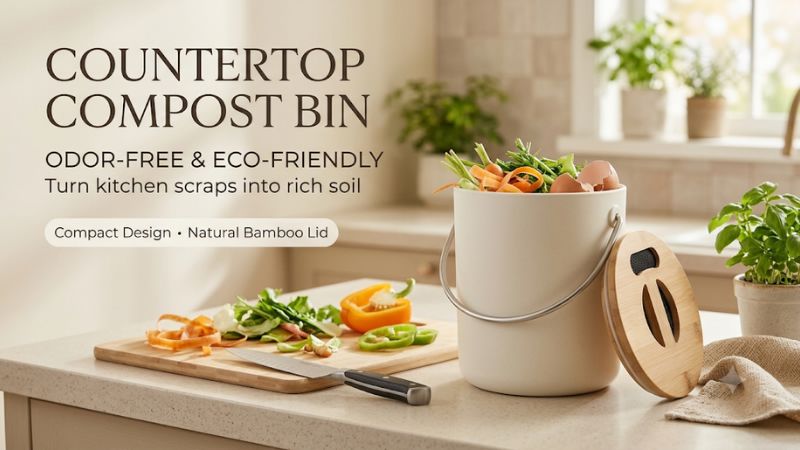
A countertop compost bin gives fruit peels, vegetable trimmings, and used coffee grounds a convenient collection point during meal preparation. Unlike a full composting system, it temporarily holds scraps until they reach an appropriate outdoor bin or collection service. This roundup compares six real countertop options by capacity, lid design, odor management, and daily cleaning.
- Quick Verdict: The Best Countertop Compost Bin Options
- Quick Comparison Table
- How We Selected These Countertop Compost Bins
- Detailed Reviews of Six Countertop Compost Bins
- Buying Guide: How to Choose a Countertop Compost Bin
- Which Countertop Compost Bin Fits Your Kitchen?
- Common Countertop Compost Bin Mistakes
- Frequently Asked Questions
- Conclusion
Quick Verdict: The Best Countertop Compost Bin Options
Countertop compost bins should be selected for how they fit into a normal cooking routine rather than for the strongest odor-control claim or most decorative appearance. Some use replaceable charcoal filters, others emphasize airflow, and certain designs prioritize easy access over a tight seal. The best option keeps food scraps separate, provides enough capacity between emptying sessions, and can be cleaned thoroughly without a complicated routine.
Our recommended products:
- Best compact everyday option: OXO Good Grips Easy-Clean Compost Bin, 0.75 Gallon.
- Best traditional steel bucket: EPICA Stainless Steel Compost Bin, 1.3 Gallon.
- Best decorative countertop choice: Bamboozle Astrik Compost Bin.
- Best stainless steel premium caddy: Joseph Joseph Collect 4L Stainless-Steel Food Waste Caddy.
- Best ventilated collector: Full Circle Fresh Air Compost Collector.
- Best integrated kitchen solution: simplehuman Compost Caddy, 4 Liter.
The OXO 0.75-gallon bin is a sensible starting point for small kitchens because its compact shape and simple lid suit frequent food-preparation tasks.
EPICA is better suited to buyers who want a conventional steel bucket with a charcoal-filtered lid.
Bamboozle emphasizes plant-based materials and countertop appearance, while Joseph Joseph’s Collect uses a stainless steel exterior and a filtered collection system.
Full Circle takes a ventilation-oriented approach, and simplehuman offers convenient integration with compatible household waste stations.
These products are not electric composting machines. They are collection containers, and the contents still require proper processing elsewhere.
Quick Comparison Table
Choosing a countertop compost collector involves practical trade-offs between size, appearance, filtration, and cleaning. Small buckets fit beside busy preparation areas but require frequent emptying, while larger containers provide more working capacity at the expense of valuable counter space. The table below summarizes six identifiable products without making unsupported claims about measured odor reduction or long-term durability.
| Product | Capacity | Best For | Key Feature | Important Limitation |
|---|---|---|---|---|
| OXO Easy-Clean Compost Bin | 0.75 gal | Compact kitchens | Stay-open lid and removable construction | Frequent emptying |
| EPICA Stainless Steel Compost Bin | 1.3 gal | Traditional bucket storage | Stainless steel and charcoal filter | Filter maintenance |
| Bamboozle Astrik Compost Bin | Verify selected variant | Decorative counters | Plant-based material and filtered lid | Variant and filter checks |
| Joseph Joseph Collect | 4 L | Premium countertop setup | Stainless steel housing and odor-filtered lid | Smaller capacity |
| Full Circle Fresh Air | 1.5 gal | Airflow-focused collection | Ventilated design | Needs frequent inspection |
| simplehuman Compost Caddy | 4 L | Integrated waste stations | Magnetic docking and removable bucket | Docking compatibility |
Capacity should be considered alongside how often scraps are transferred to a final composting destination. A small container is not necessarily inconvenient when collection is available daily, and a larger bucket may be unnecessary when the household produces only a small amount of food waste.
The best value comes from buying the right format rather than paying for unused features.
How We Selected These Countertop Compost Bins
The selection considers real product designs and the everyday challenges of collecting wet kitchen scraps. We prioritized capacity, lid accessibility, carrying comfort, cleaning, odor-management design, materials, and countertop footprint. These recommendations are based on manufacturer information and practical editorial judgment, not claims that we personally measured odors, tested filters, or compared bacterial growth.
Evaluation criteria
- Footprint: How much preparation space the container occupies.
- Capacity: Whether the bucket fits the household’s waste volume.
- Opening: Ease of adding scraps directly from a cutting board.
- Lid management: Stay-open, removable, or filtered designs.
- Carrying: Practicality of lifting and transferring a full bucket.
- Cleaning: Accessible interiors and removable components.
- Consumables: Replacement filters or compatible liners.
- Appearance: Suitability for visible kitchen storage.
- Waste handling: Compatibility with the household’s disposal routine.
We also considered whether a product’s strongest feature is genuinely useful in a typical kitchen.
A magnetic dock may be extremely convenient for a compatible trash can but less valuable elsewhere.
Similarly, a decorative material may justify a purchase for an open kitchen without improving the basic process of collecting food scraps.
Detailed Reviews of Six Countertop Compost Bins
The products below serve different household priorities, from compact daily collection to decorative storage and integrated waste sorting. Each review covers the main design, intended users, practical use, relevant maintenance needs, and limitations to consider before purchasing. The goal is to help shoppers choose a realistic collector rather than assume that one filtered bucket is universally better than every other design.
OXO Good Grips Easy-Clean Compost Bin, 0.75 Gallon
The OXO Good Grips Easy-Clean Compost Bin in the 0.75-gallon size is a compact kitchen scrap collector designed for everyday food preparation. Its rectangular body takes up relatively little counter space, and the lid can stay open while scraps are added. The smaller capacity encourages a frequent emptying routine, making it particularly useful for households with convenient outdoor compost bins or regular organics collection.
Best For
- Small apartments.
- One- or two-person households.
- Daily vegetable preparation.
- Frequent compost drop-off access.
- Kitchens with limited countertop space.
Key Specifications
- Brand: OXO Good Grips.
- Product: Easy-Clean Compost Bin.
- Selected capacity: 0.75 gallon, approximately 2.8 liters.
- Body: Plastic.
- Lid: Designed to stay open during filling.
- Placement: Countertop or suitable alternative storage.
- Cleaning: Follow the model’s care instructions.
Why We Picked It
Compact bins work well when the main problem is keeping scraps off the cutting board.
The OXO design provides a clear destination for peelings, trimmings, and coffee grounds without requiring a large countertop footprint.
Features and Practical Performance
During food preparation, open the lid and position the bin close enough that scraps can be transferred without crossing the cooking area.
A small amount of food waste can be collected quickly, and the entire container can be moved to the disposal point after the meal.
The lid helps conceal contents but should not be treated as a long-term odor barrier.
A 0.75-gallon bucket fills relatively quickly, especially when cooking fresh vegetables for several people.
That limitation may actually support better waste handling by encouraging regular emptying.
If your household prepares large meals daily, however, a larger bucket may require fewer interruptions.
Pros
- Compact footprint.
- Simple access during cooking.
- Easy-to-understand design.
- Encourages frequent emptying.
- Suitable for modest scrap loads.
Cons
- Limited working capacity.
- No large integrated storage system.
- Must still be washed and emptied regularly.
Buy If
You need a small countertop container for food scraps and can empty it frequently.
Skip If
You produce large quantities of kitchen waste during every meal.
EPICA Stainless Steel Compost Bin, 1.3 Gallon
The EPICA Stainless Steel Compost Bin is a traditional countertop bucket with a removable lid, carrying handle, and charcoal filter. Its 1.3-gallon size provides more space than a very compact kitchen caddy without becoming an oversized waste container. It is especially relevant to households that prefer the appearance and straightforward handling of a stainless steel bucket.
Best For
- Small and medium kitchens.
- Traditional countertop setups.
- Users wanting an odor filter.
- Frequent fruit and vegetable preparation.
- Households preferring metal construction.
Key Specifications
- Brand: EPICA.
- Product: Stainless Steel Compost Bin.
- Capacity: 1.3 gallons.
- Material: Stainless steel.
- Lid: Removable.
- Filter: Replaceable activated charcoal.
- Handle: Integrated carrying handle.
- Placement: Countertop.
Why We Picked It
The EPICA bucket offers a familiar collection method without complex moving parts.
The filtered lid addresses a common concern about kitchen scrap odors, while the handle makes transferring contents straightforward.
Features and Practical Performance
Place the bucket near the food preparation area during cooking.
After collecting scraps, return the lid to its intended position.
The charcoal filter is designed to help reduce some odors, but it is not a substitute for emptying the container before waste deteriorates excessively.
Check the filter regularly and replace it according to the manufacturer’s instructions.
The underside of the lid and the bucket rim should also be cleaned carefully because wet food residue may collect in those areas.
Stainless steel can show fingerprints and water marks, so users who prefer a consistently polished appearance may need to wipe the exterior more frequently.
Pros
- Traditional bucket format.
- Stainless steel body.
- Replaceable charcoal filter.
- Practical carrying handle.
- Moderate working capacity.
Cons
- Ongoing filter purchases.
- Lid and rim need regular cleaning.
- Metal surface may show fingerprints.
Buy If
You prefer a traditional countertop collector with a charcoal-filtered lid and moderate capacity.
Skip If
You want a filter-free ventilated system or an especially small bucket.
Bamboozle Astrik Compost Bin
The Bamboozle Astrik Compost Bin is intended for households that want a food-scrap collector to look like a considered part of the kitchen rather than an ordinary trash bucket. Its plant-based Astrik material and filtered lid give it a distinctive combination of appearance and construction. The product is particularly relevant to open kitchens where the compost collector remains visible during meal preparation and throughout the day.
Best For
- Open countertop layouts.
- Design-conscious households.
- Moderate food-scrap collection.
- Users interested in plant-based material alternatives.
- Buyers comfortable maintaining filters.
Key Specifications
- Brand: Bamboozle.
- Product: Astrik Compost Bin.
- Body material: Astrik plant-based material.
- Lid: Filtered configuration.
- Placement: Countertop.
- Cleaning: Manufacturer describes dishwasher-safe construction.
- Size and included accessories: Confirm the exact selected variant.
Why We Picked It
A food-waste collector is most useful when household members actually use it.
For some kitchens, a decorative design makes it easier to keep the container near the cutting board instead of hiding it in an inconvenient cabinet.
Features and Practical Performance
The Astrik bin can serve as a defined location for vegetable trimmings and other approved food scraps during cooking.
Its filtered lid is intended to help manage odors, but filter performance depends on the waste collected and how frequently the bin is emptied.
The plant-based material is an important part of the product’s appeal, yet it should not be confused with permission to place the complete bin into municipal compost collection.
Disposal requirements depend on the material, processing conditions, and local facility rules.
Also confirm the exact variant before buying because dimensions, accessories, and filter arrangements may differ.
Pros
- Decorative appearance.
- Plant-based body material.
- Filtered lid.
- Manufacturer-described dishwasher-safe cleaning.
- Suitable for visible countertop placement.
Cons
- Filter maintenance.
- Capacity and package details require variant checks.
- Material disposal claims can be misunderstood.
Buy If
You want a countertop compost collector that complements a carefully designed kitchen.
Skip If
You prefer a simple low-maintenance utility bucket without replacement filters.
Joseph Joseph Collect 4L Stainless-Steel Food Waste Caddy
The Joseph Joseph Collect 4L Stainless-Steel Food Waste Caddy combines a compact food-scrap bucket with a stainless steel exterior and an odor-filtered lid. Its four-liter capacity makes it practical for kitchens where a large compost collector would consume too much space. The design is especially appealing to users who want everyday food-waste collection with a more refined countertop appearance.
Best For
- Modern kitchens.
- Compact countertops.
- Daily cooking.
- Users wanting filter-based odor management.
- Households preferring a steel exterior.
Key Specifications
- Brand: Joseph Joseph.
- Product: Collect Stainless-Steel Food Waste Caddy.
- Capacity: 4 liters.
- Exterior: Stainless steel.
- Lid: Filtered arrangement.
- Placement: Countertop.
- Accessories: Confirm compatible filter and liner options.
Why We Picked It
The Collect occupies a middle ground between a decorative compost bucket and an ordinary utility container.
Its four-liter format provides useful daily capacity without requiring a large countertop area.
Features and Practical Performance
Use the caddy for scraps generated during ordinary meal preparation, then empty it before wet waste begins accumulating for too long.
The filtered lid may help manage odors, but its effectiveness varies with the type and age of scraps.
The stainless steel exterior is appropriate for visible storage, although it still requires regular wiping.
Pay particular attention to the lid and any interior components when cleaning. Food residue can create odors even when the exterior looks clean.
Before ordering, verify the exact model because Joseph Joseph offers several food-waste caddies with different lid configurations and materials.
The Collect and Stack product families should not be treated as interchangeable when buying replacement accessories.
Pros
- Compact four-liter capacity.
- Stainless steel appearance.
- Filter-based lid.
- Convenient for everyday scraps.
- Suitable for visible countertop storage.
Cons
- Filter maintenance.
- Modest capacity for large households.
- Related product families may cause accessory confusion.
Buy If
You want a compact stainless steel food-waste caddy with a filtered lid.
Skip If
You need a large collector or prefer a completely filter-free system.
Full Circle Fresh Air Compost Collector
The Full Circle Fresh Air Compost Collector is a ventilation-focused kitchen food-scrap container with a 1.5-gallon capacity. Its design allows airflow around collected materials instead of relying entirely on a tightly closed lid. The relatively generous capacity makes it attractive to households preparing fresh food regularly, especially when they have a convenient compost collection destination.
Best For
- Regular family cooking.
- Airflow-focused food-scrap collection.
- Households avoiding replacement charcoal filters.
- Larger produce preparation sessions.
- Kitchens with adequate counter space.
Key Specifications
- Brand: Full Circle.
- Product: Fresh Air Compost Collector.
- Capacity: 1.5 gallons, approximately 5.7 liters.
- Published dimensions: Approximately 11.38 × 8.5 × 9 inches.
- Design: Ventilation-oriented.
- Intended use: Temporary organic-waste collection.
Why We Picked It
Many compost buckets are designed around sealing odors inside.
Full Circle takes a different approach by allowing airflow through the collection system.
This makes it a useful alternative for shoppers who prefer a ventilated design.
Features and Practical Performance
The container can hold a substantial amount of fruit peels, vegetable scraps, and other approved materials while preparing family meals.
Its larger footprint requires planning, especially in a compact kitchen.
Measure the area beside the sink and leave enough clearance to open the lid comfortably.
Ventilation may help manage moisture conditions, but it does not eliminate insect attraction or odor concerns.
The collector still needs prompt emptying, particularly during warm weather.
A compatible liner may make cleaning easier, but local compost acceptance rules should determine the liner material.
Pros
- Generous working capacity.
- Ventilation-focused design.
- No dependence on charcoal filter replacements.
- Practical for frequent cooking.
- Clear published dimensions.
Cons
- Larger footprint.
- Not a sealed transport bucket.
- Frequent emptying remains necessary.
Buy If
You prepare substantial amounts of fresh food and prefer a ventilated collection system.
Skip If
You have a tiny counter or need a secure container for carrying waste in a vehicle.
simplehuman Compost Caddy, 4 Liter
The simplehuman Compost Caddy is a four-liter collection container that can dock magnetically onto compatible simplehuman trash cans or be detached for countertop food preparation. Its removable inner bucket is designed to make emptying and cleaning straightforward. The product is particularly useful for households seeking an organized waste station where ordinary trash and approved organic materials have clearly separate destinations.
Best For
- Compatible simplehuman trash systems.
- Small and medium households.
- Integrated waste separation.
- Daily meal preparation.
- Users wanting a detachable collector.
Key Specifications
- Brand: simplehuman.
- Product: Compost Caddy.
- Selected capacity: 4 liters.
- Referenced model: CW1645.
- Attachment: Magnetic dock.
- Interior: Removable handled bucket.
- Lid: Detachable.
- Placement: Docked or countertop.
Why We Picked It
The caddy addresses an organizational problem that ordinary standalone buckets do not.
It gives food scraps a predictable place beside the main trash container while remaining detachable during cooking.
Features and Practical Performance
Detach the caddy and place it beside the cutting board while preparing ingredients.
Afterward, return it to the compatible docking position.
This can reduce unnecessary trips between the preparation area and the kitchen trash station.
The removable bucket also makes it easier to transfer scraps and clean the interior.
However, the magnetic docking feature depends on compatibility with the intended trash can.
Buyers who do not own a suitable simplehuman container should evaluate whether the standalone caddy is worth the expense.
Pros
- Integrated kitchen organization.
- Magnetic docking.
- Removable inner bucket.
- Detachable for food preparation.
- Compact capacity.
Cons
- Docking requires compatible equipment.
- Smaller than large household collectors.
- Liner accessories may add recurring expense.
Buy If
You already have a compatible simplehuman trash can and want convenient food-scrap separation.
Skip If
You want an independent large-capacity collector without a coordinated waste system.
Buying Guide: How to Choose a Countertop Compost Bin
The right countertop food-scrap collector should make daily waste separation easier without occupying excessive preparation space or introducing unpleasant maintenance tasks. Capacity, appearance, lid construction, and filtration all matter, but the most important buying decision is how the container fits into the journey from cutting board to final compost destination. Consider the following factors before choosing a product.
Choose the Right Capacity for Your Household
A compact countertop bucket is useful when scraps are removed regularly, while a larger collector can accommodate the volume generated by family cooking. The correct size depends not only on the number of people in the household but also on the amount of fresh produce prepared and the frequency of compost disposal.
Practical capacity ranges
- Around 3 liters: Small households and frequent emptying.
- Around 4 liters: Many everyday kitchen routines.
- Around 5–6 liters: Larger fresh-food preparation sessions.
- More than 6 liters: Higher-volume needs with adequate space.
Do not purchase the largest available bucket simply to reduce how often you carry scraps outdoors.
Food waste can develop odors and attract insects when left indoors.
An easy-to-empty compact bin may perform better for your routine than a larger container that remains full for several days.
Understand Odor Filters and Ventilation
Odor management is often the primary reason shoppers choose one countertop compost bin over another. Charcoal filters, ventilation channels, covered lids, and frequent emptying all affect the user experience in different ways. However, no ordinary container eliminates the effects of food decomposition, especially when scraps contain considerable moisture.
Compare common approaches
- Charcoal filter: Intended to absorb some odors.
- Ventilation: Encourages airflow around the collected waste.
- Covered bucket: Conceals contents and limits direct exposure.
- Removable liner: Simplifies emptying and cleaning.
- Frequent disposal: Reduces the time scraps remain indoors.
A filtered caddy may be useful for households concerned about odor, but filters require replacement.
A ventilated caddy can reduce reliance on filters but may not suit someone needing a secure travel container.
Choose according to your priorities rather than assuming a single approach solves every problem.
Measure Countertop Space and Lid Clearance
A compost bin should be accessible during cooking without interfering with knives, cutting boards, sinks, appliances, or hot cooking surfaces. Measure the available footprint and consider how much additional clearance the lid needs when opened. A compact container may still be inconvenient if it must be moved every time the coffee machine or food processor is used.
Measurement checklist
- Available countertop width.
- Available depth.
- Height beneath cabinets.
- Clearance for opening the lid.
- Distance from the sink.
- Distance from heat-producing appliances.
- Available carrying path to the disposal point.
Place the container where food scraps are created, but not where wet waste could contaminate clean food or preparation equipment.
Avoid positioning it beside a hot stove or directly in the path of steam.
A location that supports easy cleaning is more valuable than one chosen solely for appearance.
Consider Cleaning and Replacement Accessories
Cleaning requirements can influence long-term satisfaction more than the initial purchase price. A decorative container with a complicated lid may look attractive but require considerable attention around the filter housing. Conversely, a simple removable bucket may be easier to maintain. Replacement filters and special liners can also add recurring costs.
Check before buying
- Can the lid be removed?
- Can the interior be washed separately?
- Is the exact model dishwasher-safe?
- Are replacement filters available?
- Does the manufacturer recommend special liners?
- Are liners accepted by the compost facility?
- Can the container dry thoroughly?
- Are there narrow areas that trap residue?
A compost caddy should not become an additional source of kitchen grime.
Choose an arrangement that can be emptied and cleaned regularly without unnecessary effort.
Which Countertop Compost Bin Fits Your Kitchen?
Different kitchen routines call for different collection designs. A person who cooks occasionally may prefer a small lightweight bucket, while a family preparing fresh food daily may benefit from a larger container. Open kitchens can make appearance more relevant, and households with coordinated trash stations may appreciate an integrated caddy. The examples below connect these preferences to practical design choices.
For small apartments
- Choose a compact three- or four-liter collector.
- Prioritize easy carrying.
- Avoid unnecessary countertop accessories.
- Empty scraps frequently.
For family kitchens
- Consider a five- or six-liter bucket.
- Use a wide opening for food preparation.
- Keep the lid easy to operate.
- Clean the interior regularly.
For design-focused kitchens
- Choose a visible countertop appearance you like.
- Confirm that appearance does not compromise cleaning.
- Check material-care requirements.
- Consider replacement filter availability.
For integrated waste stations
- Choose a caddy compatible with the main trash system.
- Keep organics separate from general waste.
- Ensure the inner bucket is easy to remove.
- Maintain a consistent emptying routine.
Common Countertop Compost Bin Mistakes
A well-designed bucket can still become inconvenient when household practices are inconsistent. Odors, leaks, and insects are often caused by leaving wet scraps inside too long, using an unsuitable liner, or failing to clean the lid. Understanding these problems helps prevent the assumption that buying a more expensive bin will automatically solve every waste-management concern.
Mistakes to avoid
- Treating a collection bucket as a composting machine.
- Keeping wet scraps indoors for too long.
- Assuming charcoal filters eliminate all smells.
- Forgetting to replace filters.
- Ignoring food residue beneath the lid.
- Buying a large bucket for a tiny kitchen.
- Using compostable liners that local facilities reject.
- Adding plastic stickers and packaging.
- Storing the bin near direct heat.
- Choosing a complicated design that is difficult to wash.
- Allowing liquid to accumulate at the bottom.
- Failing to confirm the final disposal destination.
A good composting habit depends more on consistent handling than on expensive accessories.
Frequently Asked Questions
Countertop compost bins are often confused with electric food-waste processors or complete composting systems. Buyers also wonder whether filters are necessary, which scraps belong in the bucket, and how much capacity is appropriate. The answers below explain these distinctions and help shoppers evaluate realistic everyday benefits.
Do Countertop Compost Bins Actually Make Compost?
Most conventional countertop compost bins are food-scrap collection containers rather than systems that produce finished compost. They hold kitchen waste until it can be transferred to an appropriate compost pile, worm bin, or municipal organics service. The transformation into mature compost occurs through a separate biological process.
Some electric appliances process or dehydrate food waste, but their output may still require further treatment.
Choose a collection bucket when your main need is convenient separation of food scraps.
Are Countertop Compost Bins Smelly?
They can develop odors when wet food scraps remain inside for too long. Charcoal filters, ventilation, and covered lids may help manage the user experience, but none prevents decomposition indefinitely. Warm temperatures, moisture, and the type of waste collected all affect odor development.
Empty the container regularly and wash it thoroughly.
A clean small caddy may be more pleasant than a large bucket filled for several days.
Is Stainless Steel Better Than Plastic for Compost Bins?
Both materials can work well. Stainless steel offers a traditional appearance and rigid construction, while plastic can be lightweight and easy to mold into removable buckets. The most important factors are cleaning access, lid design, carrying comfort, and how the chosen material performs under the manufacturer’s care instructions.
Neither material eliminates the need to wash the container.
Select the product that fits your routine and available space.
What Should Go Into a Countertop Compost Bin?
Commonly collected materials include fruit and vegetable scraps, coffee grounds, and suitable paper filters, depending on the final composting system. Acceptance rules vary between backyard composting and commercial organics collection. Meat, dairy, grease, compostable plastics, and food-soiled packaging require particular attention to local restrictions.
Check the rules of the receiving program before placing an unfamiliar material in the bucket.
Remove plastic produce stickers and other contaminants.
How Often Should I Change a Compost Bin Filter?
Replacement frequency depends on the filter type, manufacturer instructions, and amount of waste collected. Some filters are designed for a specified service period, while others require inspection and replacement according to odor performance or product guidance. There is no universal replacement schedule for every charcoal-filtered caddy.
Use compatible replacement filters for the exact model.
Continue emptying and cleaning the bucket regardless of filter condition.
Conclusion
The best countertop compost bin should fit your available space, make food-scrap collection convenient, and remain easy to empty and clean. OXO’s 0.75-gallon caddy is a practical compact choice, while EPICA offers a traditional stainless steel bucket. Bamboozle emphasizes design and plant-based material, Joseph Joseph Collect provides a refined four-liter option, Full Circle focuses on ventilation, and simplehuman supports compatible integrated waste stations. Choose according to your actual disposal routine, and remember that a collection caddy does not replace the composting process itself.





Write Your Review
No reviews yet. Be the first to share your experience!