
An over sink dish drying rack for busy mornings should make washing breakfast dishes easier without leaving wet plates and mugs across the countertop. The ideal design drains directly into the sink, keeps frequently used items accessible, and is simple to clean or put away. This guide explains how to choose a practical rack for your household.
- Quick Answer: What Should You Buy for Busy Mornings?
- Why Your Morning Routine Matters More Than Rack Size
- How to Choose an Over Sink Dish Drying Rack for Busy Mornings
- Comparison: Which Rack Type Fits Your Morning Routine?
- Practical Morning Kitchen Setups
- How to Make Morning Dishwashing Faster
- Common Buying Mistakes to Avoid
- Frequently Asked Questions
- Conclusion
Quick Answer: What Should You Buy for Busy Mornings?
For most households, a compact over-sink rack with secure supporting arms, accessible plate positions, and a removable utensil holder is a practical choice. A roll-up drying mat may be more suitable when breakfast usually involves only a few mugs, bowls, or utensils. The best option depends on the number of dishes washed, available sink space, and how quickly the rack can be cleared after use.
Choose according to your morning routine:
- One or two people: Compact drainer or roll-up rack.
- Family breakfasts: Structured rack with upright plate holders.
- Coffee-heavy mornings: Flat drying rack for mugs and accessories.
- Small apartment: Rollable or foldable design.
- Mixed dishes and utensils: Rack with removable cutlery compartment.
- Limited counter space: Over-sink design with direct drainage.
- Frequently used single-basin sink: Easily removable rack.
Busy mornings are often less about washing a large number of dishes and more about completing several small kitchen tasks in a limited period.
You may need the sink for rinsing fruit, filling a coffee machine, washing a breakfast plate, and cleaning a mixing bowl within the same short routine.
A drying rack should support those activities rather than permanently obstruct the work area.
The best design can be loaded safely, unloaded quickly, and moved without creating additional mess.
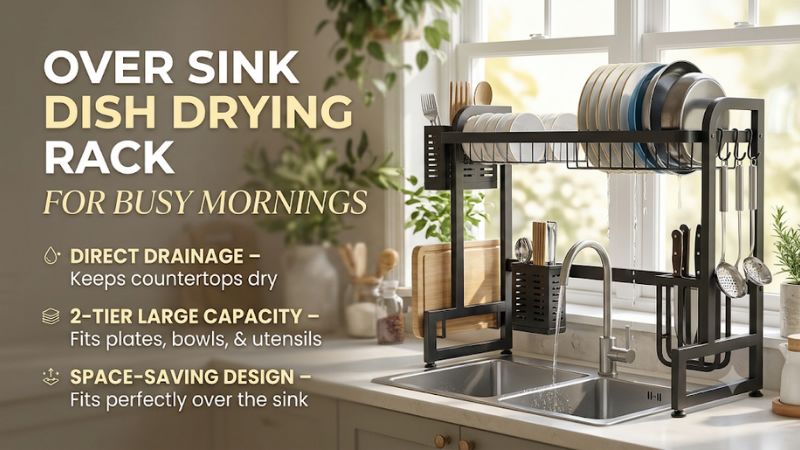
Why Your Morning Routine Matters More Than Rack Size
Dish drying is only one part of a typical morning kitchen routine. Breakfast preparation may involve coffee equipment, cereal bowls, plates, reusable bottles, lunch containers, and utensils. A large rack can provide ample capacity but occupy too much of a small sink. Conversely, a very compact design may force dishes into unstable piles when multiple family members finish breakfast at once.
Important everyday goals
- Keep water from spreading across the countertop.
- Make dishes easy to place after washing.
- Separate plates from utensils.
- Allow sufficient airflow.
- Preserve sink access.
- Make the rack easy to clean.
- Avoid complicated setup.
- Support quick unloading.
Consider how often you wash dishes by hand.
If you mostly use a dishwasher, a small over-sink rack may be sufficient for mugs and delicate items that require handwashing.
If you wash every breakfast dish manually, structured plate supports become more valuable.
A household with several reusable bottles may also need additional drying space for narrow containers and lids.
The best buying decision starts by identifying the items that regularly create clutter, rather than assuming a larger rack will solve every problem.
How to Choose an Over Sink Dish Drying Rack for Busy Mornings
A successful purchase should reduce the number of actions needed to wash, drain, and put away dishes. That requires considering how the rack fits the sink, how dishes are positioned, and whether the design can be removed when the basin is needed. The following buying factors focus specifically on morning convenience, practical cleaning, and small-kitchen usability.
Choose a Rack That Fits the Sink Securely
An over-sink rack must rest on appropriate supporting surfaces while remaining stable as dishes are added and removed. This is particularly important during hurried morning routines, when an unstable rack can become a spill or breakage hazard. Sink dimensions should be measured directly because product descriptions may refer to the overall rack length rather than the actual supported sink span.
Measurements to record
- Clear sink opening width.
- Front-to-back basin dimensions.
- Available supporting rim or counter edge.
- Faucet position.
- Clearance around the backsplash.
- Available sink depth beneath the rack.
- Space needed to lift the rack away.
For an adjustable rack, verify that the arms can reach the required distance without exceeding the manufacturer’s supported extension.
For a roll-up rack, confirm that its rigid rods and flexible ends rest securely on both supporting sides.
Do not assume that every sink with a similar nominal width has the same usable rim geometry.
An undermount sink, farmhouse sink, and top-mounted stainless steel sink may require different positioning.
Buying recommendation: Choose a rack with clearly documented dimensions and a supported arrangement that matches your actual sink.
Match Capacity to Your Breakfast Dishes
A high-capacity rack can be useful for family meals, but extra capacity is not always worth the additional space it occupies. Morning dishwashing usually involves predictable items, so a simple inventory can identify the necessary drying area. Consider plates, bowls, mugs, utensils, lunch containers, and reusable bottles separately because their shapes affect how efficiently they fit.
Typical breakfast items
- Dinner or breakfast plates.
- Cereal bowls.
- Coffee mugs.
- Drinking glasses.
- Spoons and forks.
- Small food containers.
- Reusable bottle components.
- Coffee-making accessories.
A traditional plate rack may be especially convenient for multiple flat dishes.
By keeping plates upright, the organizer makes them easier to separate and unload.
A flat rolling rack is more useful when mugs, bowls, and other items can rest securely on its bars.
Do not treat manufacturer-stated plate capacity as a guarantee for every oversized or unusually shaped dish.
Buying recommendation: Select capacity around your ordinary morning load, leaving enough space for comfortable placement rather than maximum packing.
Prioritize Fast and Direct Drainage
One reason to choose an over-sink drying rack is to allow water to return directly to the basin. This can simplify cleaning because the rack does not need a separate drip tray across the countertop. However, water must have a clear route to the drain, and the rack should not prevent the sink from functioning normally while dishes dry.
Useful drainage characteristics
- Open rack construction.
- Direct drainage into the sink.
- Adequate space between dishes.
- No unnecessary enclosed water pockets.
- Removable accessory cups.
- Easy access to the sink drain.
A structured rack with raised plate supports can help prevent dishes from resting in collected water.
A roll-up rack allows water to pass between its rods.
Both methods can be useful, but their performance depends on how items are arranged.
If bowls or cups are placed with their openings facing upward, water may collect inside regardless of the rack design.
Arrange dishes appropriately and allow them to air-dry before putting them away.
Buying recommendation: Choose an open, accessible drying structure that supports proper dish positioning and allows water to escape.
Consider Whether You Need Upright Plate Storage
Upright plate supports are one of the most valuable differences between a conventional dish drainer and a flat drying mat. They separate plates, make individual dishes easier to retrieve, and can improve the use of limited rack space. However, an upright layout may be unnecessary if the household mainly washes mugs, small bowls, and coffee accessories.
Choose upright plate supports when:
- Several plates are washed together.
- The household uses conventional dinnerware.
- Quick unloading is important.
- You want predictable dish positions.
- Flat drying space is limited.
Choose a flat rack when:
- Mugs and cups dominate the morning load.
- You frequently rinse produce.
- Storage compactness is the priority.
- You want a temporary surface.
- Large plate loads are uncommon.
A household that washes six breakfast plates every morning may benefit considerably from a structured rack.
Someone preparing coffee alone may only need room for a mug, spoon, and small container.
Buying recommendation: Select the drying format around the shapes of the items you actually wash.
Look for a Removable Utensil Holder
Utensils are small, easy to misplace, and sometimes difficult to dry securely on a flat surface. A dedicated utensil compartment can make morning cleanup more organized by separating forks, spoons, and other tools from plates. Removable designs offer the additional advantage of allowing the holder to be cleaned and unloaded independently.
Useful features
- Separate compartments.
- Drainage openings.
- Removable construction.
- Stable attachment.
- Easy access for unloading.
- Smooth washable surfaces.
A divided utensil holder can prevent cutlery from becoming tangled or mixed with larger dishes.
However, it must also drain properly.
A deep compartment that traps water may create additional cleaning work.
Avoid overcrowding utensils so tightly that moisture remains trapped between them.
For knives and other sharp tools, use appropriate safe washing and drying practices rather than leaving blades exposed in a crowded rack.
Buying recommendation: If your morning routine includes several utensils, a removable divided holder is often worth prioritizing.
Keep the Faucet and Sink Accessible
A dish rack that blocks the faucet can create more inconvenience than it removes. During breakfast preparation, the sink may need to be used repeatedly for drinking water, rinsing produce, filling a kettle, and washing cookware. The organizer should preserve a usable washing area or be simple enough to move when the entire basin is needed.
Important clearance checks
- Can the faucet swivel normally?
- Can you fill a tall water bottle?
- Can large bowls fit beneath the tap?
- Does the rack obstruct the drain?
- Can dishes be washed without knocking the rack?
- Can the rack be removed without unloading everything?
- Is there a safe place to put it temporarily?
For a single-basin sink, a removable rack can be particularly valuable.
A permanently deployed structure may leave too little space for washing a pan after breakfast.
For a double-basin sink, one side may be suitable for drying while the other remains available for washing.
Buying recommendation: Choose a drying arrangement that preserves the sink functions you use every morning.
Select Materials That Are Easy to Clean
Kitchen drying racks come into contact with water, soap residue, and occasional food particles. A suitable material should tolerate regular cleaning according to the manufacturer’s instructions and should not create unnecessarily difficult maintenance. Stainless steel, aluminum, silicone, and plastic are common components, but their care requirements vary between specific products.
Material considerations
- Aluminum: Lightweight and commonly used in rust-resistant racks.
- Stainless steel: Provides a structured metal frame.
- Silicone: Common on flexible mats and nonslip supports.
- Coated steel: Requires care to preserve protective finishes.
- Plastic: Often used in utensil holders.
- Microfiber: Useful for absorbing water but requires washing and drying.
A rack with removable components can simplify access during cleaning.
However, extra accessories also create more surfaces to maintain.
Do not assume that every product described as stainless steel can be placed in a dishwasher.
Check the instructions for the exact model.
Buying recommendation: Choose a rack whose cleaning requirements fit the amount of time you realistically have.
Decide Whether Foldable Storage Is Important
Some households prefer to leave a drying rack in place throughout the day, while others need the entire sink available after breakfast. Foldable and roll-up designs are especially useful in compact kitchens because they can be stored in drawers or cabinets. However, flexible drying surfaces may not provide the same organization as a traditional rack with plate compartments.
Storage questions
- Will the rack remain out all day?
- Is a drawer available for storing it?
- Can it be rolled or folded quickly?
- Must accessories be removed separately?
- Does it need to dry before storage?
- Is there room for a full-size structured rack?
A roll-up rack may be ideal for an apartment where breakfast cleanup is the only substantial handwashing session.
A larger traditional rack may be more convenient for a family that continuously washes dishes throughout the day.
Buying recommendation: Prioritize compact storage when preserving sink access matters more than keeping a permanent drying station.
Comparison: Which Rack Type Fits Your Morning Routine?
Different households benefit from different drying systems because their dishes, sink layouts, and morning schedules vary. Comparing rack formats by everyday requirements is more useful than ranking them solely by capacity or construction material. The following table connects common household situations with the types of features that provide the most practical benefits.
| Morning Routine | Recommended Rack Type | Main Benefit | Important Consideration |
|---|---|---|---|
| One-person breakfast | Roll-up rack | Compact and removable | Limited upright plate support |
| Couple washing mugs and bowls | Small structured rack | Organized everyday drying | Sink clearance |
| Family breakfast | Larger plate rack | Holds several dishes upright | Capacity and stability |
| Coffee and breakfast preparation | Flat roll-up rack | Flexible drying surface | Keep faucet accessible |
| Apartment with little counter space | Foldable rack | Compact storage | Dry before storing |
| Multiple utensils daily | Rack with divided holder | Easier utensil organization | Clean the holder regularly |
A flexible morning system should handle the usual dish load without requiring complicated repositioning.
If the daily routine changes substantially on weekends, consider whether a convertible rack offers enough adaptability for both situations.
Practical Morning Kitchen Setups
The most effective storage arrangement often depends on where dishes are washed, where they dry, and how quickly they can be returned to cabinets. A compact kitchen may benefit from one roll-up rack, while a family kitchen may need a structured drainer and a separate drying area for large reusable bottles. The examples below connect these common situations with practical features.
Setup One: A Small Apartment Coffee Station
A small apartment may have one sink, limited countertop space, and a coffee maker that occupies much of the preparation area. Morning cleanup may involve only a mug, spoon, milk pitcher, and small breakfast bowl. A roll-up drying rack can provide temporary drainage without requiring a permanent structure beside the coffee equipment.
Suggested setup
- Choose a rack sized for the sink.
- Keep one section of the basin accessible.
- Wash and position dishes securely.
- Allow them to drain.
- Remove clean dry items promptly.
- Roll and store the rack after cleaning.
The main advantage is flexibility.
A large structured rack would be unnecessary if the household rarely washes several plates at once.
Setup Two: Family Breakfast With Multiple Plates
A family breakfast can generate plates, bowls, cups, utensils, and food preparation equipment within a short period. A structured over-sink rack may be more convenient because it assigns different positions to the items being washed. The rack should accommodate the usual dish load without creating unstable stacks or blocking the entire sink.
Suggested setup
- Use upright plate supports.
- Reserve space for bowls.
- Separate utensils in a removable holder.
- Keep heavy cookware out of unsupported positions.
- Place frequently used dishes where they are easy to unload.
- Clean the rack after the busiest washing sessions.
This arrangement reduces the need to move dishes repeatedly.
However, a rack that occupies too much sink space may require temporary removal when cleaning larger pots.
Setup Three: Morning Meal Preparation and Lunch Packing
Some households use the kitchen heavily in the morning to prepare breakfast and pack lunches. Cutting boards, reusable containers, knives, vegetables, and coffee accessories may all pass through the sink. A drying system needs to support quick cleanup without interfering with safe food preparation or creating clutter across the worktop.
Suggested setup
- Keep the main preparation surface clear.
- Use direct-to-sink drainage when practical.
- Wash raw-food preparation tools appropriately.
- Separate clean dishes from dirty items.
- Keep sharp utensils in safe drying positions.
- Remove the rack when full sink access is needed.
A flat roll-up rack may be useful for temporary draining tasks.
A structured drainer becomes more attractive when the household produces a larger number of plates and utensils.
How to Make Morning Dishwashing Faster
A good rack supports a simple workflow, but buying storage equipment alone does not guarantee that morning cleanup becomes more efficient. The order of washing, placement of dishes, and access to cleaning tools also matter. Establishing a repeatable process can reduce unnecessary movements and help keep the sink area manageable during busy periods.
A practical routine
- Clear food scraps from dishes.
- Group similar items together.
- Wash dishes using an appropriate cleaning method.
- Rinse as required.
- Place dishes securely in the rack.
- Keep openings positioned to allow drainage.
- Avoid blocking the faucet with large items.
- Clean utensils and specialized accessories appropriately.
- Allow dishes to dry before storage.
- Remove debris from the sink and drying rack.
Keep dish soap, sponges, and brushes in an accessible location.
If a cleaning tool remains wet between uses, consider a separate ventilated sink caddy rather than storing it in the dish rack itself.
For reusable bottles, follow the manufacturer’s cleaning instructions and allow the inside to dry appropriately.
The goal is not to rush cleaning at the expense of hygiene.
Common Buying Mistakes to Avoid
A rushed purchase can produce an organizer that looks useful but creates unnecessary obstacles in the kitchen. Common problems include choosing a rack without checking sink width, overlooking the faucet, buying a flat surface for a plate-heavy household, and assuming that every rack is suitable for large cookware. These mistakes can be avoided by considering the actual morning routine before ordering.
Mistakes to avoid
- Buying based on overall sink width alone.
- Ignoring the supporting rim.
- Choosing inadequate plate capacity.
- Blocking access to the faucet.
- Overloading lightweight racks.
- Buying a rigid rack when compact storage is essential.
- Assuming every roll-up rack supports heavy cookware.
- Leaving textile drying mats damp.
- Ignoring cleaning around utensil holders.
- Storing dishes before they dry.
- Choosing unnecessary accessories.
- Failing to plan where the rack will be stored.
The most useful rack is the one that works reliably during ordinary dishwashing, not only when empty and displayed neatly.
Frequently Asked Questions
An over-sink drying rack can simplify busy mornings, but shoppers often want to know whether it will fit their sink, reduce cleanup time, and remain practical when the household uses the basin for other tasks. The following answers address common concerns about capacity, placement, materials, and the differences between compact and full-size drying systems.
What Is the Best Over Sink Dish Drying Rack for Busy Mornings?
For households washing several plates and utensils, a structured rack with extendable arms and a removable cutlery holder is often the most useful configuration. It provides defined places for common dish types and allows water to drain into the sink. However, a smaller roll-up design may be better for someone who washes only mugs and small bowls.
Choose according to the actual dish load and sink dimensions.
A rack that obstructs the faucet may be less convenient than a smaller alternative.
Is a Roll-Up Dish Rack Good for Family Breakfasts?
A roll-up rack can be useful for small or moderate drying loads when dishes can rest securely on the surface. However, it does not usually provide upright plate holders or dedicated cutlery compartments. A family washing many plates and utensils at once may find a conventional dish drainer more efficient.
Consider how many plates are washed together.
If the dish load is large, prioritize a structured rack with sufficient supported capacity.
How Do I Keep My Counter Dry During Morning Cleanup?
Position the rack correctly so water drains into the sink rather than across the countertop. Arrange dishes so trapped water can escape, and avoid overloading the drying area. If using a convertible system with a microfiber mat, follow the washing and drying instructions for the mat.
Wipe any water that collects around the sink.
A properly positioned rack can reduce countertop moisture, but it does not eliminate the need for routine cleaning.
Can I Leave an Over Sink Dish Rack Installed All Day?
Yes, a compatible rack may remain in place when it does not obstruct essential sink functions and is loaded safely. However, a permanent arrangement may be inconvenient in kitchens where the basin is needed for large cookware or food preparation. A foldable or roll-up design offers greater flexibility.
Keep the rack clean and remove accumulated debris.
If it regularly blocks washing tasks, consider an alternative placement or storage system.
Are Stainless Steel Dish Racks Easier to Clean?
Stainless steel racks can be relatively straightforward to wipe, but actual cleaning convenience depends on the construction, protective coatings, joints, and removable accessories. A complicated stainless steel rack may require more maintenance than a simple plastic or silicone design.
Follow the manufacturer’s care instructions.
Do not assume that stainless steel automatically means the complete product is dishwasher-safe.
Conclusion
The best over sink dish drying rack for busy mornings should match your everyday dishes, drain securely into the sink, and remain easy to unload or remove. A structured rack with adjustable arms and a removable utensil holder is practical for family breakfasts, while a compact roll-up mat may suit smaller households and coffee-focused routines. Measure the sink before purchasing, leave adequate faucet clearance, and choose materials that are easy to maintain. The right rack should simplify breakfast cleanup without creating extra clutter or interfering with the rest of the morning kitchen routine.










Write Your Review
No reviews yet. Be the first to share your experience!