
The best stackable pantry containers help turn crowded shelves into practical storage spaces while keeping dry ingredients accessible. A good system should combine secure lids, suitable capacities, stable stacking, and easy cleaning. This guide compares six real container collections and explains how to choose the right arrangement for your pantry.
- Quick verdict: Which stackable pantry containers are worth considering?
- Quick comparison table
- How we selected these pantry storage systems
- Best stackable pantry containers reviewed
- How to choose the best stackable pantry containers
- Practical pantry organization strategies
- Frequently asked questions
- Conclusion
Quick verdict: Which stackable pantry containers are worth considering?
A useful pantry organization system should maximize shelf space without forcing you to move several containers whenever you need flour, rice, cereal, or snacks. Shape, closure design, material, and available sizes matter more than the number of containers included in a promotional bundle.
OXO Good Grips POP Containers are a strong all-around choice for households that want modular storage with convenient push-button lids.
Rubbermaid Brilliance Pantry Containers are particularly useful for people who prefer clear Tritan construction and secure latching closures.
Progressive ProKeeper+ Modular Pantry Containers provide a compact assortment of practical sizes with airtight silicone seals.
Sistema KLIP IT PLUS is an attractive alternative for households seeking versatile rectangular containers that can also be used for other food storage purposes.
IKEA 365+ Dry Food Storage Containers are a straightforward option for buyers who prefer to purchase individual containers according to available shelf dimensions.
Rubbermaid Modular Premium Food Storage Containers are especially useful for households storing a broad range of dry foods, including cereal and larger pantry staples.
Each system has different advantages, so the right choice depends on the foods you purchase most frequently and the shelf space you need to organize.
Quick comparison table
The most important differences between pantry container systems are their closure mechanisms, modular dimensions, available capacities, and the kinds of ingredients they accommodate. A low-profile container may work well for snacks but be inconvenient for storing an entire bag of flour, while a tall cereal canister can waste space beneath a short shelf.
| Container system | Best for | Key features | Main advantage | Trade-off |
|---|---|---|---|---|
| OXO Good Grips POP | Everyday pantry organization | Push-button airtight lids, modular shapes | Broad selection of sizes | Premium cost for a complete system |
| Rubbermaid Brilliance Pantry | Flour, pasta, rice, and grains | Tritan construction, latching lids | Clear visibility and secure closures | Latches need room to operate |
| Progressive ProKeeper+ Modular | Small and medium pantry staples | Silicone seals, measurement markings | Practical mixed-size assortment | Limited capacity in smaller pieces |
| Sistema KLIP IT PLUS | Flexible multipurpose storage | Locking clips, rectangular shapes | Stacking and empty nesting | Clips add handling steps |
| IKEA 365+ Dry Food Storage | Budget-conscious customization | Rectangular containers, compatible lids | Buy only the sizes needed | Lid selection requires attention |
| Rubbermaid Modular Premium | Bulk pantry ingredients | Clear canisters, modular shapes | Large dry-food capacities | Larger pieces need deep shelves |
How we selected these pantry storage systems
The six choices were selected for their identifiable product lines, documented stacking or modular designs, and usefulness for storing ordinary dry pantry foods. Assessment priorities include closure construction, available capacities, cabinet fit, visibility, dispensing convenience, cleaning requirements, and whether the containers can be expanded into a coordinated collection.
The evaluation draws on manufacturer product information and practical storage principles rather than invented durability tests or independently measured airtight performance.
Airtight claims are treated as manufacturer descriptions, not guarantees that stored ingredients will remain fresh indefinitely.
The comparison also avoids assigning fixed affordability rankings because package sizes and retail prices vary.
Best stackable pantry containers reviewed
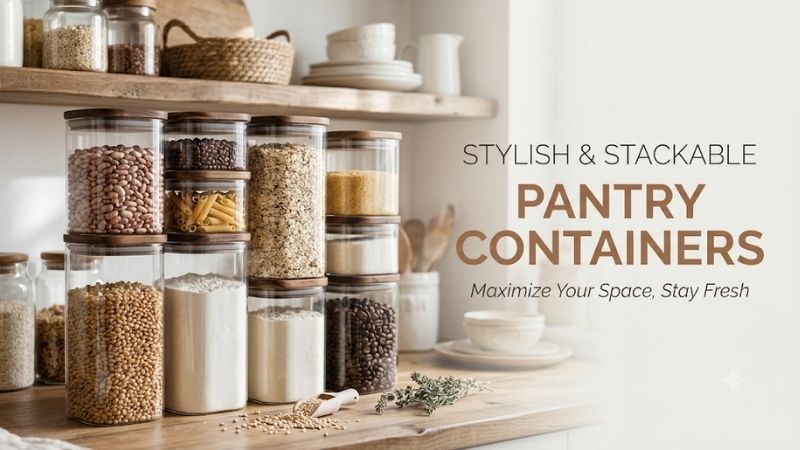
These six collections provide different approaches to storing flour, sugar, cereal, rice, pasta, beans, baking ingredients, and snacks. Each product review focuses on the actual storage method, its most suitable applications, meaningful drawbacks, and the buying decision it supports. No single design is ideal for every pantry configuration.
OXO Good Grips POP Containers — Best overall
OXO Good Grips POP Containers are a modular dry-food storage system designed around clear rectangular and square bodies with push-button airtight lids. The collection includes numerous capacities intended for ingredients such as flour, sugar, pasta, cereal, oats, and smaller snacks, making it flexible enough for compact and full-size pantries.
Best for: Home cooks who want a coordinated, expandable pantry organization system.
Why we picked it: The range combines several container footprints with an accessible closure mechanism and purpose-built stacking design.
Key specifications:
-
Modular rectangular and square storage bodies
-
Push-button airtight sealing system
-
BPA-free plastic construction
-
Dishwasher-safe components according to product instructions
-
Multiple available capacities
-
Optional compatible accessories
-
Containers designed for stacking
The push-button mechanism is the defining feature.
Pressing the button engages or releases the lid’s seal, making the containers convenient for frequent access.
This can be particularly useful for flour, sugar, oats, and other ingredients handled during daily cooking.
The modular footprint also makes it easier to arrange different capacities in organized rows.
For example, a wide container can hold flour while smaller containers accommodate baking powder, nuts, or seeds.
One of the strongest advantages is expandability.
A household does not need to purchase every available size immediately.
It can begin with several essential containers and add matching pieces as pantry needs become clearer.
The transparent bodies allow ingredients and approximate remaining quantities to be identified without opening the lids.
However, the system has limitations.
OXO instructs users to operate the button when opening and closing containers and warns against carrying a filled container by its lid.
Accessories are sold separately in many configurations.
A large collection can also become expensive compared with buying ordinary storage boxes.
Performance and practical use: The system is particularly effective for frequently used dry ingredients where fast access and organized stacking matter.
What makes it different: Push-button operation and a broad modular assortment.
Pros:
-
Convenient lid operation
-
Wide variety of compatible capacities
-
Clear, coordinated stacking system
Cons:
-
Not intended for carrying by the lid
-
Higher total cost when purchasing many containers
Buy if: You want a pantry system that can expand gradually.
Skip if: You primarily need large inexpensive bins or prefer simple snap-on lids.
Rubbermaid Brilliance Pantry Containers — Best secure-lid system
Rubbermaid Brilliance Pantry Containers use clear Tritan plastic bodies and secure latching lids to organize dry ingredients. The collection includes individual larger containers and assorted sets designed for flour, sugar, rice, cereal, pasta, and snacks, with modular shapes that support stable pantry stacking.
Best for: Buyers who want transparent containers with positive-locking closures.
Why we picked it: The combination of clear construction, tight seals, and available large capacities makes the collection useful for routine pantry storage.
Key specifications:
-
BPA-free Tritan plastic
-
Airtight lid seals
-
Secure latching closures
-
Clear bodies and lids
-
Stackable modular shapes
-
Individual containers and assorted sets
-
Available capacities including 12-cup and 16-cup models
-
Manufacturer-approved dishwasher care
Rubbermaid Brilliance is useful for households that prefer to see the contents of each container clearly.
The transparent construction helps users identify ingredients without relying entirely on labels.
The latching lid also provides tactile confirmation that the closure has been engaged.
This is an advantage for users who dislike wondering whether a push-on lid has seated correctly.
The 16-cup container is suitable for larger dry-food quantities.
However, capacity alone does not guarantee that a particular commercial food package will fit, because ingredients have different bulk densities and packaging weights.
Buyers should check the capacity against the quantities they normally purchase.
The modular design supports shelf organization, although the latches need enough clearance for comfortable operation.
A tightly packed shelf can make side latches inconvenient to open.
The containers are intended for dry pantry storage and should not automatically be treated as microwave cooking vessels.
For example, the manufacturer’s 16-cup Brilliance Pantry model is explicitly listed as not microwave-safe.
Rubbermaid
Performance and practical use: Suitable for dry foods that benefit from secure closures and easy visual identification.
What makes it different: Crystal-clear Tritan construction and latching airtight lids.
Pros:
-
Secure closure mechanism
-
Clear contents and stackable design
-
Useful larger capacities
Cons:
-
Side latches require clearance
-
Storage and heating permissions vary by product line
Buy if: You value a secure physical closure and clear visibility.
Skip if: You need extremely narrow containers with minimal side clearance.
Progressive ProKeeper+ Modular Pantry 4-Piece Set — Best compact assortment
The Progressive ProKeeper+ Modular Pantry 4-Piece Set is designed for organizing frequently used dry goods without requiring a large collection of containers. It combines one larger container with three smaller pieces, using airtight silicone seals and measurement markings to support practical storage of everyday pantry ingredients.
Best for: Apartments, small kitchens, and households organizing a limited number of dry staples.
Why we picked it: The four-piece assortment provides useful capacity variation without introducing a large number of redundant containers.
Key specifications:
-
Four modular pantry containers
-
One 2.5-quart container
-
Two 1.6-quart containers
-
One 0.7-quart container
-
Airtight silicone seals
-
Capacity measurement markings
-
BPA-free construction
-
Dishwasher-safe designation
-
Manufacturer-described stackable design
The arrangement is particularly useful for households that purchase several dry ingredients in modest quantities.
The largest container can accommodate an ingredient such as rice or oats, depending on the amount purchased.
The two medium containers can separate frequently used staples.
The smallest container may be appropriate for nuts, seeds, or other ingredients used in smaller quantities.
Measurement markings are helpful because they allow users to estimate remaining volume without transferring ingredients into a measuring vessel.
However, they do not replace accurate weighing for recipes requiring precise ingredient quantities.
The modular arrangement is intended to create organized stacks.
Buyers should verify the external dimensions because a small collection can still be poorly suited to a particular narrow cabinet.
A major advantage is that the set avoids forcing buyers into an excessively large package.
Its principal limitation is total capacity.
Households purchasing flour, rice, or cereal in bulk may need additional larger containers.
Performance and practical use: Well suited to small-scale pantry organization where mixed capacities matter more than maximum storage volume.
What makes it different: An intentionally limited assortment with measurement markings.
Pros:
-
Practical combination of four sizes
-
Airtight silicone seals
-
Measurement markings
Cons:
-
Limited capacity for bulk ingredients
-
Additional containers may be needed for larger households
Buy if: You want a manageable starter collection for a compact pantry.
Skip if: You regularly purchase large bags of dry food.
Sistema KLIP IT PLUS — Best multipurpose storage system
Sistema KLIP IT PLUS is a modular plastic storage collection designed for stacking and nesting. Its rectangular containers use locking clips and flexible seals, while multiple capacities allow buyers to organize pantry staples, refrigerated foods, and other ingredients using a coordinated storage approach.
Best for: Households seeking containers that can serve several storage needs.
Why we picked it: The system combines modular stacking, empty nesting, and practical closure mechanisms.
Key specifications:
-
Rectangular plastic storage bodies
-
Flexible sealing system
-
Easy-locking clips
-
Modular stacking design
-
Nesting features when empty
-
Multiple capacities
-
Freezer-safe designation
-
Top-rack dishwasher-safe construction
-
Selected containers approved for microwave use without lids
Sistema’s KLIP IT PLUS collection has a broader role than specialized dry-food canisters.
The system can support pantry organization while also accommodating other food storage tasks, provided the specific container is used according to its instructions.
That flexibility matters when cabinet space is limited.
Rather than buying separate specialized boxes for every type of food, a household may be able to standardize around one compatible collection.
The rectangular footprint is another advantage.
It helps reduce unused gaps between containers.
The manufacturer also describes nesting features that reduce storage volume when containers are empty.
However, stacking and nesting are different operations.
Filled containers stack with their lids attached, while empty containers may nest in a separate arrangement.
The locking clips provide a secure closure but create more handling steps than a basic push-button lid.
For someone accessing sugar or flour repeatedly while baking, the clips may be less convenient.
For ingredients that are accessed less frequently, that trade-off may be acceptable.
Performance and practical use: Flexible household storage for buyers who want one modular system across different food categories.
What makes it different: Multipurpose use and both stacking and nesting functionality.
Pros:
-
Several available capacities
-
Modular rectangular construction
-
Space-efficient empty storage
Cons:
-
Clips require manual operation
-
Care instructions vary by specific item
Buy if: You want reusable containers for several storage applications.
Skip if: You prefer a specialized pantry system with one-touch lids.
IKEA 365+ Dry Food Storage Containers — Best customizable starter system
IKEA 365+ Dry Food Storage Containers offer a straightforward approach to pantry organization through individually available clear plastic containers in different rectangular sizes. Their stackable construction is useful for kitchens that need practical dry-food storage without purchasing a large matching set immediately.
Best for: Buyers who want to choose containers individually according to measured cabinet space.
Why we picked it: The system allows capacity and quantity to be selected around actual pantry needs.
Key specifications:
-
Clear plastic construction
-
Rectangular storage designs
-
Available sizes including 3-quart and 4-quart dry-food configurations
-
Compatible lids
-
Stackable arrangements
-
Food-storage applications
-
Model-specific dishwasher and freezer instructions
The primary benefit is purchasing flexibility.
A household can begin with one or two containers for rice or pasta and add more only when needed.
This avoids the clutter created by inexpensive large sets containing numerous unsuitable sizes.
Rectangular forms make efficient use of straight cabinet walls.
Clear construction also reduces the need to open every container when checking supplies.
However, buyers must check the exact lid included with each item.
Some IKEA 365+ containers and lids are sold as separate components, while other listings combine them.
The lid’s sealing characteristics depend on the specific configuration.
Do not assume that every IKEA 365+ container provides identical airtight or leakproof performance.
The range also contains products intended for leftovers rather than dry pantry ingredients.
Select the actual dry-food model when that is your primary purpose.
Performance and practical use: A practical solution for organizing essential dry foods with minimal initial commitment.
What makes it different: Individual-size purchasing flexibility and standardized rectangular storage.
Pros:
-
Straightforward modular shapes
-
Ability to purchase only necessary capacities
-
Clear containers for easy identification
Cons:
-
Lid configurations must be checked
-
Not every IKEA 365+ product has identical storage features
Buy if: You want to organize a pantry gradually using selected sizes.
Skip if: You prefer one preconfigured matching set with no additional product selection.
Rubbermaid Modular Premium Food Storage Containers — Best for bulk staples
Rubbermaid Modular Premium Food Storage Containers are designed for dry pantry organization with a coordinated collection of larger canisters. Their clear construction, secure lids, and space-saving shapes make them especially useful for cereal, pasta, rice, dried beans, and other ingredients commonly purchased in larger packages.
Best for: Households storing several different bulk pantry staples.
Why we picked it: The collection includes larger capacities and a dedicated cereal keeper.
Key specifications:
-
Modular plastic container collection
-
Stackable space-saving design
-
Clear bases and lid windows
-
Secure-sealing lids
-
Capacity measurement markings
-
BPA-free construction
-
Dishwasher-safe designation
-
Ten-piece configuration counting containers and lids
The published ten-piece assortment contains five storage vessels.
These include 5-cup, 10-cup, 16-cup, and 21-cup canisters, plus an 18-cup cereal keeper.
This assortment is useful for households with a wide range of pantry ingredients.
A small canister can hold snacks or baking staples.
Larger containers can accommodate dry foods purchased in bulk.
The dedicated cereal keeper provides a more convenient dispensing arrangement than a conventional wide-mouth container.
Clear construction simplifies inventory checks.
Measurement markings provide an approximate indication of the volume remaining.
One disadvantage is the large overall footprint.
A collection containing several high-capacity canisters may be excessive for a small apartment pantry.
Another issue is ingredient density.
A container that holds a substantial volume of dry cereal will not necessarily hold an equivalent number of pounds of flour or sugar.
Capacity should be matched to the actual product purchased.
Performance and practical use: Particularly useful for households that want a coordinated larger-capacity dry-food system.
What makes it different: Large canisters combined with a dedicated cereal container.
Pros:
-
Broad capacity assortment
-
Clear modular construction
-
Integrated cereal storage option
Cons:
-
Large containers need substantial shelf space
-
May contain more capacity than a small household requires
Buy if: You purchase multiple dry ingredients in substantial quantities.
Skip if: You mainly need several compact containers for a narrow cabinet.
How to choose the best stackable pantry containers
Pantry containers should be evaluated according to shelf dimensions, ingredient quantities, lid performance, and daily accessibility. A coordinated system can improve organization, but buying too many pieces or choosing unsuitable capacities can make a pantry harder to use. The goal is efficient food storage, not a completely uniform appearance.
Measure shelf dimensions and available stacking height
A container’s advertised volume does not indicate whether it will fit on a particular shelf. External width, depth, height, and lid clearance determine how effectively containers use available space.
Measure the inside of the pantry before buying.
Include shelf brackets, hinges, and other obstructions.
For a pull-out drawer, measure the clearance beneath the countertop.
Consider whether the lid can be opened while the container remains in place.
If several containers will be stacked, calculate their combined height.
Leave additional room to lift the top container comfortably.
A perfectly fitted stack may look efficient but become frustrating when accessing ingredients.
Choose capacities that match grocery packages
Different pantry ingredients occupy different volumes for the same weight. A container advertised as holding several quarts may accommodate a standard cereal package but not the same weight of flour, sugar, or rice.
Use actual purchasing habits as the starting point.
Record the package weight of the foods you buy regularly.
Check the manufacturer’s recommended container capacity when available.
Leave enough room to transfer ingredients without spilling.
Avoid automatically combining new food with older supplies.
Clean and dry containers between refills when appropriate.
Keep the original package information or record important details such as allergens, expiration dates, and preparation instructions.
Consider lid access during daily cooking
A reliable seal is valuable, but an inconvenient closure can slow everyday cooking. Push-button lids, snap-on lids, and multi-clip closures all involve different handling steps.
Push-button lids can be convenient when hands are occupied during meal preparation.
Latching lids provide a more deliberate closure.
Simple snap-on lids may be sufficient for certain dry ingredients.
The right design depends on how frequently the container is opened.
A flour container used several times weekly deserves an accessible lid.
A container holding seasonal baking decorations may prioritize secure long-term storage.
Avoid creating stacks that require lifting heavy containers whenever you need a small ingredient.
Select appropriate food-contact materials
Pantry storage containers commonly use plastic, glass, or metal. Each material has different advantages related to visibility, weight, durability, and cleaning.
Transparent plastic is practical for identifying ingredients.
Glass resists many odors and stains but adds weight and can break.
Metal is durable and opaque, making labels important.
Look for manufacturer food-contact information.
Avoid assuming that every plastic product is identical.
BPA-free labeling describes the absence of a specific substance in the advertised construction and is not a universal safety guarantee.
For dry pantry use, choose containers specifically intended for food storage.
Understand what airtight storage can and cannot do
An airtight container helps limit exposure to ambient air and moisture, but it cannot reverse food spoilage or restore freshness that has already been lost.
Transfer dry ingredients only into clean, dry containers.
Keep containers away from excessive heat and humidity.
Inspect stored food periodically for insects, unusual odors, visible mold, or other signs of deterioration.
Do not use pantry containers as substitutes for refrigeration.
Foods that require refrigeration must still be kept at appropriate temperatures.
Airtight storage also does not make dry foods shelf-stable indefinitely.
Follow the product’s storage recommendations and appropriate quality dates.
Practical pantry organization strategies
An efficient pantry should make ingredients easy to locate, measure, and replace. Matching containers alone is not enough; the arrangement must reflect cooking frequency, shelf accessibility, and the actual space available. Simple grouping and labeling practices often deliver substantial improvements without requiring additional storage products.
Create zones for baking, meals, breakfast, and snacks
Grouping ingredients according to their normal use can make a pantry easier to navigate. Baking supplies, breakfast items, grains, and snacks may be more convenient in separate areas than arranged solely by container height or appearance.
Keep frequently used ingredients at comfortable reach.
Store heavier containers on lower shelves.
Place occasional-use items higher up.
Use clear labels for similar-looking ingredients such as flour, powdered sugar, and cornstarch.
When a category contains several small containers, a shallow tray can keep them together.
This helps prevent individual canisters from becoming lost at the back of a deep shelf.
Avoid excessively tall stacks
Stacking uses vertical storage space, but overly tall arrangements can make lower containers difficult to retrieve and increase the consequences of a falling container.
Keep heavy containers near the bottom.
Avoid stacking products beyond their intended design.
Use stable matching footprints.
Do not place a narrow container beneath a much wider one unless the system explicitly supports that arrangement.
For ingredients used every day, prioritize direct accessibility.
The ideal pantry layout may contain several short stacks rather than one tall tower.
Label ingredients and preserve package information
Transparent containers allow users to identify many foods visually, but appearances can be misleading. White flour, powdered sugar, starches, and other dry ingredients may look similar.
Use clear ingredient labels.
Record relevant allergen information when needed.
Keep cooking directions for products that require specific preparation methods.
For foods transferred out of original packaging, preserve useful lot or expiration information.
Do not rely on appearance alone when identifying unfamiliar ingredients.
A consistent labeling system becomes especially useful when several household members share the pantry.
Frequently asked questions
The questions below address common concerns about airtight performance, stacking safety, ingredient storage, and whether coordinated containers offer meaningful benefits beyond appearance. Choosing appropriate containers requires understanding practical limitations as well as advertised organization features.
Are stackable pantry containers always airtight?
No. Stackability describes how containers can be arranged, while airtight performance depends on the lid and sealing mechanism.
Some containers provide secure closures without a documented airtight seal.
For ingredients sensitive to moisture, choose containers specifically advertised and documented as airtight.
Are square containers better than round containers?
Square and rectangular containers generally use straight shelf edges more efficiently because their shapes fit together with fewer gaps.
Round containers may be easier to reach into or pour from in certain applications.
Choose according to shelf dimensions and the ingredients being stored.
Can flour and sugar be stored in plastic containers?
Yes, properly designed food-contact plastic containers can be used for dry flour and sugar storage. They should be clean, dry, appropriately sized, and equipped with suitable lids.
Keep them in a cool, dry area.
Retain ingredient identification and relevant package information.
Should I buy a complete pantry container set?
A complete set is useful when several included sizes match your grocery habits. However, it can create unnecessary clutter if the assortment contains many containers you do not need.
Measure the pantry and identify ingredients before purchasing.
Buying individual compatible containers may provide better value.
Can I stack pantry containers inside a refrigerator?
Only use containers in a refrigerator when the manufacturer identifies them as suitable for that environment.
Dry pantry containers may not be designed for refrigerated liquids or leftovers.
Use appropriate food-storage containers for foods requiring refrigeration.
Conclusion
The best stackable pantry containers combine secure closures, practical capacities, and shapes that fit your actual shelves. OXO POP offers a flexible expandable system, Rubbermaid Brilliance provides clear latching containers, and Progressive ProKeeper+ is well suited to compact mixed-size storage. Sistema, IKEA 365+, and Rubbermaid Modular Premium provide alternatives for different budgets and household needs. Measure your shelves, match capacities to groceries, and prioritize access over appearance to create a pantry that remains organized during everyday cooking.
Write Your Review
No reviews yet. Be the first to share your experience!