
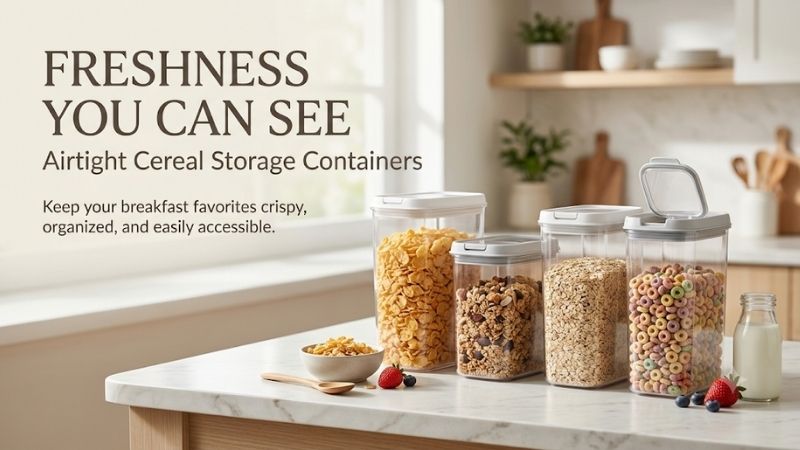
The best cereal storage containers help keep breakfast cereal organized, reduce messy pouring, and limit exposure to air and moisture. A practical container should hold your usual cereal quantity, fit the pantry shelf, and offer a secure lid that is easy to operate. This guide compares six options for families, small households, and frequent cereal buyers.
Quick verdict: Which cereal container should you choose?
Cereal storage works best when the container is sized for the amount purchased and offers a dependable closure. A large container is useful for bulk cereal, but it may waste cabinet space when only small packages are purchased. Similarly, an easy-pour spout can be convenient for breakfast but is unnecessary if cereal is always measured with a scoop.
OXO Good Grips POP Cereal Dispensers offer convenient one-handed opening and controlled pouring.
Rubbermaid Brilliance Pantry Cereal Keeper provides a large 18-cup capacity with clear Tritan construction and a secure sealing design.
Progressive ProKeeper+ Cereal Container is especially useful for households wanting a wide-mouth pouring system and measurement markings.
Sistema KLIP IT PLUS Cereal Container provides a generous 4.2-liter capacity with locking clips and an easy-pour opening.
Rubbermaid Modular Cereal Keeper is an option for families purchasing multiple cereal varieties and wanting coordinated storage with other modular pantry canisters.
Tupperware Super Cereal Storer provides a 20-cup capacity, a flip-top pouring arrangement, and a viewing window for monitoring remaining cereal.
The best purchase depends on daily breakfast habits, pantry space, and whether the container will be handled by children.
Quick comparison table
Cereal containers differ in their capacity, opening mechanism, body shape, and compatibility with other pantry storage products. The following comparison highlights the characteristics that matter most when selecting a container for regular breakfast use.
| Container | Best for | Capacity | Main advantage | Main limitation |
|---|---|---|---|---|
| OXO Good Grips POP Cereal Dispenser | Easy one-handed pouring | 3.4 qt | Pop-open lid and contoured grip | Larger hands may find broad models easier |
| Rubbermaid Brilliance Pantry Cereal Keeper | Secure large-capacity storage | 18 cups | Clear Tritan body and airtight seal | Larger footprint |
| Progressive ProKeeper+ Cereal | Everyday cereal dispensing | 14 cups | Wide-mouth spout and measurement marks | Less capacity than bulk models |
| Sistema KLIP IT PLUS Cereal | Large cereal packages | 4.2 L | Locking clips and easy-pour lid | Clips require additional handling |
| Rubbermaid Modular Cereal Keeper | Multiple cereals and pantry matching | 22 cups | Modular design and flip-top spout | Large capacity may be excessive |
| Tupperware Super Cereal Storer | Bulk cereal storage | 20 cups | Flip-top lid and viewing window | Opaque sections reduce full visibility |
How we selected these cereal containers
These six products were selected because they are identifiable cereal-storage designs rather than ordinary boxes repurposed for cereal. The evaluation emphasizes manufacturer-published capacities, lid mechanisms, pouring convenience, body shapes, cleaning requirements, and practical suitability for common household breakfast routines.
No independently measured airtightness, cereal freshness duration, or long-term durability testing is claimed.
Capacity ratings indicate the volume each manufacturer publishes, not a guarantee that every cereal box of a particular weight will fit.
Cereal shapes and bulk densities differ considerably, which makes actual package fit an important part of the buying decision.
Best cereal storage containers reviewed
A useful cereal container should make both storage and serving easier. The six options below solve different problems, including difficult pouring, large cereal packages, crowded shelves, and the need to organize several breakfast varieties. Each review explains the practical benefits, important limitations, and the type of household most likely to benefit.
OXO Good Grips POP Cereal Dispenser — Best overall
OXO Good Grips POP Cereal Dispensers use contoured plastic bodies and pop-open pouring lids with silicone seals. The design is intended to make cereal easier to pour directly into a bowl while reducing unnecessary exposure to air when the dispenser is closed.
Best for: Households that want convenient daily pouring.
Why we picked it: The dedicated pouring design combines an accessible lid mechanism with a space-conscious body.
Key specifications:
-
3.4-quart capacity in the standard large model
-
BPA-free plastic construction
-
Airtight silicone sealing design
-
One-handed pop-open lid
-
Contoured gripping surface
-
Dishwasher-safe designation
-
Slim storage-oriented shape
The container’s main benefit is ease of handling.
The body is shaped to provide a comfortable grip, while the pouring opening allows cereal to be dispensed without removing the entire lid.
This can be especially convenient when breakfast preparation is rushed.
The sealing system uses silicone components intended to help protect dry cereal from ambient air and moisture.
However, an airtight seal does not eliminate the need to observe food quality dates or store cereal in a cool, dry location.
OXO also offers smaller cereal dispensers, allowing buyers to choose a capacity better suited to their purchase habits.
The most important limitation is package fit.
A 3.4-quart container will accommodate different amounts of cereal depending on whether the product consists of dense flakes, puffed pieces, clusters, or granola.
Buyers should not assume that an entire family-size cereal box will fit without checking its volume.
Performance and practical use: Convenient for cereal, granola, pretzels, and other dry foods suitable for pouring.
What makes it different: A dedicated one-handed dispensing lid.
Pros:
-
Easy pouring arrangement
-
Space-conscious shape
-
Airtight silicone seals
Cons:
-
Capacity may be insufficient for certain bulk packages
-
Pouring performance depends on cereal shape and piece size
Buy if: You pour cereal frequently and prefer not to remove a full lid.
Skip if: You primarily purchase exceptionally large cereal packages.
Rubbermaid Brilliance Pantry Cereal Keeper — Best secure large-capacity option
Rubbermaid Brilliance Pantry Cereal Keeper is a dedicated 18-cup cereal storage container made from clear Tritan plastic. Its airtight sealing design and substantial capacity make it particularly useful for households that want to transfer cereal from cardboard boxes into a durable, easy-to-identify pantry container.
Best for: Families and frequent cereal buyers.
Why we picked it: The combination of large capacity, visibility, and secure sealing addresses common household cereal-storage problems.
Key specifications:
-
18-cup capacity
-
BPA-free Tritan plastic
-
Manufacturer-described airtight seal
-
Clear container body
-
Space-conscious rectangular design
-
Dishwasher-safe designation
-
Freezer-safe designation
-
Not microwave-safe
-
Model 2146788
The container is especially useful for keeping cereal visible.
A transparent body allows family members to see both the cereal variety and the approximate amount remaining.
This reduces the need to open the container when preparing a shopping list.
The 18-cup capacity provides enough volume for many common cereal packages.
However, cereal boxes vary substantially, and a manufacturer’s cup rating should not be interpreted as a guaranteed fit for a particular package weight.
The sealing system is intended to limit exposure to air.
That is useful for cereal because moisture absorption and repeated exposure can affect texture.
The rectangular body also makes it easier to align the container with straight pantry shelves.
One consideration is total size.
A large container can consume unnecessary space when it holds only a small amount of cereal.
Households purchasing several different varieties may prefer a mixture of capacities rather than identical large containers.
Performance and practical use: Practical for daily cereal storage and other dry breakfast foods requiring secure closures.
What makes it different: Large clear Tritan construction with an airtight closure.
Pros:
-
Generous storage volume
-
Easy content identification
-
Secure sealing system
Cons:
-
Large capacity may waste space in small households
-
Requires enough shelf depth and height
Buy if: You regularly purchase standard or larger cereal packages.
Skip if: Your pantry has very low shelves or you only buy small quantities.
Progressive ProKeeper+ Cereal Container — Best for controlled pouring
The Progressive ProKeeper+ Cereal Container is designed for convenient dry cereal storage with a wide-mouth pouring spout, contoured grip, and measurement markings. Its 14-cup capacity is suitable for many everyday cereal purchases without requiring the footprint of an oversized bulk-storage bin.
Best for: Households that want easy cereal dispensing and visible volume markings.
Why we picked it: The pouring design focuses on ordinary breakfast convenience.
Key specifications:
-
14-cup capacity
-
Wide-mouth pour spout
-
Contoured gripping area
-
Capacity measurement markings
-
BPA-free designation
-
Dishwasher-safe construction
-
Designed for dry cereal storage
-
Product SKU PKS-151
The primary benefit is controlled handling.
The contoured grip helps users position the container while pouring, and the wide-mouth spout gives cereal a relatively unobstructed exit.
This is particularly useful for larger cereal flakes or clusters that can become trapped in narrow openings.
The measurement markings provide a convenient indication of remaining volume.
However, these markings are not intended to replace nutritional serving measurements.
Different cereals have different serving sizes and densities.
For accurate portions, refer to the product’s nutrition label and use an appropriate measuring method.
Another advantage is that the container has a more manageable capacity than some very large cereal keepers.
This can make it suitable for couples or small families.
Its main limitation is that 14 cups may not accommodate every bulk package.
Buyers who purchase very large boxes should compare the container volume with the cereal quantity before choosing this model.
Performance and practical use: Suitable for daily breakfast use when pouring convenience is more important than maximum volume.
What makes it different: Wide-mouth spout combined with volume markings.
Pros:
-
Practical pouring opening
-
Contoured grip
-
Useful measurement markings
Cons:
-
Smaller than some bulk-storage options
-
Measurement marks do not directly indicate cereal serving weight
Buy if: You want a manageable cereal container for routine household use.
Skip if: You frequently purchase unusually large cereal packages.
Sistema KLIP IT PLUS 4.2L Cereal — Best for organized pantry storage
Sistema KLIP IT PLUS Cereal is a rectangular cereal storage container with a 4.2-liter capacity, locking clips, a flexible sealing system, and an easy-pour lid. The design is intended to fit within the broader KLIP IT PLUS pantry organization collection.
Best for: Families using coordinated Sistema containers.
Why we picked it: Its large capacity and compatible modular design suit households organizing several dry foods.
Key specifications:
-
4.2-liter capacity
-
Approximately 17.8 US cups
-
Rectangular container body
-
Easy-pour opening
-
Contoured grip areas
-
Locking clips
-
Flexible sealing system
-
Top-rack dishwasher-safe designation
-
Manufacturer model 881450
The large capacity accommodates a useful volume of cereal while maintaining a relatively narrow storage profile.
Its published external dimensions are approximately 8.9 inches long, 10.8 inches high, and 4.8 inches wide.
These measurements are important because a large-capacity cereal container may fit poorly beneath short pantry shelves.
The easy-pour opening is intended to reduce the need to remove the entire lid.
This can make breakfast preparation more convenient.
Locking clips provide a deliberate closure mechanism.
However, some users may prefer the simpler operation of a one-touch lid.
The KLIP IT PLUS collection includes other rectangular food storage containers, making it possible to organize cereal alongside related pantry ingredients.
This coordination is particularly helpful in kitchens where storage space must be used efficiently.
As with other plastic containers, buyers should follow the exact cleaning and temperature instructions.
Performance and practical use: Suitable for cereal and similar dry foods in a coordinated modular pantry system.
What makes it different: Locking clips, larger capacity, and compatibility with the KLIP IT PLUS collection.
Pros:
-
Generous capacity
-
Narrow rectangular shape
-
Dedicated pouring lid
Cons:
-
Locking clips add handling steps
-
Height may not suit low shelves
Buy if: You want a larger cereal container that works with a coordinated pantry system.
Skip if: Your shelving is shallow or you prefer a one-touch lid.
Rubbermaid Modular Cereal Keeper — Best for multiple cereal varieties
Rubbermaid Modular Cereal Keeper is designed for dry cereal and other pantry foods, with a modular shape, clear body, and flip-top dispensing lid. The published three-container configuration includes large cereal keepers that can coordinate with other Rubbermaid modular storage products.
Best for: Families storing several cereal varieties or purchasing cereal in bulk.
Why we picked it: The coordinated design and large capacity support organized multi-container storage.
Key specifications:
-
Available three-container configuration
-
Three 22-cup cereal keepers
-
Flip-top pouring spouts
-
Clear plastic bodies
-
Ergonomic grip areas
-
Modular organization design
-
BPA-free designation
-
Dishwasher-safe construction
-
Model 2127710
The main advantage is organized bulk storage.
A household with different cereal preferences may find it convenient to keep multiple cereal types in matching containers.
The clear bodies help family members identify contents quickly.
The pouring spouts are designed to remain open while dispensing cereal and close securely afterward.
The modular arrangement also works with compatible Rubbermaid pantry canisters.
This can simplify cabinet organization because different dry-food containers share a related design language.
However, the large capacity creates an important limitation.
Three 22-cup containers may be excessive for a household that buys only one small cereal box at a time.
The set also requires enough shelf height and depth to accommodate each large container.
For smaller kitchens, a single medium-capacity cereal keeper may offer better practical value.
Performance and practical use: Useful for households storing multiple cereal types and other bulk dry goods.
What makes it different: Large modular cereal keepers sold as a coordinated group.
Pros:
-
High storage capacity
-
Convenient pouring spouts
-
Coordinated pantry arrangement
Cons:
-
Large overall storage footprint
-
May be excessive for smaller households
Buy if: Several family members regularly eat different cereals.
Skip if: You need just one small container.
Tupperware Super Cereal Storer — Best for bulk cereal with easy visibility
Tupperware Super Cereal Storer is a dedicated dry cereal container with a 20-cup capacity, flip-top pouring lid, and transparent viewing area. Its design focuses on reducing reliance on opened cardboard boxes while giving households a convenient way to check how much cereal remains.
Best for: Buyers who purchase cereal in larger quantities.
Why we picked it: The substantial capacity and dedicated pouring opening make it practical for frequently used dry breakfast foods.
Key specifications:
-
20-cup capacity
-
Approximately 4.8 liters
-
Flip-top pouring lid
-
Wide pouring opening
-
Transparent viewing window
-
Food-use-approved construction
-
Dishwasher-safe designation
-
Not microwave-safe
-
Not freezer-safe
The container’s main benefit is combining large capacity with a dedicated serving mechanism.
The wide opening is useful for cereal varieties that may not flow easily through a narrow spout.
The transparent window provides a convenient way to check the remaining contents.
This is helpful when planning grocery purchases.
The container can also accommodate certain other dry foods, depending on their size and storage requirements.
However, buyers should not assume that all ingredients are equally suitable.
Fine powders may require a different dispensing method.
The opaque sections also provide less complete visibility than a fully transparent container.
Another practical consideration is height.
A high-capacity cereal container needs adequate cabinet clearance and may be awkward to handle when completely full.
Performance and practical use: Well suited to bulk cereal storage where pouring convenience and capacity matter.
What makes it different: Large capacity with a viewing window and flip-top lid.
Pros:
-
Substantial storage volume
-
Convenient pouring opening
-
Viewing window for checking supplies
Cons:
-
Limited full-body visibility
-
Not suitable for microwave or freezer use
Buy if: You purchase larger cereal quantities and prefer a dedicated cereal keeper.
Skip if: You need a very slim container or want a fully transparent body.
How to choose the best cereal storage containers
The ideal cereal container should accommodate the type and quantity of cereal you buy while remaining easy to pour from, refill, clean, and store. Choosing based on capacity alone can produce disappointing results because cereal density, container geometry, and lid design all affect everyday usefulness.
Match capacity to cereal package size
Cereal manufacturers sell products in different package weights, and those weights do not correspond to a single predictable storage volume. Lightweight puffed cereal can occupy substantially more space than dense granola or compact cereal clusters.
A small cereal keeper may be suitable for individual portions or modest packages.
Medium containers often work well for ordinary household cereal boxes.
Large containers are useful for bulk purchases or family-size packages.
However, a container’s cup rating should not be interpreted as a guarantee that every package will fit.
Compare your usual cereal with the manufacturer’s stated container capacity.
When possible, choose a model that leaves enough space for comfortable pouring and refilling.
Avoid filling cereal keepers so completely that the lid must compress the contents.
Choose between pour-spout and full-opening lids
Pour-spout lids are convenient for dispensing cereal directly into bowls, while full-opening lids provide easier access for scooping or transferring ingredients. The better design depends on cereal shape and the household’s breakfast routine.
A pour spout may be particularly useful for flakes, puffed cereal, and other pieces that flow easily.
Granola containing large clusters may require a wider opening.
A full-removal lid allows easier cleaning and refilling.
However, repeatedly removing an entire lid can be less convenient during busy mornings.
For younger children, a manageable container with a controlled opening may reduce accidental spills.
Nevertheless, children should be supervised according to their abilities and the kitchen environment.
Evaluate airtight seals and freshness protection
Airtight cereal containers are intended to reduce exposure to ambient air and moisture. This can help preserve the texture of dry breakfast cereal, particularly in humid environments. However, the effectiveness of a container depends on its seal condition, correct closure, and storage environment.
Look for silicone seals or other documented airtight mechanisms.
Check that the lid closes fully.
Inspect gaskets for damage or residue.
Do not store cereal in a wet container.
Airtight storage cannot restore cereal that was already stale before transfer.
It also does not make food safe indefinitely.
Follow appropriate package guidance and inspect cereal quality before use.
Measure pantry height and depth
A large cereal container may offer sufficient capacity but still be unsuitable for a short cabinet shelf. External dimensions are therefore essential to the buying decision.
Measure usable shelf height.
Include clearance for lid operation.
Check shelf depth.
Consider whether the container can be tilted or removed comfortably when full.
For narrow cabinets, a slim rectangular container may be preferable to a wide square design.
For deep pantry shelves, several matching containers can create organized rows.
Avoid placing heavy containers where they are difficult to lift safely.
Consider cleaning and replacement parts
Cereal containers should be cleaned periodically, particularly when changing cereal varieties or when crumbs and residue accumulate near the pouring opening.
Look for removable lids or accessible spouts.
Follow manufacturer dishwasher instructions.
Inspect silicone seals and locking clips.
Allow every component to dry thoroughly before refilling.
Check whether replacement lids or seals are available.
A container with a damaged sealing mechanism may no longer protect cereal as intended.
Frequently asked questions
Cereal storage involves more than keeping breakfast foods in a different box. Buyers often want to know whether airtight containers improve freshness, how much cereal a keeper should hold, and whether special dispensing lids are necessary. These answers address the practical issues most likely to affect everyday use.
Do airtight cereal containers keep cereal fresh longer?
Airtight containers can help limit exposure to air and moisture, which may support better texture retention than leaving cereal in a poorly closed package. However, freshness also depends on the cereal’s original condition, storage temperature, humidity, and time since opening.
They cannot reverse staleness or prevent all quality deterioration.
Can I store different cereals in one container?
Different cereals can be mixed when their ingredients and storage requirements are compatible, but this may complicate allergen identification and nutritional portioning.
For households with food allergies, keeping cereal varieties separately is often preferable.
Retain ingredient and allergen information from the original packaging.
Are cereal dispensers better than regular containers?
Cereal dispensers can simplify pouring, especially for people who prepare breakfast frequently. Regular containers may be more versatile for scooping, storing irregularly shaped foods, or using the same box for several types of ingredients.
Choose a dispenser when pouring convenience is important.
Choose a standard container when versatility matters more.
Can cereal storage containers prevent pantry pests?
Secure containers can help reduce access to stored food, but they are not a substitute for inspecting new groceries and maintaining pantry cleanliness.
Check packaged foods before transferring them.
Clean shelves regularly.
If infestation is present, address the affected food and surrounding area according to appropriate pest-management guidance.
How often should cereal containers be washed?
Clean containers when changing food types, when residue accumulates, or when contamination is suspected. Washing between refills may also be appropriate, particularly if crumbs or old cereal remain.
Follow manufacturer instructions.
Ensure the container and lid are completely dry before adding cereal.
Conclusion
The best cereal storage containers combine useful capacity, dependable sealing, easy pouring, and dimensions suited to your pantry. OXO POP and Progressive ProKeeper+ are convenient for regular breakfast preparation, while Rubbermaid Brilliance, Sistema KLIP IT PLUS, and Tupperware offer larger storage options. Rubbermaid Modular is useful when several cereal varieties need coordinated organization. Choose according to the volume you purchase, the type of cereal you eat, and how easily the container can be handled and cleaned.
Write Your Review
No reviews yet. Be the first to share your experience!